Freiburg Germany Vs Fribourg Switzerland: Which City Are You Actually Going To?
Two cities, two countries, one shared name. Freiburg im Breisgau sits in Germany's Baden-Württemberg, while Fribourg is a Swiss city in a bilingual canton between Bern and Lausanne. This guide separates the two so your train ticket, hotel and itinerary all point at the right place.
Short answer
Freiburg im Breisgau is a German city of 237,299 people in Baden-Württemberg, near the Black Forest and the Swiss and French borders. Fribourg is a separate city in Switzerland with its own German name, Freiburg im Üechtland. The two are connected by rail via Basel, and they use different currencies: the euro and the Swiss franc.
Two cities share the name Freiburg, and only one of them is in Germany. The other one is in Switzerland, speaks mostly French, and sits on the other side of the border from the Black Forest. If you typed "freiburg switzerland" into a search box, you were probably chasing exactly this confusion, and you are in good company: it is one of the most common mix-ups in cross-border travel planning for the upper Rhine region.
This Freiburg Travel Guide site covers the German city, Freiburg im Breisgau. It is written for people visiting that city or using it as a base for the Black Forest, Alsace, Basel and the Swiss border region. This particular page exists because the Swiss namesake keeps landing in the middle of those plans. Below, the two cities are separated cleanly: where each one is, how to travel between them, what each costs, and which one belongs in which kind of itinerary.
Is Freiburg In Germany Or Switzerland?
Freiburg im Breisgau is in Germany, in the state of Baden-Württemberg, about 237,299 residents strong as of mid-2025, and home to a university founded in 1457. Fribourg is a different city entirely, inside Switzerland, in a canton that is officially bilingual French and German, and it has no administrative connection to the German Freiburg at all. They are two places that happen to share a name.
The German city is the one this site covers, and the one most international travelers mean. It sits at the edge of the Black Forest, close to the tri-border area where Germany, France and Switzerland meet around Basel. Its full name, Freiburg im Breisgau, exists precisely to distinguish it from other places called Freiburg, and locals use the full form on official documents while shortening it in everyday speech.
The Swiss city is Fribourg in French, Freiburg im Üechtland in German, and it is the capital of its own canton, Canton Fribourg, halfway between Bern and Lausanne. It is an old university town too, with a medieval core perched above a river loop, and it is genuinely worth a visit. It is simply not the city with the famous Minster, the Bächle gutters and the Schauinsland cable car, and it is not the city most Germany-focused itineraries are built around.
| Question | Freiburg im Breisgau | Fribourg (Freiburg im Üechtland) |
|---|---|---|
| Country | Germany | Switzerland |
| Region | Baden-Württemberg, on the edge of the Black Forest | Canton Fribourg, between Bern and Lausanne |
| Official language | German | French and German |
| University founded | 1457 (charter of Albrecht VI of Austria) | Its own Swiss university, separate history |
| Currency at the till | Euro (EUR) | Swiss franc (CHF) |
| Covered by this site | Yes, extensively | Context only, for trip planning |
One more distinction matters for booking. Hotel addresses, train stations and tour listings for the German city will say "Freiburg im Breisgau" or "Freiburg (Breisgau)", and the main rail station is Freiburg Hauptbahnhof. Swiss listings will say "Fribourg" or "Freiburg" with a Swiss postal code. Checking that line before you pay for anything non-refundable is the single cheapest error-prevention step in this whole comparison.
Why Do So Many People Search Freiburg Switzerland?
The confusion is linguistic, not careless. Switzerland has a German-speaking majority, so a city called Freiburg sounds plausibly Swiss, and Fribourg's own German name is literally Freiburg, which means border-crossing searches, map apps and hotel platforms regularly return both cities for one query. The mix-up is baked into the names themselves.
German uses Freiburg for both places. The Swiss canton and its capital are formally bilingual, and in German-language Swiss media the city is called Freiburg, full stop, with the Üechtland qualifier added when clarity is needed. So a German-language search for "Freiburg hotel" can surface results in two countries, and an English-language search for "freiburg switzerland" can be either a person trying to reach the Swiss city or a person who has been told to visit "Freiburg" and is guessing at the country.
There are smaller namesakes in Germany as well, which adds a third layer for anyone tracing the name. A village-level namesake exists in Lower Saxony, and historical naming means older guidebooks occasionally muddy the waters further. For a fuller unpacking of the naming, see Are there two Freiburgs in Germany, which covers the German side of the family tree.
The practical consequence of all this naming is booking errors. They show up as a hotel reservation in the wrong country, a train ticket to the wrong station, or a tour booked in a city a traveler has no intention of visiting. Every one of those is fixable before payment and painful after it. The habit worth building: match the country and the postal code, not just the city name, in every confirmation email.
For travelers who do want to see both cities on one trip, the good news is that the confusion is convertible into an itinerary. The two Freiburgs are reachable from one another in a single travel day via Basel, and Basel itself is a destination covered in depth on this site, in Basel as a border-hopping base. A trip can legitimately include all three.
If seeing the German city properly is the priority, a guided walk is the most efficient first move, and the roster here includes several formats, from a quick one-hour orientation to longer private options.
How Do You Travel Between Freiburg And Fribourg?
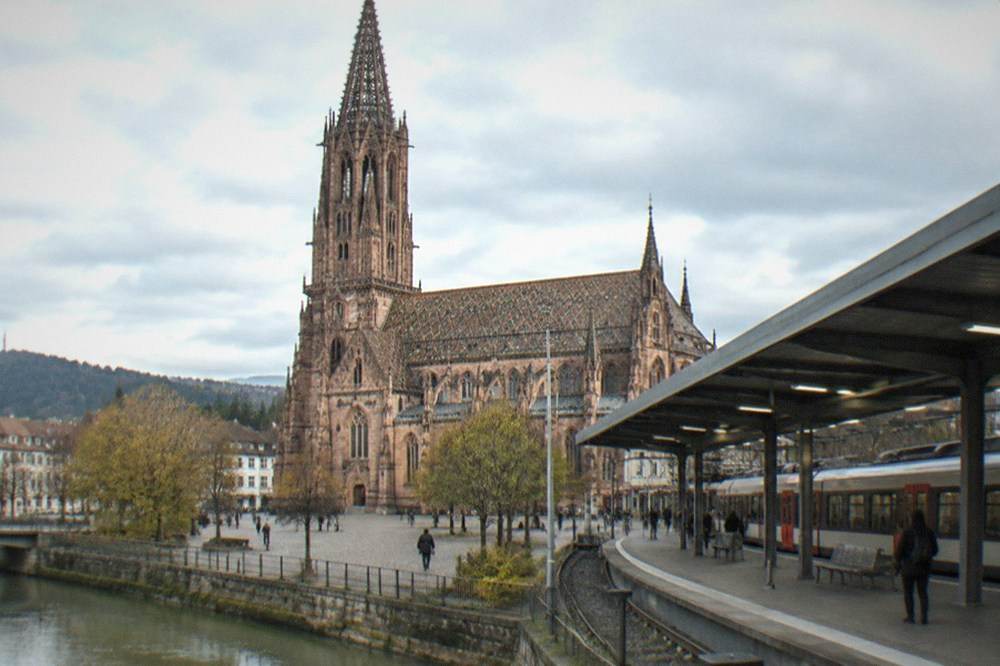
The route between the two cities runs via Basel. You leave Freiburg Hauptbahnhof heading south on the upper Rhine rail corridor, change at Basel, and continue into Swiss territory toward Bern or Lausanne, where Fribourg sits on the line between them. It is a cross-border trip, so it involves two countries, two rail systems and two currencies in one day.
No direct train links the two cities. Basel is the hinge: trains from Freiburg reach Basel first, and Swiss trains toward Fribourg depart from there. Ticketing should be bought as a through journey or as two separate legs, and prices and schedules should be checked on the operators' own booking pages before travel, since cross-border fares change with demand and booking class. This site deliberately does not quote unverified rail times; check the live timetables when you plan.
One current construction note matters for anyone planning this trip soon. The Rheintalbahn, the Freiburg to Basel line, is subject to temporary closures for the Karlsruhe to Basel four-track expansion, and around the first weekend of October 2026 regional and some long-distance trains are replaced by buses between Freiburg and Basel. The pattern of bundled weekend works has repeated through 2026, so a journey that is easy on a Tuesday can involve a replacement bus on a Saturday. Checking the operator's travel warnings for your specific date is part of the routine here, not an optional extra.
Freiburg's own main station is in the middle of a longer modernization as well. Work began on 14 September 2026 and runs until around the end of 2028, covering five new lifts in the northern underpass, platform renewals and new roofs, with the underpass initially fully closed. Trains keep running; walking routes through the station change. Arriving travelers should build a few extra minutes into the first transfer of the day.
Once you are back in Freiburg itself, local transport is cheap and simple. A single zone 1 ticket costs €3.00, or €2.70 on a smartphone, and a one-zone day ticket is €7.20, per the RVF tariff overview. The visitor-facing option is the Welcomekarte, three days at €27.00 for adults, covering buses and trains in the region and including the Schauinslandbahn cable car plus a culture bonus. For the full breakdown, see the Welcomekarte explained, and note one common myth handled there: Freiburg is not a KONUS municipality, and a hotel stay in the city does not come with a free KONUS guest card.
If your first hours in the German city matter, arriving by train and meeting a local guide near the station is a workable pattern.
What Does Freiburg Offer That Fribourg Does Not?
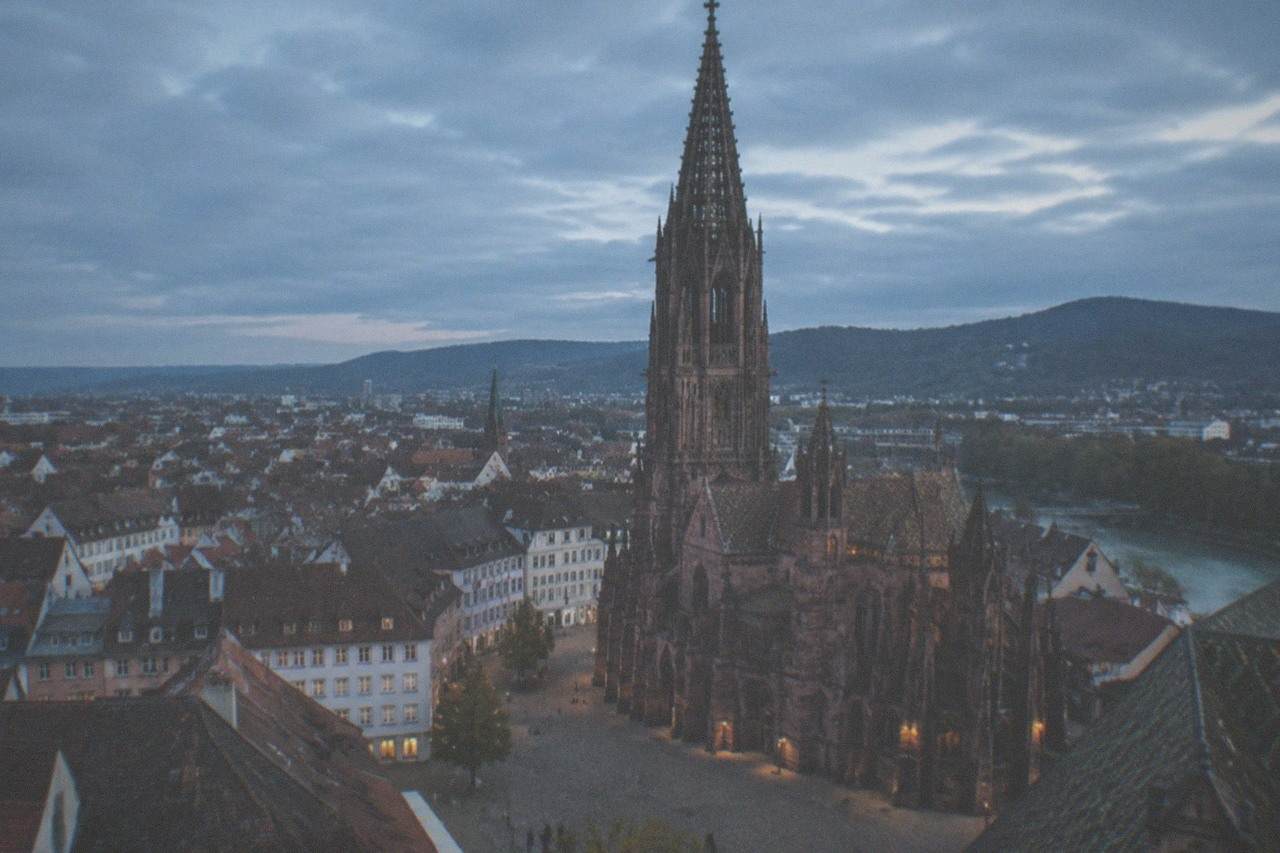
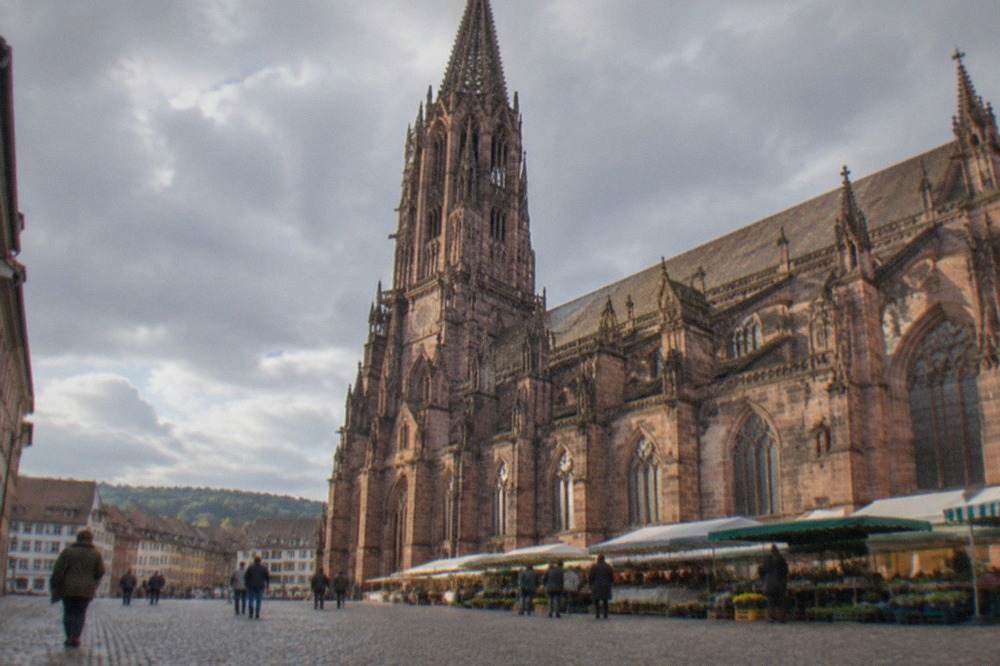
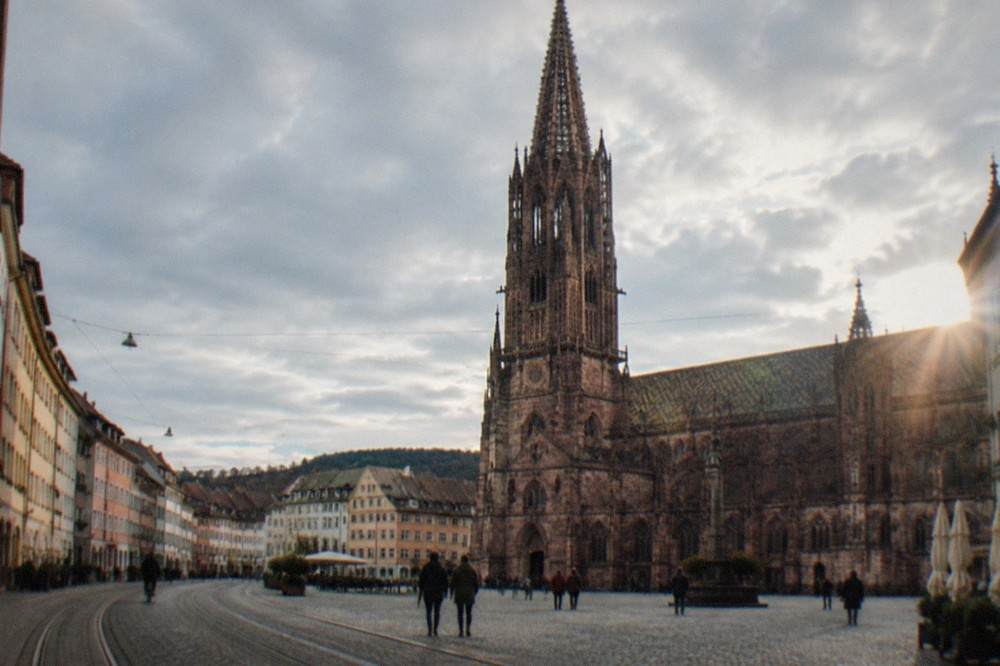
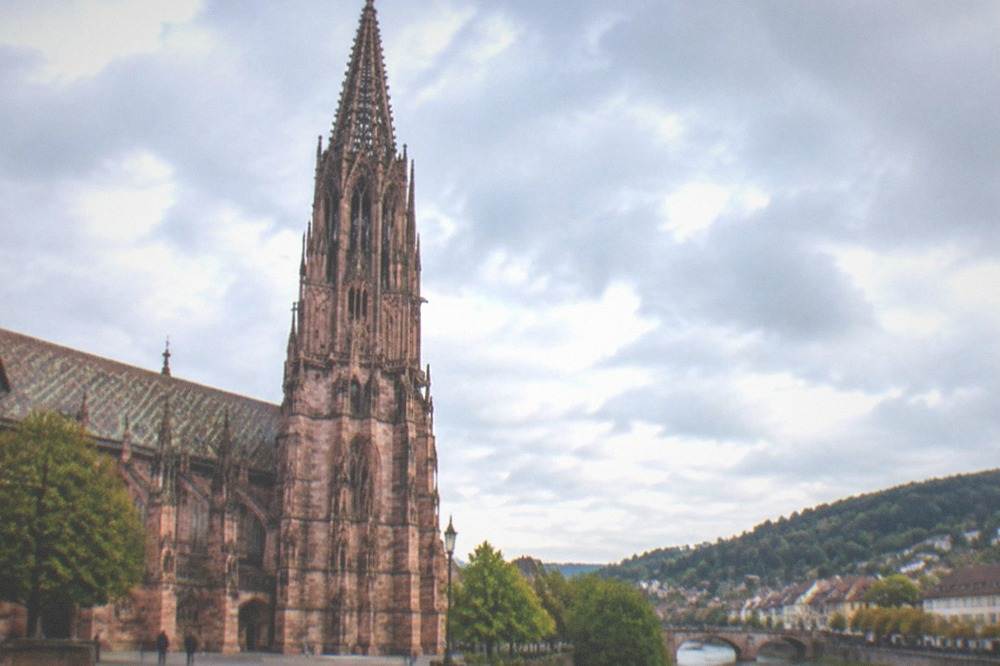
Freiburg im Breisgau's signature assets are a single Gothic Minster with a 116 m tower that visitors climb to a gallery at 70 m, the Bächle water gutters running through the old town lanes, the Schauinslandbahn cable car into the Black Forest, and a position that puts France, Switzerland and the Black Forest all inside one day-trip radius. Fribourg has none of these.
The Minster is the anchor. Entry to the nave is free, and the tower climb costs €5 for adults, €3 for children and teens, or €13 for a family, with under-7s free, according to the cathedral's own tower page, which also lists the hours: Mondays to Saturdays 11:00-16:00, Sundays and holidays 13:00-17:00, with the last ascent about 15 minutes before closing and the top gallery closed in winter. Two height figures belong together in any honest telling: the tower is 116 m tall, but the climb ends at a 70 m gallery, not the summit.
The museum story is strong right now as well. The Augustinermuseum, fully reopened on 28 February 2026 after the final phase of a renovation that ran for more than two decades, charges €12, or €8 reduced, with a day ticket valid across the city's other museums and free entry for anyone under 27. The museum complex now includes roughly 3,400 square meters of exhibition space, of which about 1,600 are new since the reopening. Any source telling you it is partly closed for renovation is out of date.
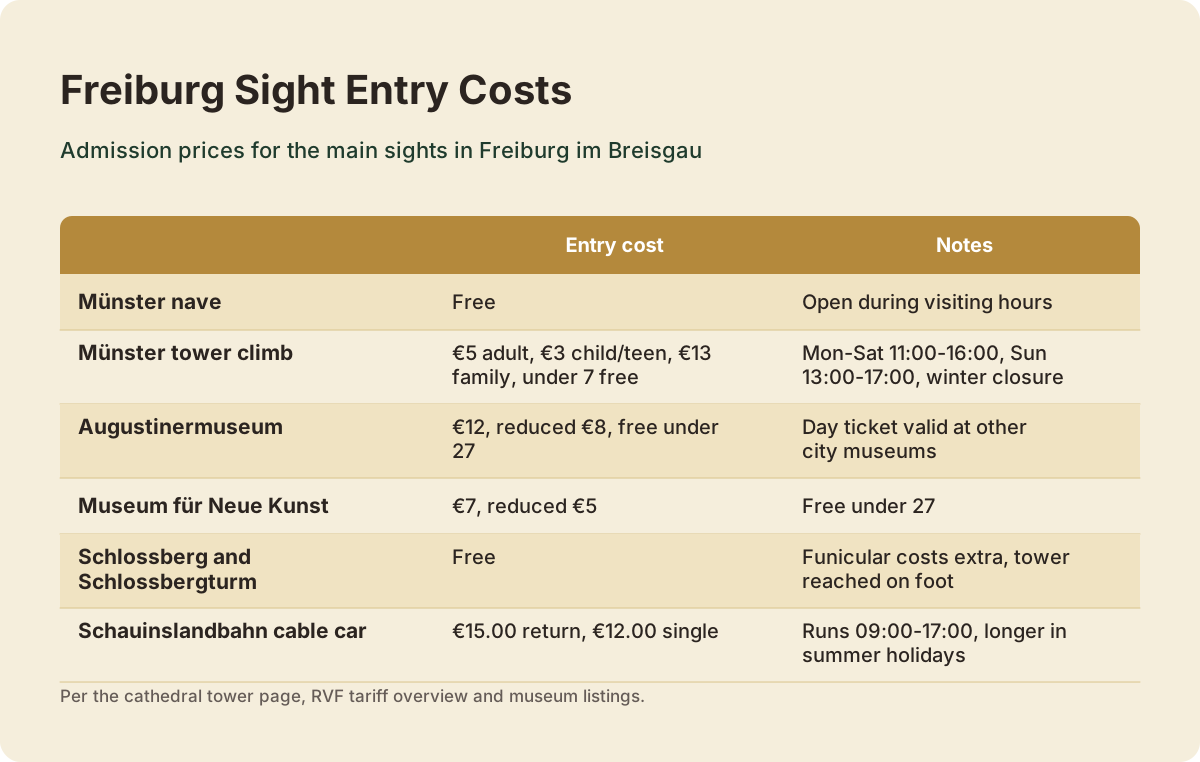
| Freiburg sight | Entry cost | Notes |
|---|---|---|
| Münster nave | Free | Open during visiting hours |
| Münster tower climb | €5 adult, €3 child/teen, €13 family, under 7 free | Mon-Sat 11:00-16:00, Sun 13:00-17:00, top gallery closed in winter |
| Augustinermuseum | €12, reduced €8, free under 27 | Day ticket valid at other city museums |
| Museum für Neue Kunst | €7, reduced €5 | Free under 27 |
| Schlossberg and Schlossbergturm | Free | Funicular costs extra, tower reached on foot |
| Schauinslandbahn cable car | €15.00 return, €12.00 single | Runs 09:00-17:00, longer in Baden-Württemberg summer holidays |
Beyond the sights, the German city's real draw is geometry. Basel is close, Colmar and the Alsace wine route are close, Titisee and Feldberg are close, and the whole spread is covered in this site's day-trip guides. A traveler based in the German city can wake up in Germany, lunch in France and dinner in Switzerland without ever checking a bag. The Swiss city, for all its charms, is not a hub for the Black Forest.
For a first visit, a private walk with a local guide is a way to lock in the layout fast. The Hello Freiburg private two-hour city walk runs from $141 and carries one review so far, too few for a star rating worth quoting, but the format itself, one guide and your group, is a good fit for visitors who want questions answered in real time rather than a fixed commentary.
What Is Fribourg Like As A Swiss Destination?
Fribourg is a compact, bilingual Swiss city with a medieval old town above a river, a cathedral of its own, and a position on the rail line between Bern and Lausanne that makes it an easy add-on to a Swiss itinerary. It is quieter than the big Swiss cities, cheaper than most of them by reputation, and best visited on its own terms rather than as a Freiburg substitute.
Its personality is defined by the language boundary. Canton Fribourg straddles French and German Switzerland, and the city itself is majority French-speaking with a German-speaking university tradition. Streets change character as you cross from one quarter to another, and the old town climbs a hill above the Sarine river, with a funicular linking the levels. The cathedral of St. Nicholas is the skyline landmark, and the town's bridges and riverside walks are what most visitors remember.
This site does not carry a dedicated Fribourg guide, and deliberately so: it is a Freiburg im Breisgau site. What belongs here is the planning context. If your trip is mostly Switzerland, Fribourg fits naturally between Bern and Lausanne, and the German Freiburg fits as an optional Black Forest extension via Basel. If your trip is mostly Germany, the calculus reverses, and Fribourg becomes the add-on you can skip without losing the core of the region.
The honest comparison is also about scale and pace. The German city holds about 237,000 residents and hosts a student body of 24,507 in the 2025/26 winter semester, per the university's own statistics, which keeps the place lively year-round. The Swiss city is smaller and calmer, more of a half-day or overnight stop on a Swiss rail pass than a base. Neither is "better"; they serve different itineraries.
How Do Costs, Currency And Visitor Cards Compare?
Costs do not translate between the two cities. Freiburg prices everything in euros, with a €3.00 zone 1 single ticket, a €27.00 three-day Welcomekarte and a 5% overnight tax on accommodation. Fribourg prices things in Swiss francs under Swiss tariffs, and this site's verified research covers none of those figures, so none are printed here. Expect Switzerland to feel markedly more expensive.
The German side is documented and predictable. A single short tram ride is €3.00, or €2.70 by smartphone, and children pay €1.80. Day tickets run €7.20 for one zone, €10.90 for two and €14.30 for three. The Deutschlandticket, valid nationwide on regional transport, costs €63.00 per month, a price that rose from €58 at the start of 2026 and should not be quoted at the old figure. The tariff details are published by the regional transport federation, the RVF, on its Welcomekarte and fares pages.
| Cost item | Freiburg im Breisgau (EUR) | Fribourg (CHF) |
|---|---|---|
| Single local transit ticket | €3.00 (zone 1), €2.70 on smartphone | Swiss tariffs, not researched here |
| Visitor transport card | €27.00 Welcomekarte, 3 days, includes Schauinslandbahn | Regional Swiss passes, check operator pages |
| Cathedral tower climb | €5 adult | Separate cathedral, separate tariff |
| Main art museum | €12 Augustinermuseum, free under 27 | Not applicable |
| Overnight visitor levy | 5% of net room price (Übernachtungsteuer) | Swiss municipal taxes, check locally |
The overnight levy deserves its own sentence because it is misnamed constantly. Freiburg charges an Übernachtungsteuer of 5% of the net room price, not a Kurtaxe and not a flat nightly fee. It has applied to private stays since 2014 and to business stays since 1 July 2023, and guests under 18 are exempt. The city's own page on the tax, at freiburg.de, is the source of record.
The Swiss side is simply out of this site's research scope, and pretending otherwise would mean inventing figures, which this site does not do. The rule for readers: budget Switzerland from Swiss sources, in francs, and do not let a euro-based Freiburg budget set expectations for the Swiss leg. Travelers who want the German city's cost picture in full should read the budget guide, Freiburg on a budget, where the euro numbers are laid out end to end.
One planning tool exists only on the German side of the border. The Welcomekarte's inclusion of the Schauinslandbahn means a three-day card effectively buys a cable car ride into the Black Forest along with the transit, which is unusual value for a visitor pass. The Swiss city's passes cover Swiss networks instead, so the two cards are not comparable line items even though they occupy the same slot in a budget.
When Is The Best Time To Visit Freiburg?
The German city's climate data supports a simple answer: May through September is the warm, bright window, with July averaging 20.1 °C and 252 hours of sunshine, while winter is grey, with 56 to 65 hours of sun in December and January. Freiburg is one of Germany's warmest and sunniest cities, though not the single warmest or sunniest, a claim the data does not support.
The climate record behind that comes from Germany's national weather service, the DWD, whose 1991-2020 normals for the Freiburg station give an annual mean of 11.0 °C and 1,815.1 hours of sunshine per year, alongside 886.5 mm of rain. May is the wettest month at 103.4 mm, and hot days above 30 °C cluster in July and August, averaging 7.3 and 7 respectively across the year. None of this makes the city tropical; it makes it pleasant and occasionally sticky in midsummer.
| Month | Mean temp | Sunshine hours | Rain mm |
|---|---|---|---|
| January | 2.5 °C | 64.7 | 48.6 |
| April | 10.8 °C | 182.2 | 63.8 |
| July | 20.1 °C | 252.2 | 92.2 |
| October | 10.9 °C | 116.2 | 78.5 |
| December | 3.4 °C | 56.3 | 66.9 |
For trip timing against events, two anchors matter. The Christmas market runs 19 November to 23 December 2026 across Rathausplatz, Kartoffelmarkt, Unterlindenplatz and Franziskanerstraße, with free entry. The wine festival on Münsterplatz drew roughly 110,000 guests over six days in early July 2026, and its 2027 dates are already announced for 1 to 6 July. Winter visitors get the market and the decorated old town; summer visitors get the wine festival, the long light and the cable car at full schedule.
The Swiss city has its own seasonal rhythm, with summer lake-and-hiking traffic flowing through the region and a quieter winter. Since this site's verified research does not cover Swiss weather station data, the comparison stops at the border: use the German table above for the German city, and consult Swiss sources for the Swiss leg.
Which City Should You Choose For Your Trip?
Choose the German Freiburg if the Black Forest, the Minster, Alsace day trips or a cheaper euro-based city break drive your plan. Choose the Swiss Fribourg if your trip is already Switzerland, centered on Bern, Lausanne or the lakes, and you want a small bilingual old town between them. Trying to substitute one for the other is the only genuinely wrong answer.
The decision usually reveals itself in the flight and rail itinerary. If you land at EuroAirport Basel-Mulhouse-Freiburg, the German city is a daily airport bus ride of about 55 minutes away, and the border triangle opens up from there. If your flights route through Zurich or Geneva, the Swiss city is on the way and the German one is a detour. The airport question is worth settling first, and this site covers it in the EuroAirport guide.
For the German leg, the tour roster on this site covers the formats a first-time visitor actually chooses between. The longer private guided walking tour runs about 1.5 hours from $239 with 12 reviews on its listing, too few for a reliable star claim either way, and suits groups who want depth. The express walk, 60 minutes with a local from $90, also carries 12 reviews, and suits tight connections and arrival-day orientation.
Between the two extremes, the timing differences are real but modest in absolute minutes: a 60-minute express walk versus a 90-minute private tour versus a two-hour private walk. What varies more is depth and price, from $90 to $239 at the roster's listed figures. The one constant across all of them is that a local guide solves the orientation problem on day one, which matters in a city whose old town lanes loop and double back on themselves.
Whichever city wins your itinerary, the name confusion ends the moment you attach the country to the booking. Freiburg im Breisgau, Germany. Fribourg, Switzerland. Match that pairing in every confirmation, and the rest of the trip, trains, hotels, tours, refunds, follows without a second thought.
For travelers who want the fastest possible orientation before setting off on their own, the one-hour format is the natural pick, and Check availability for your dates on the operator's live listing.
Common Questions About Freiburg And Fribourg
Is Freiburg in Germany or Switzerland?
Freiburg im Breisgau is in Germany, in the state of Baden-Württemberg. Fribourg, whose German name is Freiburg im Üechtland, is in Switzerland. They are two separate cities in two separate countries that share a name.
Is Fribourg the same city as Freiburg?
No. Fribourg is the capital of the Swiss Canton Fribourg, between Bern and Lausanne, and is majority French-speaking. Freiburg im Breisgau is a German city of 237,299 residents at the edge of the Black Forest. No administrative or transport link exists beyond ordinary cross-border rail travel via Basel.
How do you get from Freiburg to Fribourg?
Travel by train via Basel. Trains from Freiburg Hauptbahnhof reach Basel, where you change to Swiss services toward Bern or Lausanne, with Fribourg on that line. Check live timetables and fares on the operators' booking pages, and watch for temporary Rheintalbahn closures between Freiburg and Basel, which have required replacement buses on some 2026 weekends.
Is Freiburg Germany worth visiting compared with Fribourg Switzerland?
They serve different trips. The German city offers the Minster with its 70 m climbing gallery, the Bächle, the reopened Augustinermuseum and a day-trip radius covering the Black Forest, Alsace and Basel, priced in euros. The Swiss city offers a bilingual medieval old town on a Swiss itinerary. If the Black Forest or France is in your plan, choose Freiburg.
Does the Welcomekarte work in Switzerland?
No. The RVF Welcomekarte, €27.00 for three days, covers buses and trains in the Freiburg region of Germany and includes the Schauinslandbahn cable car, plus a culture bonus. It has no validity in Switzerland. Swiss travel needs Swiss tickets or passes.
Which airport should I fly into for each city?
For the German Freiburg, EuroAirport Basel-Mulhouse-Freiburg is the closest major airport, with a daily airport bus taking about 55 minutes into the city. For the Swiss Fribourg, Geneva or Zurich airports connect by Swiss rail. Match the airport to the country your hotel is actually in.