What Is The Prettiest Part Of The Black Forest?
An honest, research-based answer to which corner of the Black Forest is the most beautiful, from the southern lakes around Titisee and Feldberg to the Triberg waterfalls, the Ravenna Gorge and the Schauinsland.
What Is The Prettiest Part Of The Black Forest?
The prettiest part of the Black Forest is the southern high country around Titisee, Feldberg and Hinterzarten, where lakes, moors, gorges and the range's highest summit sit within a short drive of each other. The Triberg waterfalls and the Ravenna Gorge make the strongest challenge. Both are reachable from Freiburg in well under an hour.
Pretty is a judgment, so this answer leans on what the region actually contains rather than on slogans. The southern high Black Forest, the stretch of the Naturpark Südschwarzwald around the Titisee, the Schluchsee and the Feldberg, packs the widest variety of scenery into the smallest area. You get an alpine-looking lake, a moorland plateau, the highest summit in the whole range, gorge trails and waterfalls, plus the famous steep-roofed villages of the south. Nothing else in the range concentrates so much within one easy loop.
The rest of the range has beauty of a different kind. The north, around Baden-Baden and the Murg valley, is all deep gorges and half-timbered spa towns. The west softens into the vineyard slopes above the Rhine plain, where wine country takes over from fir forest. The middle, around Freudenstadt and the Kinzig valley, is gentler and more agricultural. If you want the most dramatic scenery per kilometer, the south wins; if you want wine with your view, the west wins.
This guide is written from an editorial desk that has pored over official sources, tourism statistics and operator listings for the whole region, not from someone's single trip. Where a figure is solid, it appears plainly. Where it rests on one news report, that is said too.
Why The Southern Black Forest Around Titisee And Feldberg Stands Out
The southern high Black Forest earns the title because it stacks four kinds of scenery in one compact area: the Titisee lake, the Feldberg massif, the moorlands of the Hinterzarten high plateau, and wooded gorges like the Wutachschlucht. Comparable highlights elsewhere in the range sit hours apart by car. Here they sit minutes apart.
Start with the Titisee itself, a glacial lake in a bowl of dark firs, with a promenade, boat rentals and a shoreline that photograph well in every season. Swim, a short swim from shore or a walk around the water, the lake is the single most-visited image of the whole range and the anchor of most southern itineraries. The neighboring Schluchsee is bigger and calmer, better if you like water with fewer people on it.
The Feldberg above them is the highest mountain in the whole range. On a clear day its summit plateau looks south to the Alps, a view you cannot get anywhere else in the Black Forest, and its trails cross open moorland that looks closer to Scotland than to Germany. Reporting indicates the Bismarck monument near the summit finished its renovation in August 2025, so that viewpoint is back in full order. Note that figure comes from a single press report rather than an official confirmation.
Hinterzarten, the village in the middle of the high plateau, deserves more of the praise than it usually gets. It is a classic spa-resort village of timbered houses and sanatorium architecture, surrounded by moor lakes like the Titisee-adjacent Windgfällweiher, and it sits on the Höllentalbahn, one of the range's most scenic rail lines. From Hinterzarten you can walk or ski in several directions without ever moving your car.
Set the regions against each other and the logic of the southern claim becomes clear:
| Area | Signature scenery | Character | Best base |
|---|---|---|---|
| Southern high forest (Titisee, Feldberg, Hinterzarten) | Lake, summit, moorland, gorges | Alpine feel, busiest in summer | Titisee-Neustadt or Hinterzarten |
| Central gorge country (Triberg, Ravenna Gorge) | Germany's highest waterfall, gorge trails | Dense forest, cuckoo-clock villages | Triberg or Freiburg |
| Northern forest (Baden-Baden, Murg valley) | Deep gorges, spa architecture | Refined, garden-heavy | Baden-Baden |
| Western vineyard slopes (Kaiserstuhl, Markgräflerland) | Vineyards above the Rhine plain | Soft, sunny, wine-focused | Staufen or Breisach |
For readers planning a wider route, the site's Titisee and the southern lakes guide covers the lake district in detail, and the Black Forest five-day itinerary strings the southern highlights together from a Freiburg base.
For travelers who arrive in Freiburg and want to be shown the scenic spots rather than hunt for them, there are a few short-listed local options:
Triberg's Waterfalls And The Ravenna Gorge
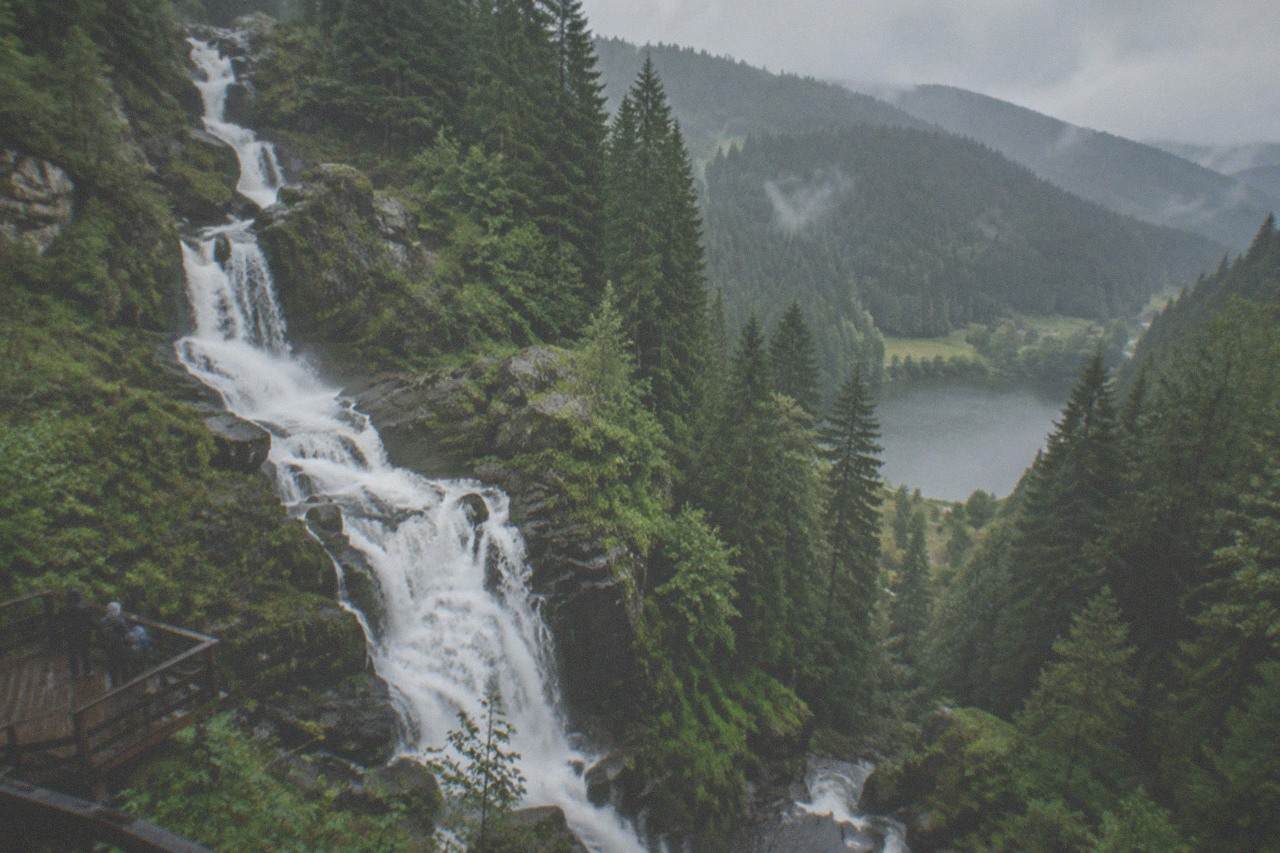
The strongest rival to the southern lakes is the central gorge country around Triberg and the Ravenna Gorge near Breitnau, home to Germany's highest waterfall and a series of brook-cut ravines that feel older and darker than the open south. If drama-in-forest is your idea of pretty, this is the prettiest part.
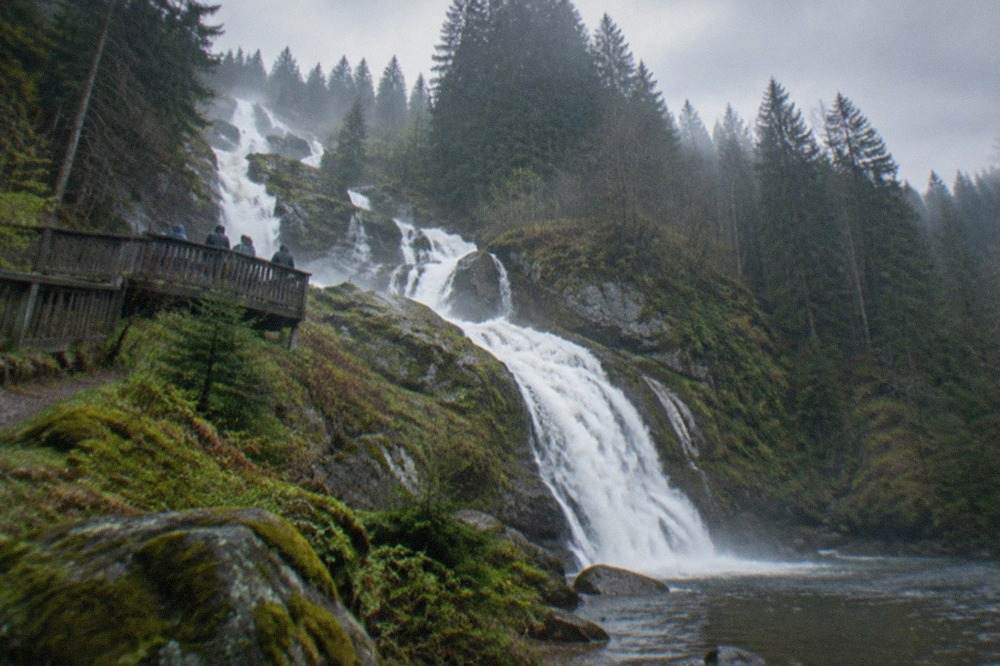
The Triberg waterfalls drop the Gutach river in seven cascades inside a narrow, almost subtropical-feeling gorge of mossy rock. They are the range's most famous single natural sight after the Titisee, and the town around them doubles as the home of the cuckoo-clock trade, so the visit pairs a natural spectacle with the kitsch-and-craft heritage that made the region famous in the first place. Trails at several levels let you climb beside the falls or view them from below.
The Ravenna Gorge, a few valleys east near Breitnau, is the quieter and, many would argue, prettier gorge. The Ravenna stream cuts through a canyon whose walls lean toward each other overhead, crossed by old timber flumes, and in December the gorge hosts one of Germany's most photographed Christmas markets, stalls lit by lanterns in the canyon itself. Outside the festive season it is a plain forest walk with water sounds, which is precisely the point.
The Ravenna Gorge and the Höllental, the "valley of hell" that the Höllentalbahn climbs toward Titisee, are both inside the area you would cover from Freiburg or from a southern base. That is the quiet advantage of the central-south overlap: choosing the southern high country does not mean giving up the gorges, because the prettiest of them, the Ravenna and the Wutachschlucht, sit on the southern plateau's rim.
The Wutachschlucht deserves its own word. It is a wild, meandering gorge on the southern edge of the range, with a river that twists so hard the valley's necks break off one by one, and it is widely considered the finest long gorge walk in the Black Forest. It has no lake, no summit and no village at its heart, which is exactly why hikers rank it above the postcard spots.
The Triberg and its waterfalls guide on this site covers the falls, the clock shops and the practicalities of reaching them without a car.
Schauinsland, The Mountain Window On Freiburg's Doorstep
For visitors based in Freiburg, the prettiest immediately reachable corner is the Schauinsland massif south of the city, a forested mountain with a cable car, show mine and summit tower that puts a full Black Forest panorama within 15 minutes of the valley station. It is the region's scenery at minimum travel cost.
The Schauinslandbahn, the gondola that hauls you up from the Horben valley, is the longest cable car of its kind in Germany at 3,600 m, and it runs a return trip for adults at €15.00, or €12.00 single, according to the operator's own fare page. It operates daily from 09:00 to 17:00 year-round, with extended hours in the Baden-Württemberg summer holidays. There is a maintenance exception worth knowing: the cable car and its mountain restaurant close for the autumn overhaul from 16 November to 4 December 2026.
The mountain itself delivers a lot for its modest height. The Eugen-Keidel-Turm, the octagonal summit tower, reopened in April 2025 after a multi-year closure for sanitation works, and from its platform you look over the Rhine plain to the Vosges, and on clear days south to the Alps. The Museums-Bergwerk, the former silver mine, runs guided tours underground from April to early November. In short, the Schauinsland packages forest, views, industrial history and a bird's-nest perspective over the city in one half-day outing, which is why Freiburg residents defend it so fiercely in any "prettiest corner" argument.
The mountain matters for this question for a structural reason. The south's lakes and gorges are an hour or more from the city; the Schauinsland is close enough that a visitor with only one free afternoon can still touch real Black Forest scenery rather than settling for the city's own hills. Freiburg also sits at the range's western edge, so everything described in this article radiates out from it as a natural base.
Visitors staying in Freiburg itself should also know the transport card situation, because it is a common trap: a hotel night in Freiburg does not come with a free KONUS guest card, since the city is not a KONUS member. The city's own visitor product is the RVF Welcomekarte, three days of buses and trains for €27.00 that, unusually, includes the Schauinslandbahn cable car. That inclusion effectively bundles the prettiest nearby mountain into the price of getting around.
Where To Find The Best Photo Spots
The most photogenic Black Forest spots cluster along three corridors: the Titisee promenade and Feldberg summit in the south, the Triberg falls and Ravenna Gorge in the center, and the vineyard slopes of the Kaiserstuhl at the western edge. Around Freiburg itself, the Bächle-lined old town and the Schlossberg viewpoint fill the frame between them.
Photographers treat this region as a three-light problem. Morning mist on the lakes, the dark verticals of the fir forest, and golden-hour light across the Rhine plain from the western slopes: each corridor favors a different hour. The Titisee and Schluchsee shoot best in early morning before boat traffic and crowds. The gorges, permanently shaded, actually work best at midday when the sun finally reaches their floors. The Kaiserstuhl vineyards want late afternoon, when the rows pick up low light above the plain.
The Schlossberg, Freiburg's own hill, gives the classic city shot with the Münster's spire, and the neighboring Lorettoberg adds the view across the Rhine toward the Vosges. These are city scenes rather than forest scenes, but they explain why so many Black Forest photo tours begin in Freiburg: the old town's gutters, gates and market square are the range's most compact set of foregrounds.
Among bookable options, the photogenic walk listed by an operator, Explore Freiburg's Most Photogenic Spots with a Local, runs about 90 minutes from $92 and has only two reviews so far, far too few to support a rating claim; the operator's live listing carries the current details. The self-guided scavenger hunt option, by contrast, has a 4.4 rating across 43 reviews and starts at $3, making it the budget way to be led past the scenic spots.
How The Western Vineyard Slopes Compare
The west flank of the range, where the Black Forest hills drop into the Kaiserstuhl and the Markgräflerland, is the prettiest part of the region for travelers who prefer soft agricultural beauty to dark forest, with terraced vineyards above the Rhine plain, wine villages and France visible across the water.
This is the part of the argument where "prettiest" splits by temperament. The Kaiserstuhl is technically its own small volcanic range rather than the Black Forest proper, but it begins where the forest ends, and every western itinerary blends the two. Villages like Staufen and the wine communities around Breisach sit in the transition zone, with the forested hills behind and vine rows in front. The Badische wine route strings them together.
The Markgräflerland south of Freiburg, around Müllheim and Badenweiler, adds a Roman-bath history and a spa tradition on a smaller, gentler scale than Baden-Baden's. The 2026 wine calendar here is active: the Markgräfler Weinfest at Staufen runs from 31 July to 3 August, and the Breisach wine festival over 28-31 August, per regional listings.
What the west cannot offer is the range's signature density of forest drama. No waterfalls of Triberg's order, no summits to rival the Feldberg, no moorland. What it offers instead is light: the west-facing slopes catch the afternoon sun across the whole Rhine plain, and on a clear evening the Vosges turn blue behind the vines. Travelers who have seen the postcard lakes and found them busy often end up ranking a quiet Kaiserstuhl evening higher.
One more honest note on crowds: Freiburg's 2025 tourism figures, 1,010,708 arrivals and 2,130,785 overnight stays across establishments with at least ten beds, were about 2% down on 2024, and international arrivals still rose 2.7%. The southern lakes carry the bulk of those visitors in summer. If solitude is part of your definition of pretty, shoulder seasons or the western and central corridors are where you find it.
How To Choose The Right Corner For Your Trip
Choose the southern high forest for the densest mix of lake, summit and gorge; the Triberg-Ravenna center for waterfalls and forest drama; the west for vineyards and evening light; the Schauinsland if your time is short. Travelers with only a day trip from Freiburg get the best return from the Schauinsland plus a lake or gorge.
A quick matching table, built on trip type rather than on ranking:
| Your trip type | Prettiest-fit corner | Why |
|---|---|---|
| First visit, 2-3 days, car | Titisee, Feldberg, Hinterzarten | Widest scenery range per driving hour |
| Day trip from Freiburg, no car | Schauinsland | Cable car from a Welcomekarte-covered valley station |
| Hiking-focused | Wutachschlucht and Ravenna Gorge | Long wild gorge trails |
| Photography-focused | Titisee dawn, gorges at noon, Kaiserstuhl dusk | Each corridor has a best light |
| Families with children | Titisee lake and Triberg falls | Flat promenades and short signposted loops |
| Wine and food focused | Kaiserstuhl and Markgräflerland | Wine festivals, taverns, evening light |
Food shapes the choice more than most guides admit. The Black Forest's famous exports, ham and the cream-and-cherry cake, are range-wide, but the eating differs sharply by corridor: lake fish and hotel patisseries in the south, cuckoo-clock-town sausage kitchens in the center, wine-tavern plates in the west. Travelers who want the region's food scene explained in advance often book a tasting-led walk. The full-meal food tour of Freiburg runs about three hours from $126 with seven reviews so far, too few for a rating claim, while the four-wine tasting at the old town hall square covers the local Badense glass for about an hour from $31.
For deeper planning by area, the site's Schauinsland day guide and its best Black Forest towns roundup are the natural next reads, and this Freiburg Travel Guide hub covers the city most visitors base themselves in.
If a guided start appeals before you go exploring on your own, these are the three short-listed options again:
Common Questions About The Prettiest Part Of The Black Forest
What is the prettiest part of the Black Forest?
The southern high Black Forest around Titisee, Feldberg and Hinterzarten has the strongest claim, combining a glacial lake, the range's highest summit, moorland and gorges in one compact area. The Triberg waterfalls and the Ravenna Gorge are the strongest challengers for pure forest drama.
Is Titisee worth visiting or is it too crowded?
Titisee is the range's most visited lake and does get busy in summer, but the crowds thin quickly on the eastern shore path and on the walks toward the Feldberg. Early morning visits avoid the peak, and the neighboring Schluchsee is the calmer alternative with similar scenery.
Can you see the prettiest parts without a car?
Largely yes. The Höllentalbahn and other regional trains reach Titisee, Hinterzarten and Triberg, and the Schauinsland is served by a cable car from a valley station covered by the RVF network. The southern lakes, the Feldberg area and both major gorges are reachable by rail plus footpath.
Which is prettier, Triberg waterfalls or the Ravenna Gorge?
Triberg is bigger, louder and more famous, with seven cascades down a mossy gorge wall. The Ravenna Gorge is narrower, quieter and many repeat visitors prefer it once the initial spectacle of Triberg has been seen. If time allows, both sit on the same central-south corridor.
What is the best time of year for scenery in the region?
Summer suits the lakes and high moorland; late September and October bring color to the deciduous slopes; winter turns the Feldberg into a small ski area and the Ravenna Gorge hosts its lantern-lit Christmas market. Each season flatters a different corridor rather than the whole range at once.