What Does Freiburg Mean In German?
A direct answer to what Freiburg means in German, where the name comes from, why there are two Freiburgs in the German-speaking world, and how to pronounce it.
What Does Freiburg Mean In German?
What Does Freiburg Mean In German?
Freiburg means "free castle" or, more precisely, "free town." The name joins two medieval German words: frei, meaning free, and Burg, which originally meant a fortified settlement or castle rather than a single palace. A Freiburg was therefore a town whose residents had been granted freedoms, such as market rights and release from serfdom, in exchange for settling and defending a fortified place. The name is a compressed medieval charter.
That single compound word carried a promise in the Middle Ages, when towns with "frei" in their name were recruiting settlers across the German-speaking world. Move here, the name said, and you will not be a serf. You will hold a plot, trade at a market, and answer to a town's courts rather than a lord's whims. The founders of such towns were usually local dukes or counts who wanted a reliable, taxpaying, wall-defending population on a contested frontier, and a name advertising freedom was part of the pitch.
The Burg half of the name is the older of the two. In medieval usage a Burg was a fortified place, anything from a true castle to a walled hilltop refuge, and the word sits at the end of dozens of German town names as a result. The frei half is the part that made the name attractive. Towns called Freiburg were explicitly marketed as places of personal liberty at a time when most people in the countryside had very little of it. What the name did not promise, and never has, is that the town itself was free of a ruler. Freiburg im Breisgau belonged to the lords of Zähringen, then for long stretches to the Habsburgs, and its residents' "freedoms" were a specific, listed set of rights, not modern civic freedom.
The Freiburg that carries this name today is a city of 237,299 people in the southwest corner of Germany, on the edge of the Black Forest, and the Freiburg Travel Guide covers it in depth. Its university, founded by charter in 1457 according to the university's own history pages, still shapes the streets: 24,507 students were enrolled in the winter semester of 2025/26. So when you hear the name, you are hearing a recruitment slogan from the Middle Ages that stuck to a place which now runs trams, a medical faculty and a famous minster.
The city's full official name, Freiburg im Breisgau, adds a regional tag. Breisgau is the name of the surrounding stretch of country between the Rhine plain and the Black Forest's western slopes, and the tag exists to distinguish this Freiburg from the other one, which we will get to shortly. Locals almost never say the full version out loud; the tag lives on train departure boards and official letters.
One honest caveat belongs here. The medieval freedoms behind the name applied to the burghers of the town, the property-holding citizens, and even they held those rights because a ruler granted them, not because they were inherent. The name is a piece of marketing that happened to be reasonably accurate for its first audience, and like most marketing, it flattens a lot of history.
If the etymology has made you curious about the place itself, these are the guided experiences that best match a first visit themed around the old town that grew out of that "free town" promise:
Why So Many German Towns End In -Burg
The ending -Burg simply means a fortified place, and it marks towns that began as, or beside, a castle or walled settlement. Hamburg, Salzburg, Würzburg, Regensburg, Brandenburg, Wolfsburg and Freiburg all carry the same suffix, with the first half of each name usually describing either the founder, a natural feature, or, as in Freiburg, a legal status. Once you can read the suffix, a whole tier of German place names becomes legible.
The pattern runs deep because fortified settlements were the growth points of the medieval German world. A lord built a castle, settlers clustered under its protection, a market followed, and the cluster kept the castle's name. Salzburg keeps a salt-trade story in its name, Wolfsburg a wolf, Brandenburg the fire or burning clearing implied by its first element, and Freiburg a legal promise. The names are readable leftovers of a settlement map drawn hundreds of years ago.
| Town | Name reads as | What the first element refers to |
|---|---|---|
| Freiburg | "free fortified town" | Legal status offered to settlers |
| Salzburg | "salt castle" | The medieval salt trade and mining |
| Wolfsburg | "wolf's castle" | Wolves in the area, or a heraldic image |
| Brandenburg | "burning fortification" | A cleared or burned site, or St. Brenden |
| Hamburg | "fortified place on the Hamma" | An old river or boundary name |
| Regensburg | "fortress on the Regen" | The Regen river at the confluence |
There is a cousin suffix worth knowing because it explains the rest of the map. Burg and Berg get confused constantly by English speakers, and in German place names they mean different things. A Burg is a fortification, while a Berg is a mountain: Heidelberg has a Burg in ruins on its hillside, while Feldberg, above Freiburg, is a mountain. Freiberg in Saxony, which is not the same town as Freiburg at all, is a "free mountain," a mining town whose prospectors were granted mining freedoms on the ore-bearing slopes. The three names, Freiburg, Freiberg and Fribourg, cause real confusion in booking searches, and travelers mix them up every year.
Our piece on what Freiburg in Germany is famous for goes deeper into the city's identity, if the name has made you want the full picture of the place behind it.
The Other Freiburg And Why The Tag Im Breisgau Exists
There is a second, entirely separate Freiburg: Fribourg in Switzerland, whose German name is also Freiburg, officially Freiburg im Üechtland. The German city's full name, Freiburg im Breisgau, and the Swiss city's tag, im Üechtland, exist precisely to keep the two apart. There is also Freiberg in Saxony, a different name and a different story.
The Zähringen family built a chain of new towns across the upper Rhine and the Swiss plateau in the Middle Ages, and Freiburg im Breisgau and Fribourg im Üechtland sit at the two ends of that project. Both names promise the same freedoms to settlers. The Swiss Freiburg is today a bilingual canton capital where French dominates the street level while the German name survives officially, and its old town, on a rock spur above the Sarine river, is one of the best-preserved medieval townscapes in Switzerland. The confusion is entirely reasonable and older than the internet: two dynastic siblings, 120 kilometers apart, sharing one name.
For travelers the practical risk is booking the wrong one. A search for "Freiburg" can surface the Swiss city's hotels and the German city's museum pages in one list, and the two are not close: the drive between them crosses the whole Swiss plateau. We cover the comparison in detail in our guide to Freiburg versus Fribourg, and the short version is that the German Freiburg is the larger, sunnier, Black Forest one, with roughly 237,299 residents, while Fribourg is the smaller bilingual Swiss one. If a booking site shows you a town on a river called the Sarine, you are looking at Switzerland.
The name confusion has a lighter side too, and Freiburg's own tourism culture leans into it. Local historians give walking talks on the Zähringen founders, the city's museum dedications treat the founding charter as the origin story, and the evening entertainment scene plays freely with the city's identity. The Christmas season is when the old town's identity is at its loudest, with the market running 19 November to 23 December 2026 across Rathausplatz and the surrounding squares, more than 120 stands, and free entry to wander.
How The Free-Town Story Shows Up On The Ground Today
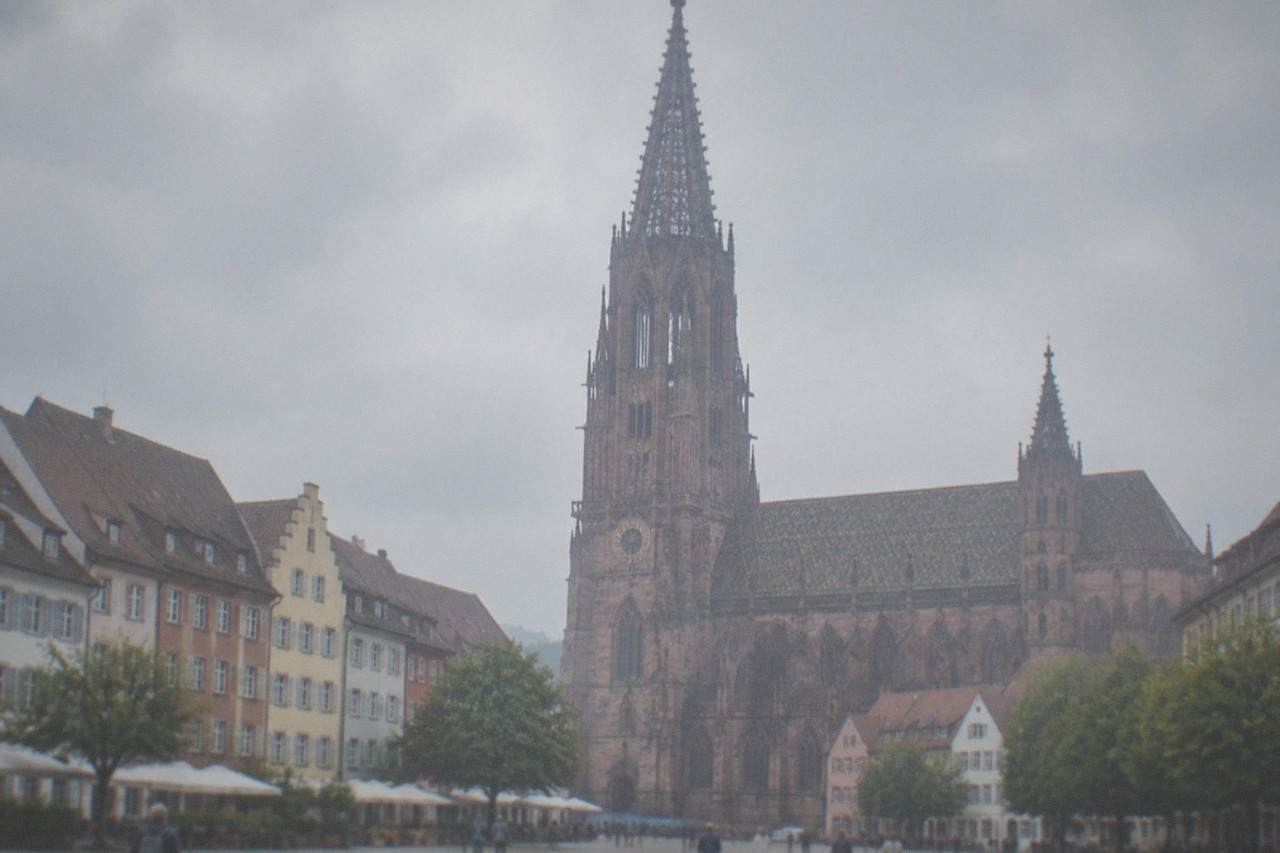
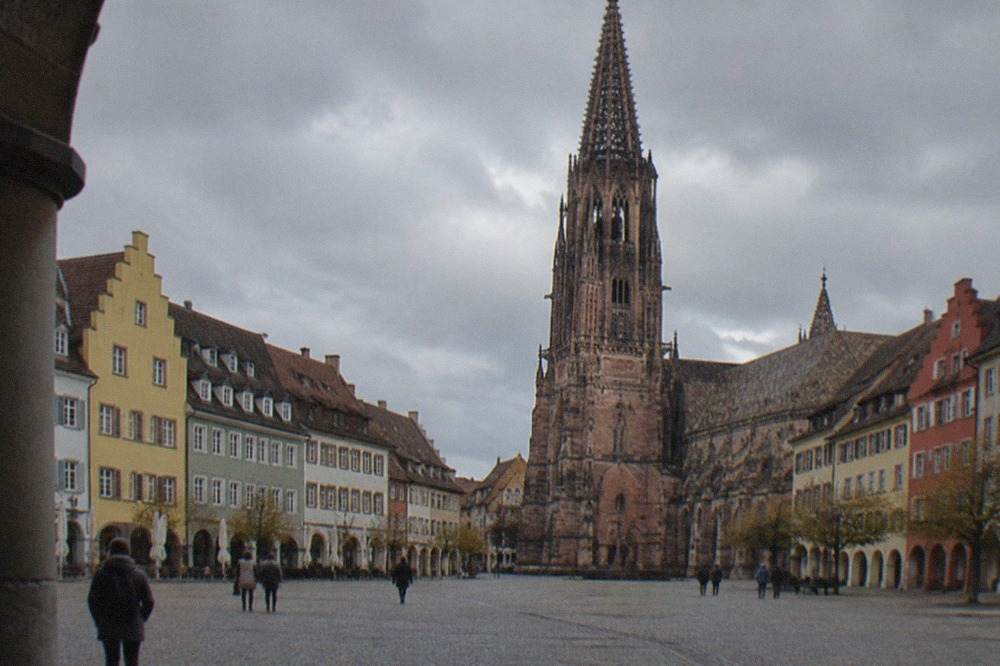
The medieval free town survives most visibly in the layout you walk: the Münsterplatz market square, the narrow streets of the old town, and the Bächle, the tiny water channels running beside the cobbles. The minster's tower, 116 meters tall, can be climbed to a gallery at 70 meters for €5 for adults, €3 for children and teens, with a family ticket at €13. The freedoms the name promised were exercised in exactly these streets.
A market right was the core freedom a free town offered, and Freiburg's is still running: the Münstermarkt fills the square beside the minster on weekdays from 07:30 to 13:30, with up to 130 stalls, and on Saturdays to 14:00. Standing among them you are watching the town's founding privilege in continuous operation, centuries on. The Historisches Kaufhaus on the square's edge, with its red facade and late-Gothic trading hall, is the same story in stone: it was built for the merchants whose market rights made the town rich.
| Freiburg in figures | Figure |
|---|---|
| Population | 237,299 |
| University founded | 1457 |
| Students, winter semester 2025/26 | 24,507 |
| Annual sunshine, 1991-2020 average | 1,815.1 hours |
| Minster tower height | 116 m, visitor gallery at 70 m |
| Christmas market 2026 | 19 November to 23 December |
The city's numbers still belong to the free-town tradition in a way few visitors expect. Freiburg's population is verified at 237,299 on the city's own statistics page, and the sunshine figure above, 1,815.1 hours per year on the 1991-2020 average, is what earns the city its reputation as one of Germany's warmest and sunniest, though not the single sunniest. The climate is the reason the market squares and riverside beer gardens work so well as public spaces: a town built around outdoor markets needs weather that lets people stand in them.
Food is the easiest way into the old-town atmosphere that the name implies, and a guided tasting walk is the least-effort version. The Culinary Tour of Freiburg runs about two hours and is listed from $61; it is a very new listing with only 2 reviews so far, too few to say anything about quality either way, so weigh it on the route description rather than a rating. It moves through the old town with stops that trace the regional kitchen, from Badische sausage to the onion tart and wines that the surrounding Kaiserstuhl and Markgräflerland vineyards send into the city, which is a fair way to taste the same agricultural wealth the medieval market was built on.
How To Say It, And Where To Hear The Story Told Aloud
In German, Freiburg is pronounced roughly "FRY-burk": the "ei" is an "eye" sound, the "u" is short, and the final "g" softens to a sound close to the "ch" in Scottish "loch." English speakers often render it "FREE-burg," which locals understand without complaint. The name's spelling also shifts with language: French Fribourg, Italian Friburgo, and the German original all point back to the same free-town idea.
Getting the pronunciation right is a small courtesy that pays off in a university city where a lot of street conversation happens in accented English anyway. The stress sits on the first syllable, the "ei" diphthong is the same as in "Freiburg's" cousin word "frei" used alone, and the final consonant is the one that trips people up. Our full guide to how to pronounce Freiburg breaks it down syllable by syllable for English speakers.
Hearing the story told aloud is where the name stops being a dictionary entry. The classic route is a dramatized city walk: the Guided City Tours with Actors, about 90 minutes, rated 4.9 across 497 reviews from $17, puts costumed performers on the real sites, and the Dramatized Tour of the Main Attractions, running since 1998, rated 4.7 across 78 reviews from $17, covers the founding story among the headline sights. For a quieter version, the standard Gässle, Bächle and More City Tour, rated 4.7 across 3,187 reviews from $15, is the volume seller, and the self-guided audio tour in English, from $9, lets you stand at the Münster and hear the medieval town explained at your own pace.
The evening end of the spectrum is more theatrical. The Drag Queen Show Walk with Betty BBQ runs about an hour and 25 minutes, is rated 4.6 across 699 reviews and costs from $40; it is the year-round original, a city walk in cabaret form, and the Christmas edition, the Christmas Drag Show Walk with Betty BBQ, rated 4.6 across 55 reviews from $43, wraps the same format in the seasonal market streets. A review on the live listing calls it an evening visitors remember, and the format is exactly what it sounds like: the old town's history delivered as a show, with the name and the founding story folded in among the jokes.
For a later-night version of the same streets, the Guided Pub Crawl with Drinks runs about four hours, is rated 4.4 across 107 reviews and is listed from $51, moving through the bars around the old town. Whichever version fits your evening, these are the current highlights if you want the free town's story told while you stand in it:
Common Questions About The Freiburg Name
What does Freiburg mean in German?
Freiburg means "free castle" or, more accurately, "free town." It joins frei, meaning free, with Burg, a medieval word for a fortified settlement. The name advertised the personal and commercial freedoms, such as market rights and release from serfdom, offered to settlers of the new fortified town.
Is Freiburg the same city as Fribourg in Switzerland?
No. Fribourg's official German name is also Freiburg, and both towns were founded as free towns by the Zähringen dynasty, but they are separate cities 120 kilometers apart. The German city is Freiburg im Breisgau; the Swiss one is Fribourg, or Freiburg im Üechtland, and is a bilingual French-German canton capital.
How do you pronounce Freiburg?
Roughly "FRY-burk," with the stress on the first syllable, the "ei" as an "eye" sound, and a final consonant close to the "ch" in Scottish "loch." Locals will understand the anglicized "FREE-burg" without comment.
Was a town called Freiburg actually free?
Free in the medieval sense, not the modern one. Settlers received listed rights, such as holding property, trading at the market and using the town's courts, rather than living as serfs. The town itself still belonged to a ruling family; Freiburg im Breisgau passed to the Habsburgs for long stretches of its history.
Why does the city's full name include im Breisgau?
The tag distinguishes this Freiburg from the Swiss Freiburg. Breisgau is the name of the surrounding region between the Rhine plain and the western Black Forest. You will see the full form, Freiburg im Breisgau, on train boards and official documents, though locals just say Freiburg.
Are there other towns with similar names?
Yes. Besides the Swiss Fribourg, there is Freiberg in Saxony, a "free mountain" mining town founded on prospectors' freedoms, and dozens of German towns ending in -Burg, from Hamburg to Salzburg, that share only the fortified-settlement suffix. None of them is the Freiburg near the Black Forest.