What To Do On A Rainy Day In Freiburg: Museums, Markets And Indoor Plans
Rain in Freiburg is common, especially in May and October, and most of the city's best indoor answers sit within a ten minute walk of the Münster. Here is how to spend a wet day well.
Short answer
Freiburg has unusually strong rainy day options for a city its size: the Augustinermuseum (EUR 12, free under 27), three more city museums, the Markthalle food hall, the Münster, and covered guided tours from $27. May is the wettest month at 103.4 mm of rain; plan two indoor blocks and one flexible outdoor slot.
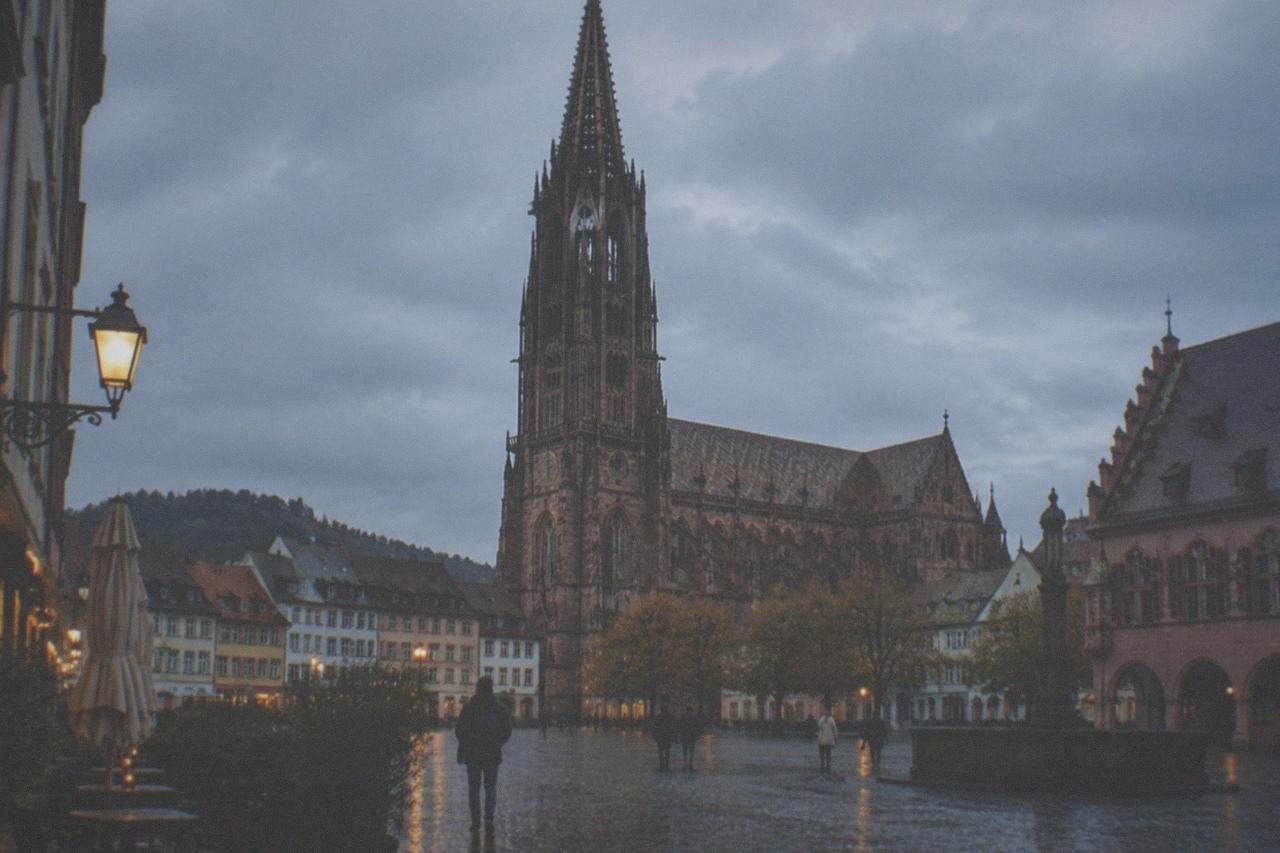
Rain catches Freiburg regularly. The DWD climate normals for the city's own weather station put annual rainfall at 886.5 mm, spread fairly evenly across the year, with May the wettest month at 103.4 mm and October close behind at 78.5 mm. That is not a reason to stay in the hotel. It is a reason to plan the day around the city's unusually dense cluster of indoor options, most of which sit inside a ten minute walk of the Münsterplatz.
This guide is for someone already in Freiburg, or about to arrive, staring at a gray forecast. The short version: museums first, a covered market lunch, a guided tour that works in any weather, and a thermal bath or wine bar for the evening. The long version is below, with prices, opening windows and the handful of closures that matter.
How Rainy Is Freiburg, Really?
Freiburg records 886.5 mm of rain across the year, with a marked wet season from May through September and a secondary peak in October, and 64 frost days that rarely coincide with rain. The sunniest months are June and July. Rain here is frequent but rarely torrential, so the practical question is not whether it will rain but how many hours it will rain for.
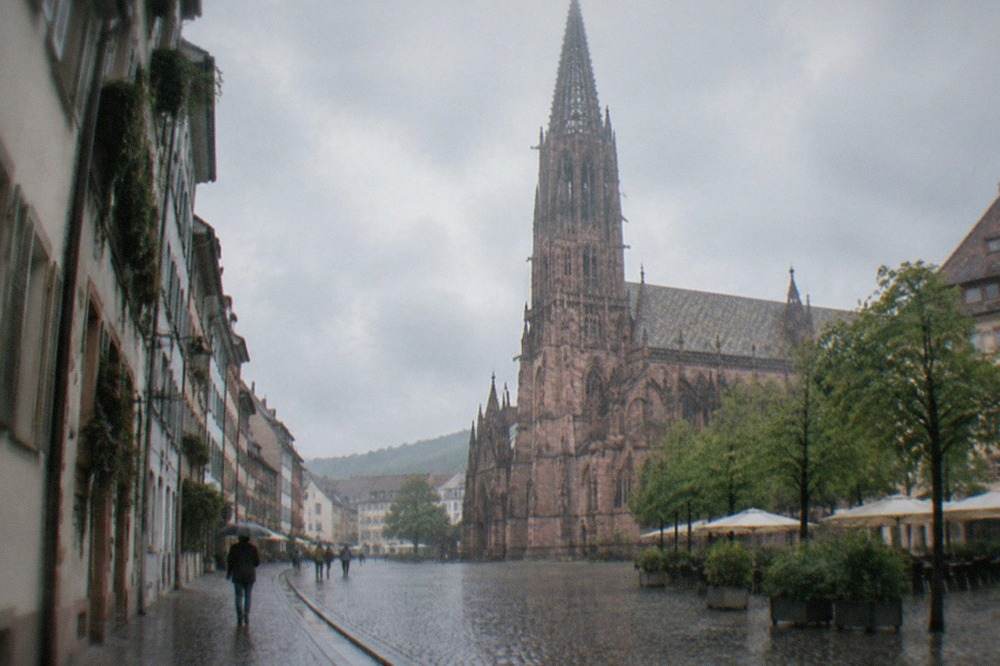
The city's own data is worth reading properly before you build a day around it. Freiburg sits in the Upper Rhine plain, sheltered by the Black Forest to the east and the Vosges to the west, and that geography gives it one of Germany's warmest and sunniest climates: an annual mean of 11.0°C and 1,815.1 hours of sunshine. But warmth does not mean dryness. Convective summer storms build over the Black Forest in June, July and August, when monthly rainfall runs 89.8, 92.2 and 83.3 mm respectively, and they can arrive fast in the afternoon after a bright morning.
Autumn behaves differently. October and November bring long, steady frontal rain rather than sharp showers, the kind of day where the Bächle, the small water channels running beside most old town streets, actually look like part of the design rather than a curiosity. Winter is the driest stretch of the year in total millimeters, February at 49.1 mm, but the days are short and the Christmas market does the heavy lifting from mid November.
The planning takeaway is simple. In summer, book your indoor anchor for the afternoon and keep the morning flexible. In October and November, assume the rain will last all day and structure the whole itinerary around covered options, which Freiburg happens to make easy.
The Museum Afternoon: What Is Open, What Costs What
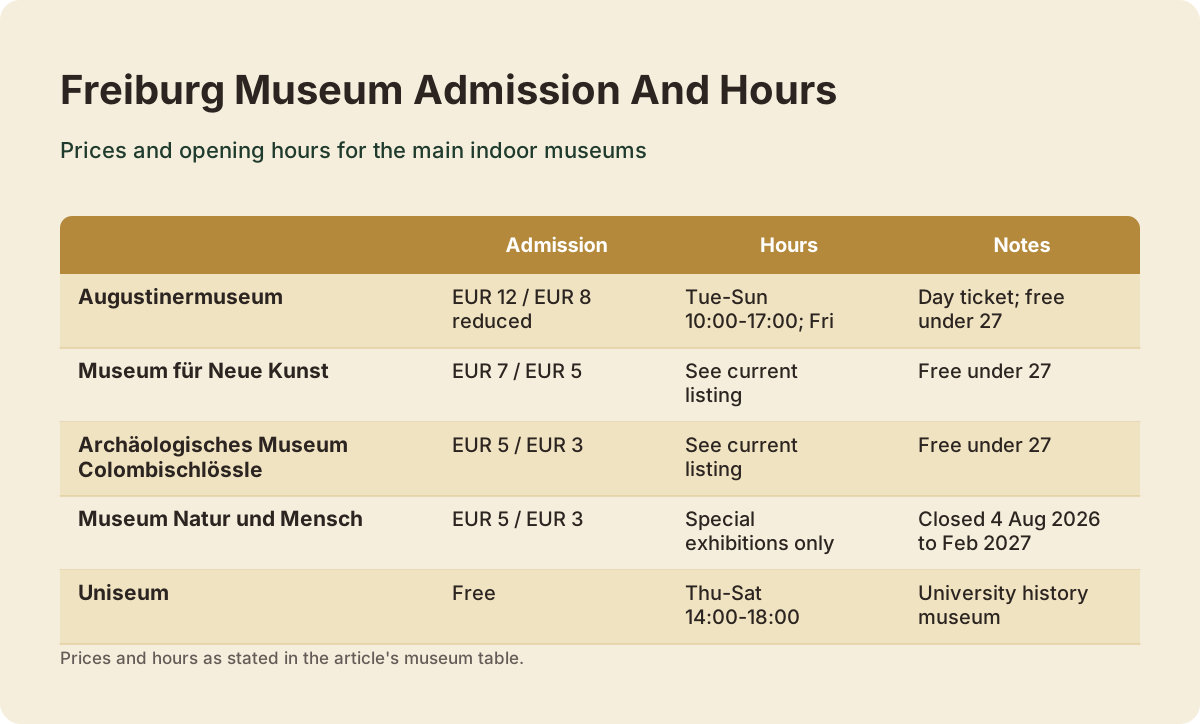
The Augustinermuseum is the anchor, at EUR 12 adults, EUR 8 reduced, free for anyone under 27, and its day ticket covers every other city museum except the free Uniseum. Tue to Sun 10:00-17:00, Fridays until 19:00. Museum für Neue Kunst costs EUR 7, Colombischlössle EUR 5, and all of them are under-27 free.
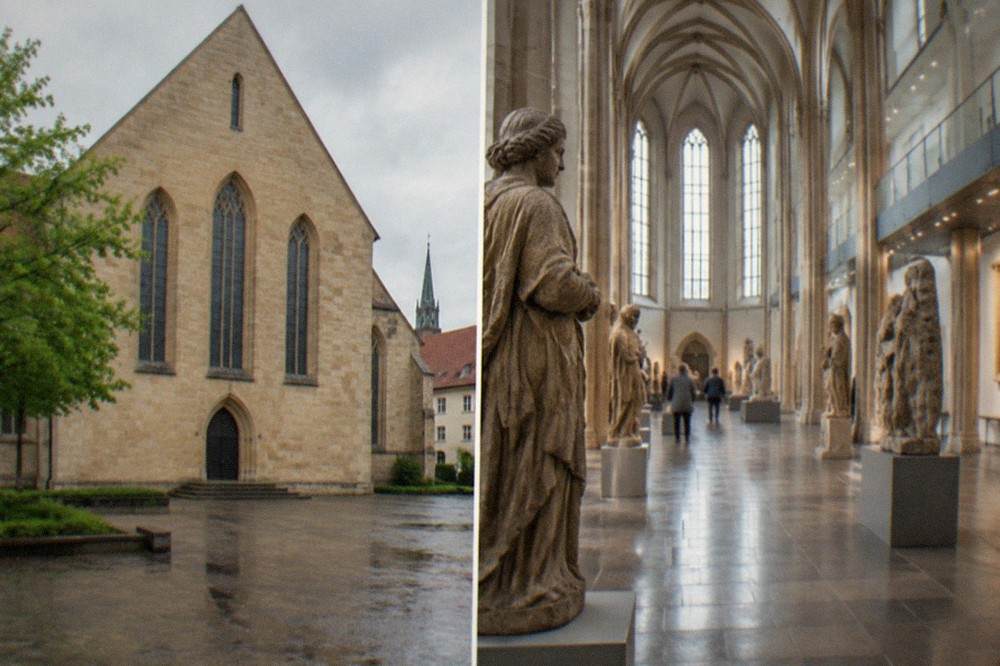
Start at the Augustinermuseum, and start it after lunch rather than before, because it is the one Freiburg museum that genuinely absorbs hours. It reopened fully on 28 February 2026 after the final phase of a renovation that had run for more than twenty years, and the new convent wing and vaulted cellars brought the total to roughly 3,400 square meters of displays on regional art and cultural history. The building itself, a former Augustinian monastery church, is the best rain shelter in the old town: vast, stone, quiet. Current admission is EUR 12 for adults, EUR 8 reduced, and the day ticket is valid at the other city museums, so it makes sense to buy it here and keep moving. Anyone under 27 walks in free at every city museum, which makes this afternoon nearly free for traveling students.
From there, the decision depends on taste. The Museum für Neue Kunst, a short walk west, holds modern and contemporary work and costs EUR 7, reduced EUR 5. The Archäologisches Museum Colombischlössle, in a neo-Gothic villa on Rotteckring, costs EUR 5 and covers the archaeology of the region, and its modernization wrapped up with a new museum guide published in late 2025.
One real caveat for 2026: the Museum Natur und Mensch closed its permanent exhibition on 4 August 2026 for renovation, with reopening expected around the end of February 2027. The museum stays open for special exhibitions and the mineral vault at the same EUR 5 admission, but a family expecting the full natural history floor plan will be disappointed, so mention it before you commit. The university's own Uniseum, free and open Thursday to Saturday 14:00-18:00, is a good small substitute for an hour.
| Museum | Admission | Hours | Notes |
|---|---|---|---|
| Augustinermuseum | EUR 12 / EUR 8 reduced | Tue-Sun 10:00-17:00, Fri until 19:00 | Day ticket covers other city museums; free under 27 |
| Museum für Neue Kunst | EUR 7 / EUR 5 | See current listing | Free under 27 |
| Archäologisches Museum Colombischlössle | EUR 5 / EUR 3 | See current listing | Free under 27 |
| Museum Natur und Mensch | EUR 5 / EUR 3 | Special exhibitions only | Permanent show closed 4 Aug 2026 to about end Feb 2027 |
| Uniseum | Free | Thu-Sat 14:00-18:00 | University history museum |
A practical sequencing note. The Augustinermuseum is on Augustinerplatz, the Museum für Neue Kunst is on the edge of the Wallanlage, and both are five minutes from the Markthalle. That triangle, museum, museum, food hall, is the entire spine of a good Freiburg rainy day, and it never requires more than a short dash between awnings. The official museum pages at museen.freiburg.de carry the current hours for each house.
If a half day opens up rather than a full one, our longer page on the Augustinermuseum's collections and layout helps you pick the floors that matter to you before you go.
Tours That Work Whatever The Weather
Guided walking tours are Freiburg's best all-weather product, because almost every route runs through covered arcades, the Münster nave and museum lobbies. Prices run from $27 for a themed group tour to $237 for a private two hour guide, and most listings allow free cancellation up to 24 hours ahead, which matters when the forecast is uncertain.
The first thing to understand is that rain does not cancel a Freiburg walking tour, it just changes the route. The old town is compact, the Münster nave is free and dry, the Historisches Kaufhaus has its courtyard and arcades, and the Markthalle sits directly on the square. A good guide simply shifts the balance from open squares to interiors, and the city rewards that with more covered ground than most visitors expect.
For something genuinely different from the standard history walk, the Historical Red Light Tour, themed around Freiburg's heavier historical characters, runs about two hours and starts from $27. It is a small review pool, just 3 reviews so far, so treat it as an interesting newcomer rather than a proven quantity. The theme suits a wet evening perfectly, since much of the storytelling happens under arcades and in sheltered corners, and Check availability if the evening slot suits your wet day plan.
Private guiding is the other rain-proof category. The 2 Hours Private Guided Walking Tour of Freiburg runs from $237 and holds a 5 review pool, again small, but private tours are where a guide will genuinely reorganize the route around the weather, spending longer inside the minster or the Augustinermuseum while the rain passes. Book the afternoon slot if you can, because summer rain in Freiburg is most likely after midday.
| Tour | Length | Price | Review pool |
|---|---|---|---|
| Historical Red Light Tour | ~2 hours | from $27 | 3 reviews |
| 2 Hours Private Guided Walking Tour | ~2 hours | from $237 | 5 reviews |
Both private formats reward a message to the guide ahead of time about what you want to see, and on a rain day that message is worth being specific: interiors first, viewpoints only if the sky opens. A professional guide who knows the town will trade a summit photo stop for an extra cloister without being asked twice, which is exactly the flexibility a group tour cannot offer.
The Münster, The Markthalle And The Covered Old Town
The Münster nave is free, dry and open regardless of weather, while the tower climb to the 70 m gallery costs EUR 5 but closes its top gallery in winter. The Münstermarkt runs Mon-Fri 07:30-13:30 and Saturdays to 14:00, and the Markthalle food hall next to the Martinstor is the reliable covered lunch, whatever the hour.
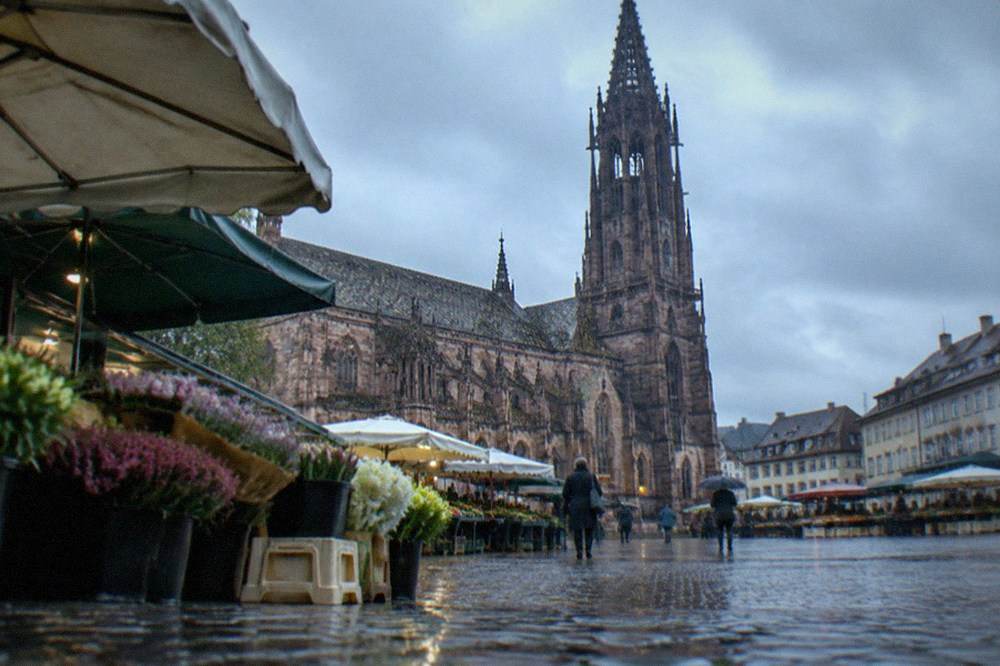
The Münster is the single most useful building in Freiburg when it rains. The nave is free to enter, and a Gothic interior of this scale takes an unhurried hour on its own, with the stained glass best viewed on a bright-wet day when the color saturates. The tower climb is the part that needs judgment: the west tower stands 116 m tall, but visitors climb to a gallery at 70 m, adults pay EUR 5, children and teens EUR 3, family tickets EUR 13, and under 7s go free. Climbing hours are Mon-Sat 11:00-16:00 and Sundays and holidays 13:00-17:00, with the last ascent about 15 minutes before closing. Do it only if the rain is the light, steady kind, and skip it entirely in winter, when the top gallery closes. The official tower page carries the current times.
Outside, the Münstermarkt runs Mondays to Fridays from 07:30 to 13:30 and Saturdays to 14:00, with up to 130 stalls, and a rainy market morning in Freiburg is a genuinely good scene rather than a consolation prize: stallholders haul out awnings, the bratwurst grills steam harder, and the crowds thin to locals. Buy something warm and eat it under the minster's west front, which overhangs far enough to shelter a small crowd.
The Markthalle, between the Martinstor and the Universität, is the plan when the rain gets serious. It is a proper food hall, the kind of place where a wet group splits up, collects dumplings, Flammkuchen, coffee and Badische wine from different counters, and reconvenes at a long table. Hours and stall rotations shift, so check current listings rather than assuming, but as a rain refuge it has no equal in the old town. Our Markthalle eating guide lists what is worth ordering, and the minster's interior deserves more than a quick look if you have the hour to give it.
Wine, Food And Evening Plans Under Cover
Freiburg's Badische wine tradition gives a wet evening its best shape: a wine bar or tavern dinner indoors, with regional tasting options from around $31 for a structured town hall square tasting with onion tart to about $79 for a full wine hike on a dry day. Café Melange closed in August 2026 after 29 years, but several new openings, including a 400 wine bar in Fischerau, arrived in 2026.
Baden is Spätburgunder and Müller-Thurgau country, and Freiburg takes its wine bars seriously, which is exactly what a rainy evening needs. The 2026 news is mostly good: Ludvigs opened as the region's first standing wine tavern after a renovation, Augustiner am Platz brought Bavarian and Badische pub cooking plus Augustiner beers to Augustinerplatz in October 2025, and the Trotte wine bar opened in Fischerau with around 400 wines, 12 by the glass, weighted toward German and Burgundy producers. The one loss is real: Café Melange, the long-running Italian café on Eisenbahnstraße, closed at the end of August 2026 after 29 years.
For a structured rainy afternoon rather than a free-form evening, the tasting formats are worth comparing. A tasting of four wines at the town hall square with onion tart runs about an hour from $31, which is an easy add-on after the museum block, and it sits in the heart of the old town with no travel attached. Longer options, like the roughly 2.5 hour regional wine tour format from $79, are better saved for a day the forecast cannot ruin. The background on what is in the glass is in our Baden wine guide.
Dinner logic on a wet night is simple: stay inside the old town ring. Augustinerplatz and the streets off it hold enough taverns, wine bars and Weinstuben that no one needs to cross the city in the rain, and the tram stops at Bertoldsbrunnen and Stadttheater put nearly all of it within two stops of any hotel in the center. Book ahead on Friday and Saturday, because the indoor capacity everyone else is using is the same capacity you are.
Rainy Day Trips And What To Avoid
Europa-Park is the headline wet-day day trip, reachable by train to Ringsheim plus a connecting bus; check the current price at booking on the park's own site rather than assuming a fixed figure. The Schauinslandbahn closes 16 November to 4 December 2026 for its autumn overhaul, and the Museum Natur und Mensch's permanent show is shut until about February 2027, so those two are the main avoid items.
Not every rainy day should stay in the city, and one category actually improves with bad weather: theme parks. Europa-Park at Rust is a train ride to Ringsheim plus a short bus away, and its mostly indoor ride and show inventory means a wet weekday can be the smart time to go, with shorter queues at the indoor attractions while everyone else avoids them. The park's day ticket price moves with the date, so read it off the operator's own ticketing page rather than from a summary, including any on-site surcharge versus the online price.
The Schauinslandbahn cable car is the opposite case. The line is 3,600 m long, runs daily 09:00-17:00 in normal operation, and the valley station is a tram ride out of the center, but it will be fully closed, cable car and mountain restaurant together, from 16 November to 4 December 2026 for the autumn overhaul, and a spring 2027 closure is also scheduled from 22 February to 19 March. Beyond those windows, riding a cable car into low cloud is a poor use of a rainy day anyway: you pay EUR 15 for the return trip and see weather from inside it. A good rule is to ride the Schauinslandbahn only when the summit is above the cloud, which happens, but is not a rainy day bet.
Basel and Colmar both work as rainy day trips by direct train, both built around dense indoor old towns and major museums, and both close enough that a morning start gives a full afternoon inside. Basel's museum density in particular is a genuine rain asset. Colmar's old town is compact and mostly uncovered, though, so weigh how much of the day will be spent outdoors before committing.
| Day trip option | Travel method | Rain suitability | 2026 caution |
|---|---|---|---|
| Europa-Park (Rust) | Train to Ringsheim plus bus | High, strong indoor inventory | Check the current price at booking |
| Schauinslandbahn | Tram to valley station | Poor in low cloud | Closed 16 Nov to 4 Dec 2026 |
| Basel | Direct train | High, dense museums | Check rail works before travel |
| Colmar | Direct train | Medium, outdoor old town | None current |
| Stay in Freiburg | Walk or tram | High, museums plus food hall | Museum Natur und Mensch show closed to about Feb 2027 |
One transport note that ties the whole day together. If the rain is set to last your entire stay, the RVF Welcomekarte is the visitor product that matters here: three days, EUR 27.00 for adults, covering regional buses and trains, and it even includes a Schauinslandbahn ride plus a culture bonus. Details and the fine print are on the Welcomekarte guide, and the RVF's own fare page is the primary source.
Practical Tactics For A Wet Day In Freiburg
Wear waterproof shoes, not umbrellas, walk one street back from the Bächle edge, and book indoor anchors in the afternoon in summer and all day in autumn. A single ticket is EUR 3.00 in zone 1 with a discount by smartphone app at EUR 2.70, the day ticket is EUR 7.20, and the trams run frequently enough that you never need to stand in the rain waiting long.
Start with shoes. Freiburg's old town is cobblestone, and the Bächle, those narrow channels running along many streets, are exactly ankle height and exactly where your mind thinks the edge of the sidewalk is. Locals step over them without thinking and visitors step into them at least once, usually on a wet evening. Water resistant shoes with grip solve both problems at once, and an umbrella is honestly optional, because the old town's arcades, the Münster's west front and the Markthalle make dashes short. Rain jackets beat umbrellas in the Bächle streets anyway, where space is narrow and a shared umbrella fight is common.
Ticketing has a wet day quirk worth knowing. The newer electric buses in the VAG fleet carry cashless machines and no driver sales on some vehicles, so a paper ticket bought at a machine or a smartphone ticket is the safer default on a rainy day when you want to hop on the first thing that arrives. A zone 1 single is EUR 3.00, EUR 2.70 by smartphone, and the one zone day ticket is EUR 7.20, with two and three zone versions at EUR 10.90 and EUR 14.30. With rain overhead, the day ticket usually wins the math by early afternoon.
The last tactic is sequencing, and it is the difference between a good wet day and a frustrating one. In summer, put the flexible outdoor sightseeing before 13:00, when convective rain over the Black Forest is least likely, and hold a booked indoor anchor for the afternoon: the Augustinermuseum, a guided tour, a wine tasting. In October and November, invert that entirely and treat the outdoors as the bonus, because frontal rain there arrives for the day, not the hour. Either way, keep the triangle of Augustinerplatz, the Markthalle and the Münsterplatz as your default base, because from those three points you are never more than a few minutes from cover, and the whole Freiburg Travel Guide is built around how walkable that core is.
For a fuller seasonal frame, the winter months extend this same logic into the December market season, and the Keidel thermal baths are the classic rainy evening answer when museums are done and dinner is not yet appealing.
Common Questions About A Rainy Day In Freiburg
Is Freiburg rainy?
Freiburg records 886.5 mm of rain per year on average, spread across every month. May is the wettest at 103.4 mm, June, July and August average 89.8, 92.2 and 83.3 mm respectively, mostly as afternoon storms, and October averages 78.5 mm of steadier frontal rain. Rain is common but rarely ruins a whole day outside late autumn.
What is there to do in Freiburg when it rains?
The Augustinermuseum, Museum für Neue Kunst, Colombischlössle and the Uniseum are all within a short walk of the old town, with under-27s free at the city museums. The Münster nave is free, the Markthalle is a covered food hall, and guided walking tours and wine tastings run in all weather, from around $27 for a themed tour.
Is the Münster tower climb open in the rain?
The climb runs Mon-Sat 11:00-16:00 and Sundays and holidays 13:00-17:00, adults EUR 5, and visitors reach a gallery at 70 m rather than the tower's full 116 m. It is open in light rain but the top gallery closes in winter, so check the official tower page before going.
Which museums in Freiburg are free?
All city museums, including the Augustinermuseum, Museum für Neue Kunst, Colombischlössle and Museum Natur und Mensch, are free for visitors under 27. The Uniseum is free for everyone, open Thursday to Saturday 14:00-18:00. The Dokumentationszentrum Nationalsozialismus is also free.
Does the Schauinslandbahn run in bad weather?
The cable car runs daily 09:00-17:00 outside its maintenance windows, but it closes fully from 16 November to 4 December 2026 for the autumn overhaul, with another closure scheduled 22 February to 19 March 2027. In low cloud or storms the summit view is poor, so check conditions before buying the EUR 15 return ticket.
What is the best rainy day trip from Freiburg?
Europa-Park works well in rain thanks to its large indoor ride and show inventory, reached by train to Ringsheim plus a connecting bus. Basel, a direct train away, is the strongest museum day trip. Avoid the Schauinslandbahn during its 2026 and 2027 overhaul closures.