Camping In Freiburg: Campsites, Transit Passes And Seasonal Planning
Freiburg is one of the few German cities where camping and city sightseeing genuinely mix, because the tram and regional train network reaches the city edge from almost every direction. This guide sets out what the verified numbers say about passes, climate, opening hours and day-trip costs, without guessing at campsite prices that belong on each site's own listing.
Short answer
Camping around Freiburg works because the city is compact and its transit network reaches its edges: a single RVF ticket costs €3.00, a three-day Welcomekarte €27.00 including the Schauinslandbahn. The climate is one of Germany's warmest, with a July mean of 20.1°C, but May is the wettest month at 103.4 mm.
What Camping Near Freiburg Actually Means
Camping in Freiburg means a small ring of pitches around the city edge, a tram network that reaches most districts, and a Black Forest hinterland within an hour. The city has 237,299 residents and recorded 2,130,785 overnight stays in 2025, and its campsites serve that demand rather than sitting detached from it. The numbers matter more here than in most German cities. This is a destination where 310,346 international arrivals were counted in 2025, up 2.7 percent on the previous year, and where the balance between city comfort and outdoor access is unusually good. A camper based on the Freiburg edge can be at the Münster in twenty minutes and on a forest trail an hour after that.
The reason this works is structural. Freiburg sits at the point where the Rhine plain meets the Black Forest's western slopes, so the terrain a camper wants, hills, gorge trails and high moorland, starts at the southern and eastern city boundary rather than a drive away. The same geography that makes the city attractive to hikers makes it attractive to campers, and the transit network was built to move people between the two.
It also means the practical questions are specific ones, not generic camping questions. Which transit pass pays off. Whether a city campsite includes a visitor transport card. When the rain actually falls. What a day in town costs once you are there. This Freiburg Travel Guide page answers those from verified figures only: transit fares from the RVF's own tariff sheet, climate from the German weather service's 1991-2020 normals for station 1443, and admissions from the museums' and operators' own pages. Where a figure is not verified, it says so rather than guessing.
Choosing Your Base: Campsites And City Access
The practical choice around Freiburg is proximity to transit over proximity to scenery, because the scenery starts at the city edge anyway. The tram and regional bus network covers the districts a camper would sleep in, and a pitch on a tram corridor keeps the Münster, the station and the market within a short ride. A site that requires a car for every trip into town erodes most of Freiburg's advantage. The city's hotel market, for what it tells you about where demand sits, reported 55.2 percent bed occupancy in 2025, and the campsite demand follows the same geography, close to the corridors that move people downtown.
When comparing campsites, three questions do most of the work. First, is there a tram stop or S-Bahn station within walking distance of the pitch, and does it run late enough for an evening in the old town. Second, does the site take tents, campervans or both, and in high summer how far ahead does it book out, which is a question for the site's own listing rather than for any guide to answer with a number. Third, how does the site handle the city's overnight tax, which applies to paid accommodation in Freiburg and is covered in detail further down this page.
For travelers who want an alternative to the campsite itself, the options run from hostels and budget hotels in the districts near the station to the wider where to stay in Freiburg picture. Camping is usually the cheapest of these, but not always by as much as people assume once transit passes, the overnight tax and market food are counted honestly.
An evening in town is part of the point of camping here, and two of the stronger guided options are dramatized rather than standard sightseeing walks. The Historical Red Light Tour runs about two hours from $27 and has 3 reviews so far, too few for a star rating to mean anything, while a 2 Hours Private Guided Walking Tour runs from $237 with 5 reviews. There is also a professional-guide walking tour whose price is shown on the live listing rather than in any verified figure this site carries. Comparing the three side by side before the trip is easier than deciding at the tent door.
Getting Around From The Campsite Without A Car
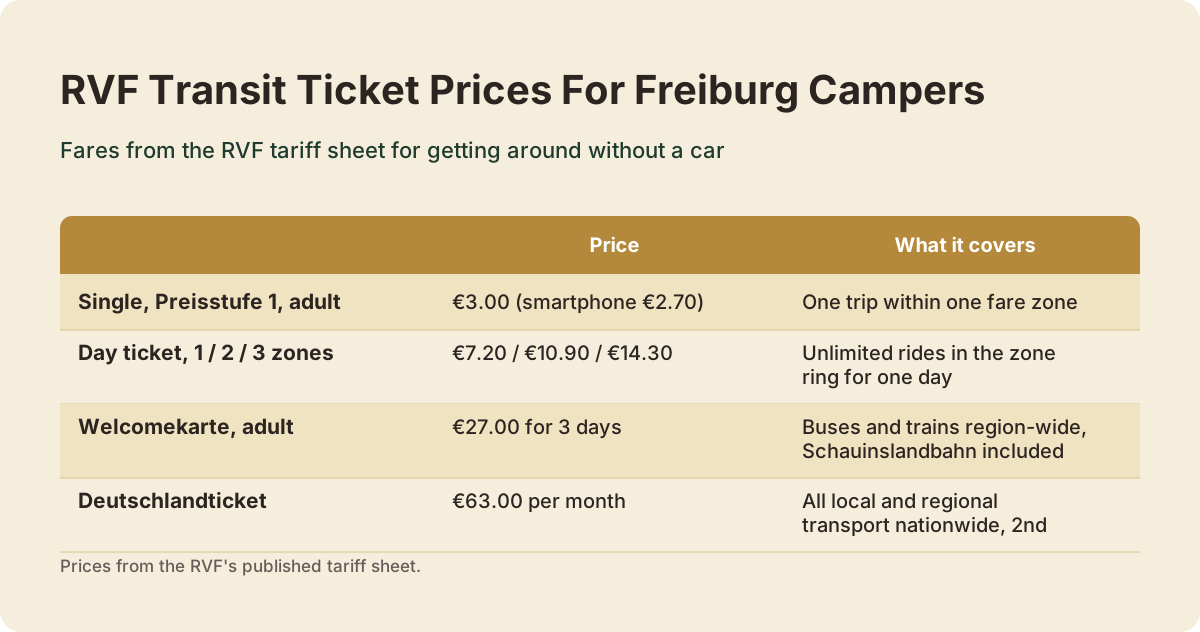
You do not need a car. An RVF single ticket in zone 1 costs €3.00, or €2.70 on a smartphone, a one-zone day ticket costs €7.20, and the three-day Welcomekarte at €27.00 covers buses and trains across the region and includes the Schauinslandbahn cable car. The Deutschlandticket at €63.00 per month only pays off for stays beyond a long weekend. Those four figures come from the RVF's own published tariff sheet, and they cover almost every camping scenario: one trip in, a day of hopping around, or three days of regional trains plus the mountain.
The pass landscape is worth understanding before arrival because the wrong assumption is common. Freiburg is not a KONUS municipality, so a campsite inside the city does not hand out the Black Forest's free guest transport card. That card is issued by member towns such as Kirchzarten, Horben, Titisee-Neustadt, Bad Krozingen, Staufen and St. Peter, and a card issued in one of those towns is valid on Freiburg's trams and buses, but camping inside Freiburg itself means buying tickets or the RVF Welcomekarte, which is the city's actual visitor product.
| Ticket | Price | What it covers |
|---|---|---|
| Single, Preisstufe 1, adult | €3.00 (smartphone €2.70) | One trip within one fare zone |
| Day ticket, 1 / 2 / 3 zones | €7.20 / €10.90 / €14.30 | Unlimited rides in the zone ring for one day |
| Welcomekarte, adult | €27.00 for 3 days | Buses and trains region-wide, Schauinslandbahn included, plus a culture bonus |
| Deutschlandticket | €63.00 per month | All local and regional transport nationwide, second class |
A few practical notes sit behind those rows. The Deutschlandticket is a calendar-month product, not a rolling pass, so mid-month buyers only get the remainder of that month, and at €63.00 it needs roughly nine or ten day-ticket-equivalent journeys to beat the day-ticket ladder. The Welcomekarte's inclusion of the Schauinslandbahn is the detail most people miss: a return cable car ride on its own costs €15.00, so a camper planning the mountain plus three days of transit gets real value from the card. The tram fleet itself is increasingly pleasant to ride, with 45 electric buses now in service, about two-thirds of the bus fleet, deployed across all lines since the December 2025 schedule change.
One more transit fact belongs in every camper's planning notes: Freiburg's main station entered a major modernization program on 14 September 2026, running until around December 2028, with five new lifts in the northern underpass and platform renewals on tracks 3 to 5. Trains keep running, but the northern pedestrian underpass is initially fully closed, so arriving with a backpack and a tent means following the signed detours rather than the usual route out of the station.
When To Camp: The Climate Numbers That Matter
The verified climate record puts July at a mean of 20.1°C, the warmest month, with May the wettest at 103.4 mm of rain. Freiburg records 18.5 days at or above 30°C per year and 64 frost days, which means the camping season is genuinely long, roughly April through early October, with September the quiet sweet spot. These are the German weather service's 1991-2020 normals for station 1443, the station that also underpins the city's "one of Germany's warmest and sunniest cities" reputation, a claim that holds up as long as nobody upgrades it to "the warmest," which the station rankings do not support.
The table below is the planning core of this guide, read it before booking anything. The rainfall pattern surprises people who assume southern Germany is dry in summer: June, July and August each carry between 83.3 and 92.2 mm, while September drops to 77.4 mm and sunshine holds at 176.2 hours. October stays mild at a 10.9°C mean but the rain climbs back to 78.5 mm and the sun falls to 116.2 hours.
| Month | Mean °C | Rain mm | Sun hours | Days ≥30°C | Frost days |
|---|---|---|---|---|---|
| Jan | 2.5 | 48.6 | 64.7 | 0 | 15.7 |
| Feb | 3.5 | 49.1 | 91.8 | 0 | 13.7 |
| Mar | 7.0 | 54.3 | 146.8 | 0 | 8.9 |
| Apr | 10.8 | 63.8 | 182.2 | 0 | 2.2 |
| May | 14.9 | 103.4 | 206.8 | 0.8 | 0.1 |
| Jun | 18.3 | 89.8 | 232.7 | 4 | 0 |
| Jul | 20.1 | 92.2 | 252.2 | 7.3 | 0 |
| Aug | 19.7 | 83.3 | 234.4 | 7 | 0 |
| Sep | 15.4 | 77.4 | 176.2 | 0.6 | 0 |
| Oct | 10.9 | 78.5 | 116.2 | 0 | 1.7 |
| Nov | 6.1 | 66.2 | 66.6 | 0 | 6.5 |
| Dec | 3.4 | 66.9 | 56.3 | 0 | 13.8 |
For campers, two details in that record shape decisions more than the headline warmth. The first is the frost column: even in April the average is 2.2 frost days, so an April trip needs a three-season sleeping bag, while May through September is genuinely frost-free. The second is the rain in May, the wettest month, which lands just as the season's first long weekends arrive; campers with flexibility usually do better in the second half of June or across September.
The warmth also cuts the other way. With 18.5 days a year at or above 30°C, concentrated in July and August, a campsite with shade or a swim option matters more in high summer than a site with the biggest pitch. The Seepark on the western edge is the city's obvious daytime heat escape, and its eastern shore got a fully replaced bridge in June 2026 after the old structure was found to be damaged.
What A Day In Town Costs From The Campsite
A day in town costs very little beyond transit. The Münster nave is free, the tower climb is €5, and the Augustinermuseum day ticket at €12 covers every city museum, with under-27s free at all of them. Add market food from the Münstermarkt and a realistic sightseeing day runs at pocket-money prices. That combination, free flagship church, cheap climb, one ticket for five museums, is unusual in German cities this size and it is the main reason a campsite base works for budget-conscious travelers.
| Sight or museum | Adult | Reduced | Notes |
|---|---|---|---|
| Münster nave | Free | Free | Open during visiting hours |
| Münster tower climb | €5 | €3 children and teens | Family ticket €13, under 7 free, gallery at 70 m |
| Augustinermuseum | €12 | €8 | Day ticket valid for all city museums, free under 27 |
| Museum für Neue Kunst | €7 | €5 | Free under 27, Thursdays until 19:00 |
| Archäologisches Museum Colombischlössle | €5 | €3 | Free under 27 |
| Museum Natur und Mensch | €5 | €3 | Permanent exhibition closed 4 Aug 2026 to around end of Feb 2027 |
| Schlossbergbahn funicular | €6.50 | €4.60 child return | One way €3.70 adult |
Two of those rows deserve a second look. The Münster's tower is 116 m tall, but the climb ends at a gallery at 70 m, not the top, and the upper gallery closes in winter, so a late-season camper should check the season before promising children the view. The tower's own hours are Monday to Saturday 11:00-16:00 and Sundays and holidays 13:00-17:00, with the last ascent about fifteen minutes before closing. The Museum Natur und Mensch row matters for timing: its permanent exhibition is closed from 4 August 2026 until approximately the end of February 2027 for renovation, though the museum stays open for special exhibitions, the mineral vault and workshops.
The Münsterplatz market is the other budget anchor. It runs Monday to Friday 07:30-13:30, with Saturday until 14:00, closed Sundays and holidays, and carries up to 130 stalls. Breakfast from a market stand plus a museum day is the classic cheap Freiburg day, and it needs nothing but a tram ticket.
For the evening, the city's dramatized walks are the distinctive option and the Historical Red Light Tour is the strongest fit for campers who want a story rather than a lecture. It runs about two hours from $27 and, with only 3 reviews so far, it is honest to say the rating pool is thin rather than dressing it up. Its heavier companion, the Guided Pub Crawl with Drinks, runs about four hours from $51 and is rated 4.4 across 107 reviews, which is a real pool.
Practical Rules, Taxes And Local Knowledge
Campsites inside Freiburg fall under the same rules as hotels: a 5% Übernachtungsteuer on the net overnight price, charged on private stays since 2014 and on business stays since 1 July 2023, with guests under 18 exempt. It is not a Kurtaxe and it is not a flat nightly fee, so expect it as a percentage add-on at the site's own prices. The details are on the city's own overnight-tax page, and the rate has not changed in the last year.
The second correction to hold onto concerns transport cards, because it is the single most common planning error for this city. Freiburg is not a KONUS municipality. Campers staying inside the city buy tickets or the Welcomekarte; campers staying in a member town like Kirchzarten or Titisee-Neustadt receive the KONUS card from that town, and it is then valid on Freiburg's trams and buses, second class, from check-in to departure day. Neither card is issued by the other's territory, and a guide that blurs this costs its readers real money.
Wild camping is the other question campers arrive with, and it deserves a direct answer rather than a shrug. The rules in the Black Forest are stricter than in the Nordic countries and the details, exceptions and fines are laid out in the dedicated question page can you wild camp in the Black Forest. The short version for planning purposes: do not build a Freiburg trip around sleeping outside a campsite, because the region's enforcement culture and private-forest ownership make it a poor bet compared with the region's genuine, affordable pitches.
Beyond the rules, a few pieces of local knowledge make camping here smoother. The Frelo bike-share system was fully renewed from January 2026 with around 1,200 new bikes including 206 e-bikes, and the network expanded to 162 stations from March 2026, 100 of them in Freiburg itself, which makes a campsite without a tram stop far less of a problem. The city also added 66 bike parking spots at the main station's eastern side in December 2025. And if a trip overlaps early October, note that the Rheintalbahn between Freiburg and Basel has taken scheduled construction closures in autumn 2026, with replacement buses running on affected weekends, so rail-based arrival plans deserve a check against the current timetable.
Day Trips From The Campsite
The two headline day trips from a Freiburg campsite are the Schauinsland cable car, €15.00 return and 3,600 m long, and Europa-Park at Rust. A combined transport-and-entry bus product runs from the city from $127 and removes the parking question entirely, while recent reporting puts a 2026 adult park day ticket at about €59.50-76, varying by date. Those two trips bracket the camping experience here, one quiet and vertical, one loud and flat, and both are reachable without a car.
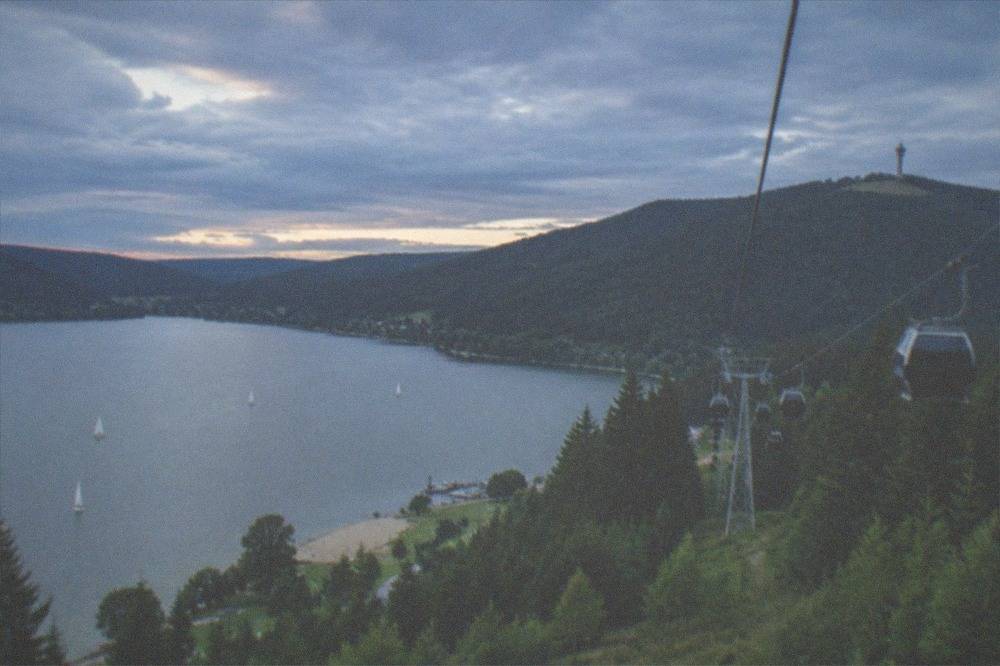
Schauinsland is the closer and simpler half. The cable car runs 09:00-17:00 daily year-round, extended to 18:00 only in the Baden-Württemberg summer holidays, and the operator's own tariff page lists the €15.00 return and €12.00 single adult fares that this guide quotes. The Eugen-Keidel tower on the summit reopened in April 2025 after its sanitation closure, and the summit's mining museum runs a seasonal program, open in 2026 from 4 April to 1 November, with guided descents on Wednesdays, Saturdays, Sundays and holidays and daily in July and August. Campers with the Welcomekarte ride the cable car on the card, which is the cheapest way up the mountain the region offers.
The Europa-Park half needs more planning honesty. The park sits at Rust, a drive that recent reporting puts at roughly 30 to 40 minutes by road, and the public-transport route is a train to Ringsheim followed by a bus. The combined product sold from Freiburg, transport plus park entry in one booking from $127, wraps all of that into a single decision and suits campers without a vehicle. Its listing carries no verified review pool yet, so there is nothing to say about ratings, but the format itself answers the question most campsite-based visitors actually have.
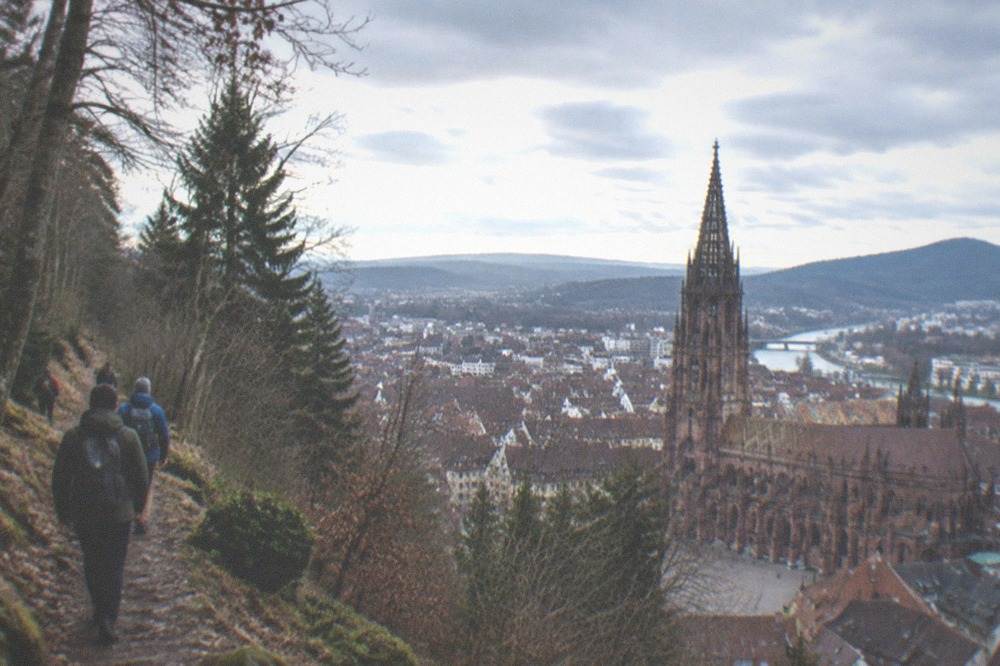
For travelers who would rather stay vertical than flat, the guided Schlossberg hike covers narrow paths, history and views in about two and a half hours from $28, starting on the city's own hill rather than in the far Black Forest. It carries no verified rating pool, so again the honest position is that the format, not the stars, is the selling point. And for a first evening back in town before the trip winds down, the professional-guide walking tour of the city is the flexible fallback option, its price shown on the live listing, bookable for a group on a whim once the campsite routine is settled.
Common Questions About Camping In Freiburg
Can You Camp Wild Near Freiburg?
Not as a plan. The Black Forest's rules on wild camping are stricter than many travelers expect, and the details, exceptions and enforcement picture are covered in the dedicated page on wild camping in the Black Forest. Freiburg's campsites and the wider region's pitches exist precisely because the wild option is a poor bet here.
Do Freiburg Campsites Include A Free Transport Card?
No. Freiburg is not a KONUS municipality, so no campsite in the city issues the Black Forest's free guest card. The visitor product for stays in Freiburg is the RVF Welcomekarte, €27.00 for three days, covering buses and trains and including the Schauinslandbahn. A KONUS card issued in a member town such as Kirchzarten or Titisee-Neustadt is valid on Freiburg's trams and buses.
What Tax Is Added To A Campsite Bill In Freiburg?
A 5% Übernachtungsteuer on the net overnight price. It applies to private stays since 2014 and business stays since 1 July 2023, and guests under 18 are exempt. It is a percentage, not a flat nightly fee, and it is not a Kurtaxe.
When Is The Best Month For Camping Around Freiburg?
September. The monthly mean is 15.4°C, rainfall drops to 77.4 mm after the wetter summer months, and sunshine holds at 176.2 hours. July is the warmest month at a 20.1°C mean but carries 7.3 days at or above 30°C, while May is the wettest month at 103.4 mm.
Do You Need A Car While Camping In Freiburg?
No. A single RVF zone 1 ticket costs €3.00, day tickets start at €7.20, and the three-day Welcomekarte at €27.00 covers regional trains and the Schauinslandbahn. The tram and bus network reaches the city's edge districts, and the Frelo bike-share network expanded to 162 stations in March 2026.