Seepark Freiburg: A Practical Guide To The City's Lakeside Park
The Seepark is where Freiburg goes to slow down: a lake, wide lawns, playgrounds and a now protected 1980s garden design in the western Betzenhausen district, a short tram ride from the Münster.
Short answer
The Seepark is Freiburg's lakeside park in the west of the city, built around the Flückiger See and listed as a heritage site in 2026 for its 1980s garden design. A zone 1 RVF single costs €3.00, a day ticket €7.20, and July is the warmest month at a 20.1 °C mean.
What Is The Seepark In Freiburg?
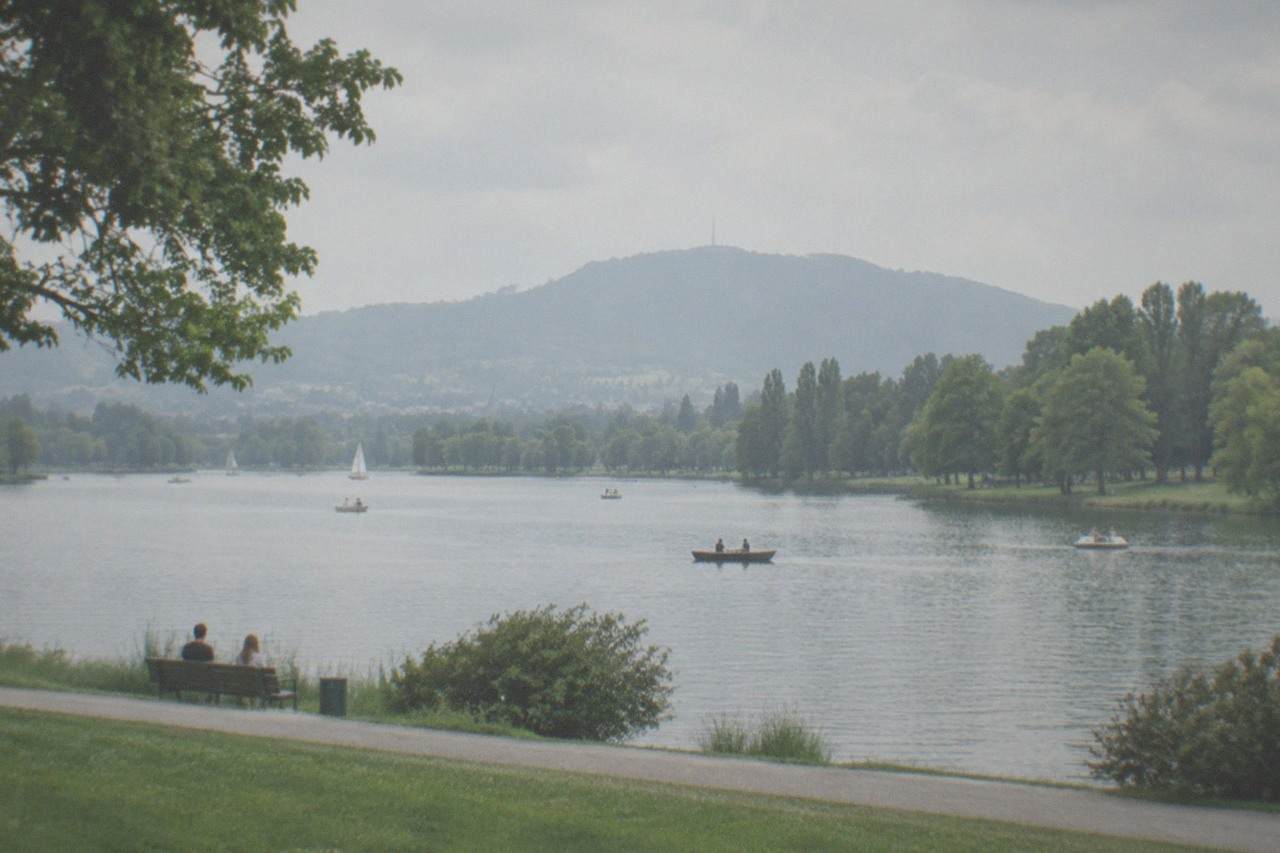
The Seepark is Freiburg's largest lakeside park, laid out in the city's west around the Flückiger See, and it is now a protected heritage site: in 2026 the park was listed for its 1980s garden-art significance. It sits in the Betzenhausen district, a short tram ride from the old town, and it folds open water, meadows, mature trees, playgrounds and a restaurant terrace into one walkable green space.
The park began as a deliberate piece of city planning rather than an accident of geography. Its garden design, laid out in the 1980s, was formal enough as a composition of water, paths, plantings and sightlines that in 2026 it received heritage protection, an unusual outcome for a park of that era, as recorded on the park's heritage listing. That listing matters to a visitor in a simple way: the park you walk today is the park as designed, not a casually reworked version of it. The lake at its center, the Flückiger See, gives the whole site its structure, and everything else in the park, from the lawns to the bridge crossings, arranges itself around that water.
For a city that markets itself as a Green City, the Seepark is the western anchor of that identity. Freiburg's own planning reports show that walking, cycling and public transport together rose from 67% of all trips in 2017 to 76% in 2023, and the Seepark is exactly the kind of close-in green space that makes a car-free visit feel natural rather than a sacrifice. The park is a local park first, which is precisely why it rewards a visitor: you get the Freiburg that residents actually use, alongside the old town churches and gates covered in the Freiburg Travel Guide and its historic old town itinerary.
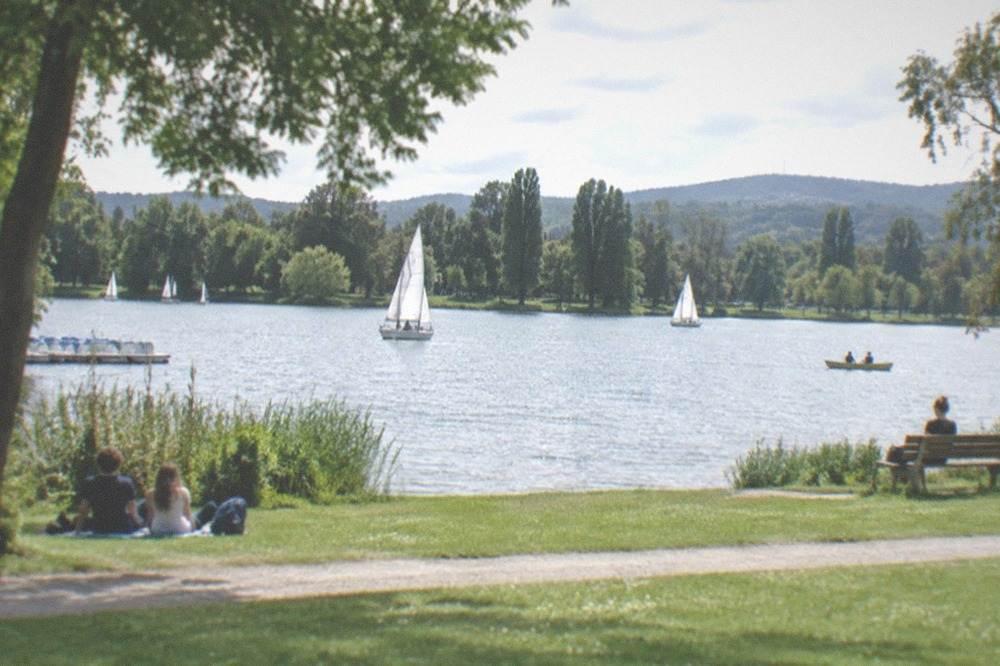
Practically, the Seepark is a half-day outing that can stretch to a full day if you add the Mundenhof animal park next door or push on to the surrounding neighborhoods. There is no single headline monument inside it. The appeal is the loop: water on one side, meadows on the other, the occasional bridge crossing, and the Black Forest's green western edge visible beyond the city. Families use the playgrounds, runners use the path around the lake, and in the warmer months the lawns fill with the low-key picnic culture that defines German park life.
What Can You See And Do At The Seepark?
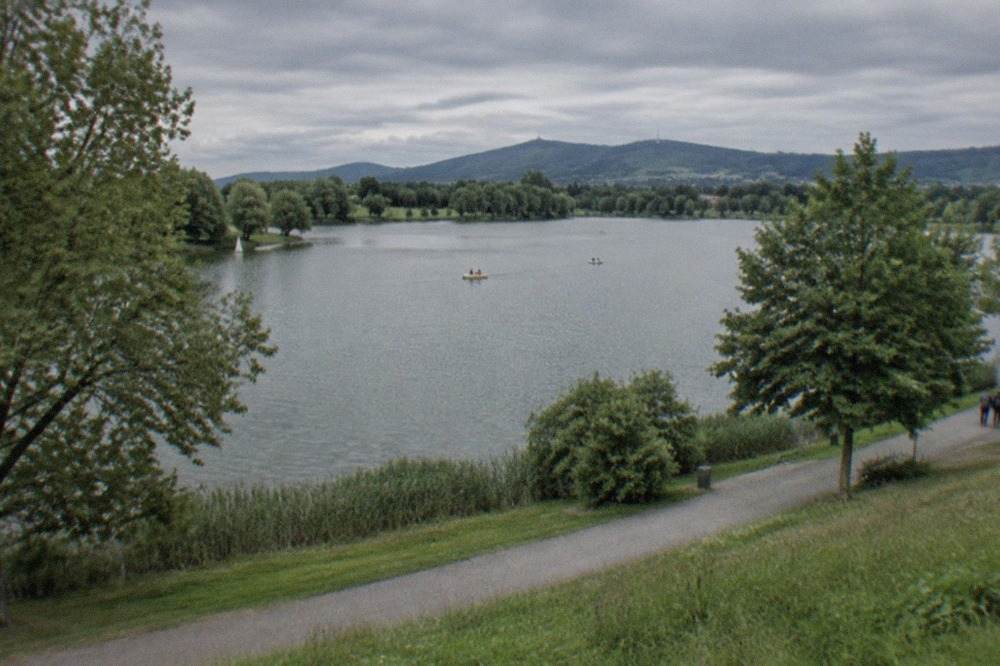
Visitors walk the lake loop, cross the rebuilt Steg am Rhododendron-Tal bridge, spread out on the lawns, and use the playgrounds and paths for unhurried downtime between old town sights. The water is the draw: the circuit around the Flückiger See, the pontoon crossing on the shore, and the June 2026 replacement of the steel-and-fiberglass bridge give the loop a genuinely varied character rather than one repeated view.
The lake loop is the park's spine. It takes a comfortable hour at a strolling pace, longer with children or a picnic stop, and it changes character repeatedly: wooded sections on one side, open meadow on the other, the water visible through reeds in places and wide open in others. The eastern shore carries the Rhododendron-Tal crossing, whose older structure was fully replaced in June 2026 with a new steel construction, fiberglass-reinforced plastic decking and steel railings with wooden handrails, while the old abutments were retained, as reported by local coverage of the works. During the replacement works, which closed that crossing from 8 to 25 June 2026, the nearby Pontonsteg served as the alternative crossing, and it remains part of the park's circulation today.
The rest of the park divides naturally into zones. The lawns are the biggest single surface, and on a warm afternoon they function as the city's collective living room. Playgrounds give families a reason to stay for hours rather than minutes. The restaurant infrastructure around the lake means you are not dependent on packing food, though the market culture of the old town, covered in the Münsterplatz market guide, is the better option if you want to assemble a picnic from Badense produce.
For orientation, this is what changed recently and what it means for a visit:
| Item | What happened | Visitor impact |
|---|---|---|
| Steg am Rhododendron-Tal | Full replacement, steel structure with fiberglass-reinforced plastic decking, wooden handrails, old abutments retained | The eastern crossing is open again on new steelwork |
| Bridge closure window | Closed 8-25 June 2026 for the works | Passed; no lasting disruption to the loop |
| Heritage protection | Park listed in 2026 for its 1980s garden-art design | The original layout is protected, so the design you walk is the design as planned |
| Mundenhof smoking rule | Non-smoking indoors and outdoors from 1 June 2026, designated zones only | Relevant if you combine the park with the animal park next door |
The honest pitch for the Seepark is that it is not a monument and does not try to be. It is the place where a Freiburg trip breathes. If your itinerary is dense with the Münster, the Bächle, the museums and the gates, the park is the counterweight: flat, free-roaming, and shaped by the one thing this region never lacks, which is green. Guided walks, by contrast, belong in the old town, and the trio below covers the formats that pair best with a park afternoon: a classic sightseeing-and-history walk, a National Socialism history walk, and an evening comedy format for a night out.
How Do You Get To The Seepark?
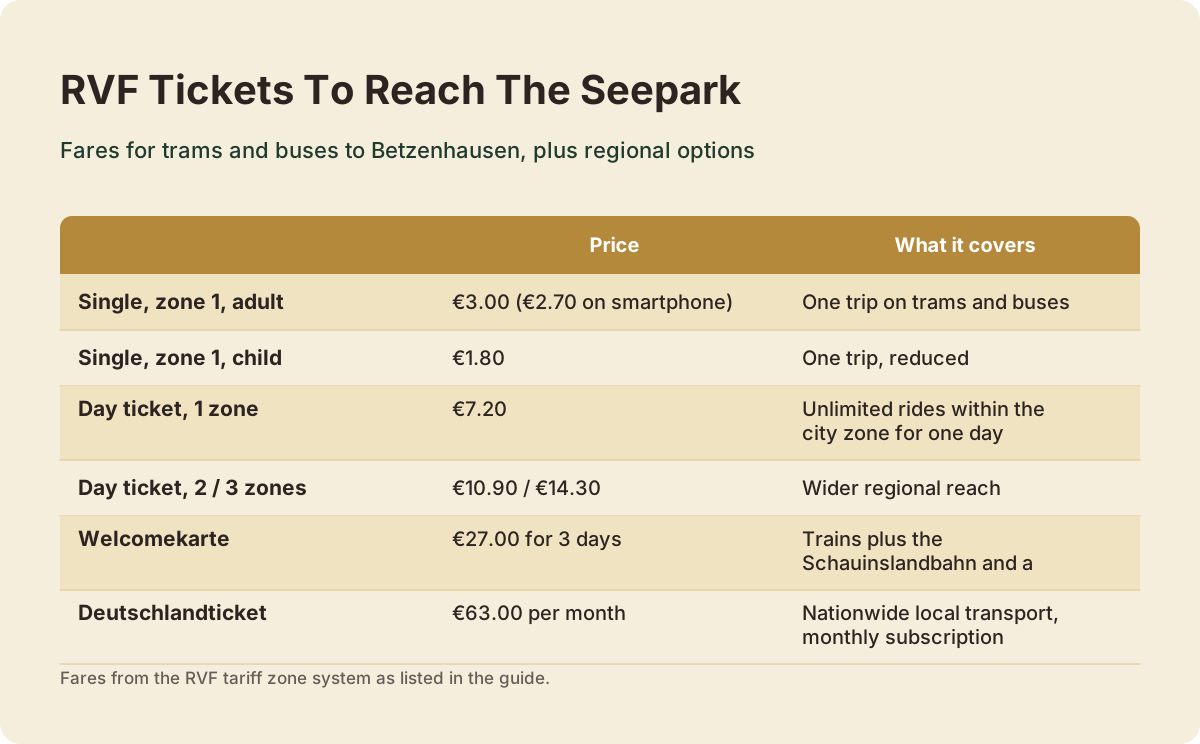
The Seepark sits in Freiburg's western Betzenhausen district, and a zone 1 RVF ticket covers the trip: €3.00 for a single adult ride, €2.70 on a smartphone, or €7.20 for a one-day ticket valid across the city's trams and buses. The RVF Welcomekarte, at €27.00 for three days, adds regional trains and the Schauinslandbahn cable car for visitors packing several days of sightseeing into one stay.
Freiburg's transit network makes the park genuinely easy to reach. The city runs one of Germany's most-used tram systems, and its fleet is now heavily electric: 22 new electric buses joined in October 2025, bringing the total to 45 E-buses, roughly two-thirds of the bus fleet, and the city opened a second charging port to support them. Trams and buses share the RVF tariff zone system, so a single ticket buys a ride across both. The fare table below reflects the current published RVF tariff, which was adjusted in August 2025 and again at the turn of 2026.
| Ticket | Price | What it covers |
|---|---|---|
| Single, zone 1, adult | €3.00 (€2.70 on smartphone) | One trip on trams and buses |
| Single, zone 1, child | €1.80 | One trip, reduced |
| Day ticket, 1 zone | €7.20 | Unlimited rides within the city zone for one day |
| Day ticket, 2 / 3 zones | €10.90 / €14.30 | Wider regional reach |
| Welcomekarte | €27.00 for 3 days | Buses and trains plus the Schauinslandbahn and a culture bonus |
| Deutschlandticket | €63.00 per month | Nationwide local and regional transport, monthly subscription |
Two of those options deserve a plain word. For a visitor staying a few days and moving between the old town, the Seepark and the Black Forest edge, the Welcomekarte, detailed on the RVF fare page, is the strongest value because it bundles the Schauinslandbahn cable car, which on its own costs €15.00 for an adult return. The Deutschlandticket only makes sense for longer stays, since it is a monthly subscription rather than a visitor product. And one correction worth repeating, because it confuses many first-time visitors: Freiburg city is not a KONUS municipality. The KONUS guest card is issued by member towns in the surrounding Black Forest, and a card issued there is valid on Freiburg's trams, but a hotel stay inside Freiburg itself does not hand you one. The Welcomekarte is this city's own visitor product.
Cyclists have an even easier run at it. Freiburg is one of Germany's most bike-oriented cities, the Frelo bike-share system was fully renewed with roughly 1,200 bikes including 206 e-bikes from January 2026 and expanded to 162 stations from March 2026, and the route to the park is flat, as covered in the cycling in Freiburg guide. Riding from the station to the lake takes well under half an hour, and the park's paths connect onward to the western neighborhoods without forcing you back onto roads.
One seasonal note belongs here rather than buried in a schedule: the city's transit network runs ongoing construction-related reroutes, including works affecting several tram lines into late 2026. None of them remove the Seepark from reach, but a quick check of the current VAG disruption notices on the day you travel saves a surprise at the platform.
Planning a bigger first day in the city before you head west to the lake? The city walk below is the natural fit for a morning in the old town, and it leaves your afternoon open.
How Do You Fit The Seepark Into A Freiburg Day?
A practical Seepark day pairs the park with one anchored activity in the old town: the lake loop takes roughly an hour at a stroll, and a guided morning walk adds structure before you head west. The Exciting City Tour with Sightseeing and History runs about two hours, is rated 4.4 across 118 reviews, and costs from $26, which leaves a full afternoon for the lake, the lawns and the Mundenhof next door.
The sequence that works best is old town first, park second. The Münster, the Bächle, the Martinstor and the Augustinermuseum are all within a few minutes' walk of each other in the compact center, and they are best seen before the afternoon warmth builds. July, the warmest month, averages a 20.1 °C mean, which sounds mild until you account for the 7.3 days at or above 30 °C the month averages; the lawns of the Seepark are exactly where you want to be during those hours, not a stone plaza.
A guided walk gives the morning shape without you having to plan it. The two-hour Exciting City Tour with Sightseeing and History is the middle option in the city's walk lineup: long enough to reach the gates and the cathedral, short enough that you are on a tram west by early afternoon. It suits the visitor who wants one solid introduction rather than a series of thematic walks, and its review pool, 118 reviews with a 4.4 rating, is broad enough to read as a real signal rather than a handful of early opinions. Check availability if that format matches your first day, and compare it with the one day in Freiburg itinerary for the fuller sequence.
For families, the same day tilts differently. The playgrounds inside the Seepark are the anchor, and Mundenhof, the animal park immediately beyond it, stretches the outing toward a full day: it recorded more than 570,000 visitors in 2025, its strongest year, and it now runs a covered picnic house converted from a former stable building. Arrive at the park by mid-morning, let the lake loop and playgrounds consume lunch, then walk to Mundenhof for the afternoon. The whole western complex is flat and stroller-friendly, and a day ticket at €7.20 covers the return tram rides for every adult in the group.
For travelers without children, the park works as a late-afternoon decompression stop between the museums and dinner. The old town's restaurants cluster in the center, and the tram back from Betzenhausen is short enough that the park never feels like a detour. In the warmer months the light on the lake in the early evening is the best the park offers, and the restaurant terrace around the water means you can end the loop with a drink rather than a sprint for a tram.
When Is The Best Time To Visit The Seepark?
Late spring through early September is the best window: July averages a 20.1 °C mean and 252.2 hours of sunshine against the 1991-2020 climate normals for Freiburg's station, and even September holds a 15.4 °C mean with 176.2 sunshine hours. Winter is quieter but workable at a 2.5 °C January mean with only 64.7 sunshine hours; May is the wettest month at 103.4 mm of rain, so pack for showers.
Freiburg's climate reputation is real but routinely overstated. The city is one of Germany's warmest and sunniest cities, not the single warmest or sunniest: the official 1991-2020 normals put its annual mean at 11.0 °C, ranking 34th among more than a thousand national stations, and its 1,815.1 annual sunshine hours rank 20th. What that means for the Seepark specifically is that the warm-season window is generous, roughly from April's 10.8 °C mean through September's 15.4 °C, and the park's open lawns make the most of it.
| Month | Mean temperature | Rainfall | Sunshine hours |
|---|---|---|---|
| April | 10.8 °C | 63.8 mm | 182.2 h |
| May | 14.9 °C | 103.4 mm | 206.8 h |
| June | 18.3 °C | 89.8 mm | 232.7 h |
| July | 20.1 °C | 92.2 mm | 252.2 h |
| August | 19.7 °C | 83.3 mm | 234.4 h |
| September | 15.4 °C | 77.4 mm | 176.2 h |
| October | 10.9 °C | 78.5 mm | 116.2 h |
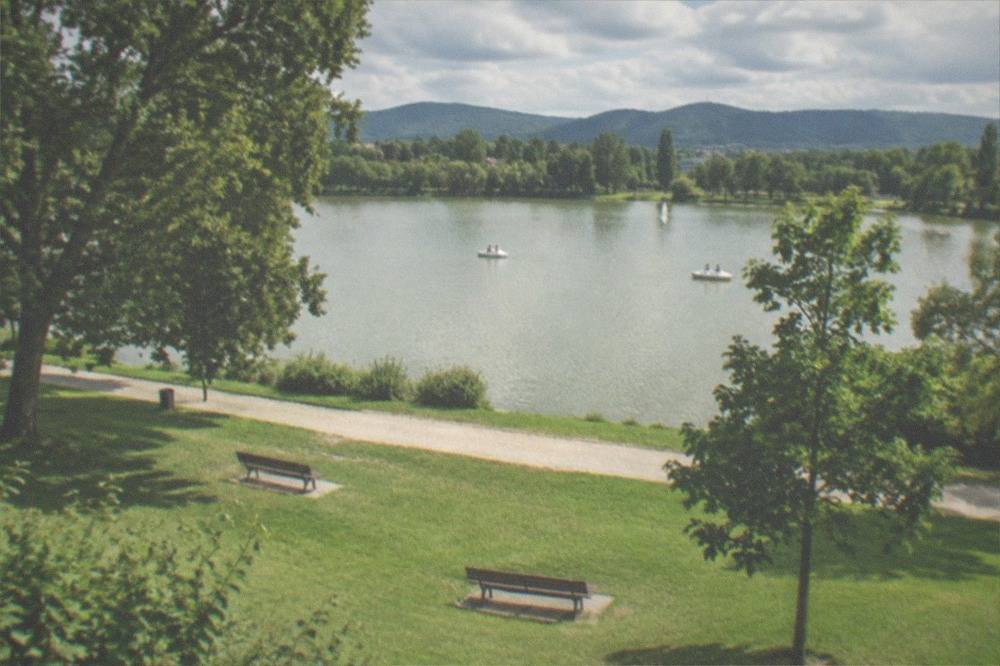
The numbers reward reading closely. July and August carry the heat: the year averages 18.5 days at 30 °C or above, and almost all of them fall in June, July and August. The lawns, the water proximity and the mature tree cover make the Seepark the right place to spend those hours, and the same months are when the park feels most alive. May looks tempting on the sunshine figure, 206.8 hours, but it is also the wettest month of the year at 103.4 mm, so a May visit should carry a rain layer rather than an assumption of dry lawns.
Spring and autumn are the connoisseur's months. April and September both sit in the 10-16 °C band with rainfall well below the May peak, the paths are less crowded, and the park's tree cover is at its most photogenic in both seasons. Winter is the honest low point: 64.7 sunshine hours in January and 56.3 in December, with frost on an average of 64 days per year. The park stays open and walkable, and the lake in cold weather has a stillness that the summer crowds never allow, but this is a walking visit, not a lingering one.
What Else Is Near The Seepark?
Mundenhof, Freiburg's animal park, is the nearest headline attraction, and it drew more than 570,000 visitors in 2025, its record year. Beyond it, the car-reduced Vauban district, the Wiehre quarter and the Schlossberg hill are all within easy reach, and the Seepark anchors a low-effort western loop that suits families, cyclists and anyone pairing green space with a museum or market morning.
The western edge of Freiburg is a cluster rather than a single sight. Mundenhof sits closest: a working animal park with a farmyard character, now fully non-smoking across its indoor and outdoor areas under a rule in force since 1 June 2026, with designated smoking zones instead. Its 2025 attendance of more than 570,000 visitors made it one of the most visited attractions in the whole region, and it is close enough to the Seepark that the two read as a single half- or full-day outing. The Mundenhof guide covers its layout and what to expect from a visit.
South of the park, the terrain rises gently toward the green neighborhoods the city is known for. The city's own Green City materials present Vauban as a car-reduced district with energy-plus housing and its solar settlement, and Rieselfeld alongside it as another planned, transit-oriented quarter; both are walkable extensions of a Seepark visit for travelers interested in how Freiburg actually builds, not just how it looks in postcards. The Vauban district guide walks the streets worth seeing. The Wiehre quarter to the southeast is the softer, older alternative, covered in the Wiehre neighborhood guide, its streets lined with the residential architecture that gives the city its calm, well-kept feel.
| Nearby place | Character | Distance relationship |
|---|---|---|
| Mundenhof | Animal park, over 570,000 visitors in 2025 | Immediately adjacent to the Seepark, walkable |
| Vauban | Car-reduced district, solar settlement | South of the park, flat walk or short tram |
| Wiehre | Historic residential quarter, cafes | Southeast, short tram via the center |
| Schlossberg | Wooded hill, tower views over the city | East across town, pairs as a morning before the park |
For visitors drawn to Freiburg's green identity, one further option belongs in this western loop: a guided walk that engages the city's plant life directly. The Herbal Walking Tour Including a Snack with Wild and Green Toppings runs about three hours and costs from $36, pairing a walk through the city's usable greenery with a snack built from what the walk discusses. It is a niche format, its listing carries no rating on this site's roster, so read the recent reviews on the operator's live listing before booking, but for travelers whose interest in the Seepark is botanical rather than merely scenic, it is the tour that matches.
How Much Do Guided Tours In Freiburg Cost?
Guided walks in Freiburg run from $15 to $79 for shared-group formats, with private tours from $90 upward. Mainstream shared city walks cost $15-$26 for roughly 1.5 to 2 hours, dramatized and themed walks cluster at $17, food, pub and wine formats run $31-$79, and private guiding starts at $90 for an express hour and rises past $239 for full private itineraries.
Tour prices on this site are listed in USD, while everything you pay at a German till, tram tickets, museum admission, the Welcomekarte, is in euros. That split is worth keeping straight as you budget a day. The table below gathers the formats most relevant to a Seepark-centered trip, with each figure taken from the operator's own listing.
| Tour | Length | Price | Reviews |
|---|---|---|---|
| Gässle, Bächle and More City Tour | ~1.5 hours | from $15 | 4.7 across 3187 reviews |
| Exciting City Tour with Sightseeing and History | ~2 hours | from $26 | 4.4 across 118 reviews |
| Drag Queen Show Walk with Betty BBQ | ~1h 25m | from $40 | 4.6 across 699 reviews |
| Guided Sustainable City Walking Tour | ~1.5 hours | from $17 | No rating shown yet |
| Herbal Walking Tour with wild green snack | ~3 hours | from $36 | No rating shown yet |
| Veni, Vidi, Vino wine hike and tasting | ~2.5 hours | from $79 | 4.4 across 167 reviews |
Two patterns in that table deserve comment. First, the rating pools vary enormously: the largest review base on the roster belongs to the classic Gässle and Bächle walk with 3187 reviews, while several interesting niche formats, including the sustainable and herbal walks, have not yet accumulated ratings at all. A tour without a rating is not a bad tour; it is an unproven one, and the honest move is to say so and let you judge from the operator's listing. Second, price tracks length and specialization more than quality: the $15-$26 band buys a solid 1.5-2 hour introduction, and the higher figures buy food, wine or private formats rather than a better guide.
For the green-minded visitor, the Guided Sustainable City Walking Tour is the natural companion to a Seepark day, since it covers the same themes the park embodies, compact, transit-first, low-carbon city life, inside the old town itself. It runs about 1.5 hours from $17.
Whatever mix you settle on, the structure of a good Freiburg visit rarely changes: a guided or self-guided morning in the compact center, a tram or bike ride west, and the Seepark as the place where the day slows down. Budget the walk in the morning when energy is high and the stones are cool, and save the lawns for the warm hours the climate data says you should not spend on a sun-exposed plaza.
Common Questions About The Seepark In Freiburg
What is the Seepark in Freiburg?
The Seepark is Freiburg's lakeside park in the western Betzenhausen district, built around the Flückiger See. It was laid out in the 1980s and received heritage protection in 2026 for that garden design, which means the layout you walk today is the layout as originally planned, a mix of open water, lawns, mature trees, playgrounds and a restaurant terrace.
How do you get to the Seepark?
Take a tram west from the center and pay the standard RVF zone 1 fare: €3.00 for a single adult ticket, €2.70 if bought on a smartphone, or €7.20 for a day ticket covering the whole city network. Cyclists can ride from the main station to the park in well under half an hour on flat routes, and the Frelo bike-share system covers the city with roughly 1,200 bikes at 162 stations.
When is the best time to visit the Seepark?
April through September. July is the warmest month with a 20.1 °C mean and 252.2 sunshine hours, though it also averages 7.3 days at 30 °C or above, so the park's lawns are exactly where you want to spend the afternoon. May is the wettest month at 103.4 mm of rain, while September is a comfortable shoulder option at a 15.4 °C mean.
What else is near the Seepark?
Mundenhof, the animal park that drew more than 570,000 visitors in 2025, sits immediately adjacent and is walkable from the lake. The car-reduced Vauban district and its solar settlement lie just south, the Wiehre quarter sits a short tram ride east, and the Schlossberg hill works well as a morning counterpart before an afternoon at the lake.
How much do guided tours in Freiburg cost?
Shared-group walking tours run from $15 to $79 per person. Classic city walks sit at $15-$26 for 1.5 to 2 hours, dramatized and themed walks cluster at $17, and food, pub and wine formats run $31-$79. Private tours start at $90 for an express hour and rise past $239 for full private itineraries. All tour prices are in USD, while local costs like tram tickets and the €27.00 Welcomekarte are in euros.