Frankfurt To Freiburg: The Practical Route, Tickets And First Hours In The City
The Frankfurt to Freiburg run is one of the easiest long-distance hops in Germany: a direct ICE down the Rhine plain, a station that sits on the edge of the old town, and a small city that repays every hour you give it.
Short answer
A direct ICE train links Frankfurt and Freiburg, with recent reporting putting the journey at roughly 1 hour 40 minutes to 2 hours. Freiburg Hauptbahnhof sits a short walk from the old town. A 3-day RVF Welcomekarte at €27.00 covers buses, trains and the Schauinslandbahn cable car, and a 5% overnight tax applies to hotel bills.
How To Get From Frankfurt To Freiburg
The core answer is a direct ICE train. Recent reporting puts the Frankfurt to Freiburg ICE journey at roughly 1 hour 40 minutes to 2 hours, and German rail schedules should be rechecked on the official DB planner before you commit to a connection. Regional trains also run the corridor but take notably longer and usually involve changes. Freiburg Hauptbahnhof drops you a ten-minute walk from the Münster.
That is the whole decision, most of the time. You board in Frankfurt, you ride south down the Rhine plain past Offenburg, and you step out in a university city of 237,299 people where the old town begins the moment you leave the station concourse. There is no transfer, no airport-style transfer leg and no reason to rent a car for the city itself. The corridor is one of the busiest in the country, which means multiple departures across a normal day and a decent chance of a seat if you book ahead.
The one thing worth watching is construction. The Rhine valley line between the Frankfurt area and Basel is being expanded to four tracks, and that produces bundled weekend closures with replacement buses on sections including the Freiburg to Basel stretch in early October 2026. Deutsche Bahn publishes the affected dates in advance, so if your trip falls on a closure weekend, the planner will show the replacement-bus legs automatically. Build a little slack into an arrival day that matters, say a tour booking or a dinner reservation.
If you are starting at Frankfurt Airport rather than Frankfurt city, the logic still holds. The airport has its own long-distance rail station, and the same southbound ICE services call there before continuing toward Freiburg. It is one of the reasons the pairing works so well for international arrivals: you can be off a long-haul flight and in a Black Forest university town without ever entering Frankfurt itself.
What Your Ticket Buys Once You Are In The RVF Network
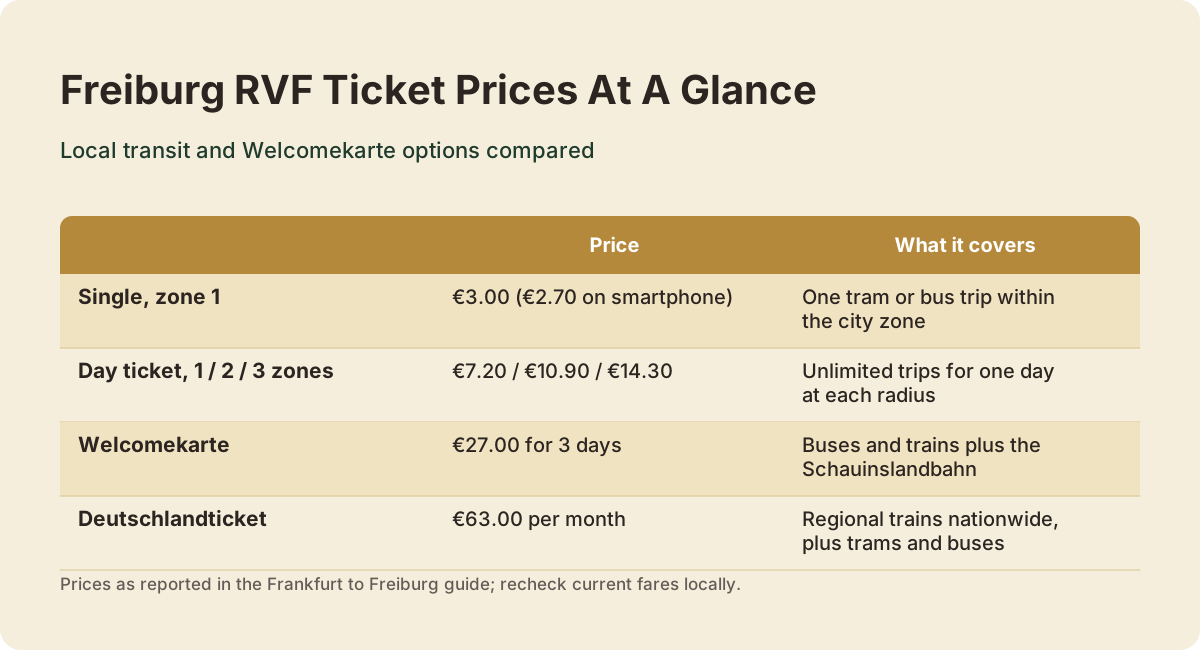
Once you arrive, everything local runs on the RVF fare system. A single zone 1 ticket is €3.00, day tickets for 1, 2 or 3 zones cost €7.20, €10.90 and €14.30, and the Deutschlandticket is €63.00 per month. For a three-day visit, the RVF Welcomekarte at €27.00 is the product to look at, because it includes the Schauinslandbahn cable car.
The Welcomekarte is the one worth doing arithmetic on, and the arithmetic is genuinely favorable. Three one-zone day tickets would cost €21.60 on their own. A return ride on the Schauinslandbahn is €15.00 at the till. That is €36.60 if you buy them separately, against €27.00 for the card, so a visitor who plans to ride the cable car once and use trams at all comes out ahead. The card also carries a Kulturbonus, a small culture perk, and it is sold as a visitor product rather than a resident one.
Do not confuse this with the KONUS card, a common mistake on this route. KONUS is the Black Forest guest card, free local transport issued by member municipalities, and Freiburg city is not one of them. Nearby towns such as Kirchzarten, Staufen and Titisee-Neustadt do issue it, and a KONUS card issued there is valid on Freiburg's trams and buses. But a hotel stay in Freiburg itself does not hand you one. The RVF's own Welcomekarte page sets out what is included.
The Deutschlandticket deserves a sentence too, because it is often the right answer for a longer Germany trip. At €63.00 per month it covers regional trains across the whole country, including the regional run down from Frankfurt, plus Freiburg's trams and buses. For a three-day visit it is more than you need, but for two weeks split between Frankfurt, Freiburg and the Black Forest it can beat point-to-point pricing. It is a subscription product, so read the cancellation terms before buying rather than assuming it behaves like a day pass.
| Ticket | Price | What it covers |
|---|---|---|
| Single, zone 1 | €3.00 (€2.70 on smartphone) | One tram or bus trip within the city zone |
| Day ticket, 1 / 2 / 3 zones | €7.20 / €10.90 / €14.30 | Unlimited trips for one day at each radius |
| Welcomekarte | €27.00 for 3 days | Buses and trains plus the Schauinslandbahn and a Kulturbonus |
| Deutschlandticket | €63.00 per month | Regional trains nationwide, plus Freiburg's trams and buses |
A note on how you pay. New electric buses in the VAG fleet carry cashless ticket machines, and cash or driver sales are not available on those vehicles. Buying on a phone app or at a platform machine before boarding is the habit that saves an awkward moment. The trams remain the backbone: Freiburg's walking, cycling and public transport share of trips rose from 67% in 2017 to 76% in 2023, which tells you how little locals lean on cars.
What To Expect At Freiburg Hauptbahnhof
Freiburg Hauptbahnhof is a terminus-style station directly north of the old town, and a ten-minute walk takes you to the edge of the historic center. Since 14 September 2026 it has been a construction site for accessibility modernization, with the northern underpass initially fully closed and platforms 3 to 5 being renewed, work scheduled to run until around December 2028. Trains keep running throughout.
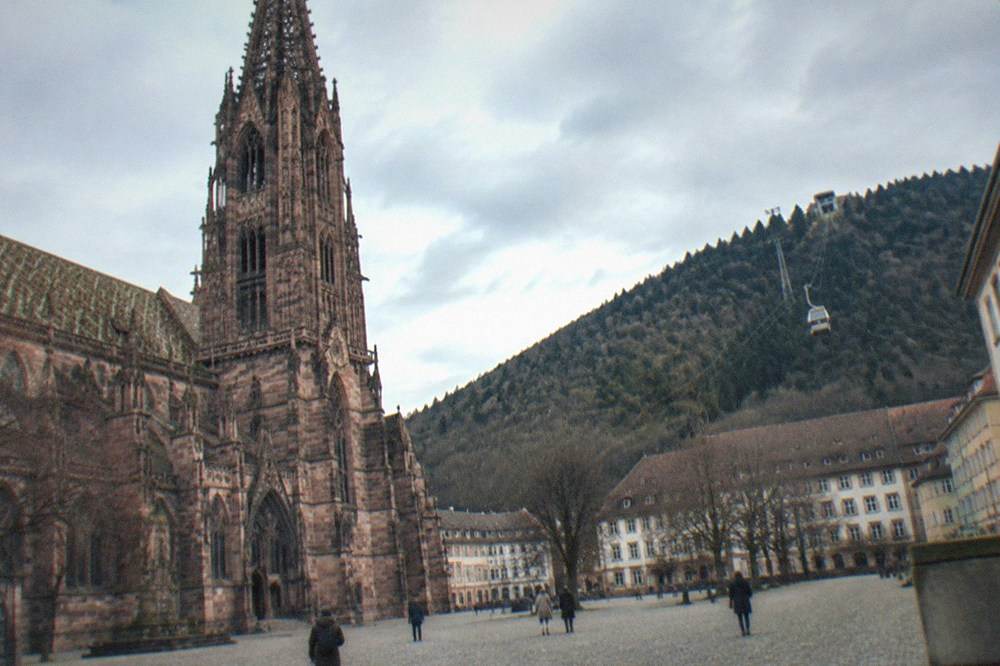
The practical consequence for a visitor is minor but real. Lifts are being installed and platform heights adjusted, so wayfinding inside the station is temporarily less tidy than the permanent layout will be, and the northern pedestrian underpass is closed at the start of works. None of this affects the basic geometry that makes the station so convenient: exit toward the city, cross the tram loops, and you are on the road into the old town with the Münster's 116 m west tower visible ahead of you as a landmark. The Deutsche Bahn project announcement details the roughly €36.7 million scope, funded with the federal government, Baden-Württemberg and the city.
What surprises many Frankfurt arrivals is how small the walkable core is. The old town between the station and the Münster is a few hundred meters in each direction, and almost everything a first-time visitor wants sits inside it or on its slopes. The station area itself, with the Konzerthaus opposite and the hotels clustering around it, is a sensible base: one hotel in that cluster is currently operating as a Novotel with a rebrand to Scandic planned for autumn 2027 after renovation, a reminder that this district is actively upgrading.
For onward connections the station is also the region's hub. Direct regional trains run into the Black Forest, and the Schauinslandbahn and Schlossberg lifts sit on tram and bus lines from the city center. If your plan is Freiburg plus a lake or a summit, staying near the station costs you nothing in access and saves hauling luggage across the old town's cobblestones.
The one thing not to do is treat the station district as the destination. Freiburg's character lives ten minutes south of it, in the Bächle-lined lanes around the Münster, and that is where the rest of this guide goes.
Where To Start When You Step Into The Old Town
Start at the Münster. The cathedral nave is free to enter, and the tower climb costs €5 for adults, €3 for children and teens and €13 for a family, with under-7s free. The west tower is 116 m tall, but visitors climb to a gallery at 70 m, not the top, and the gallery closes in winter. Climbing hours are Monday to Saturday 11:00 to 16:00 and Sundays and holidays 13:00 to 17:00.
That 116 m against 70 m distinction matters, because it is the difference between what the postcard shows and what the ticket buys. The official tower page is the source for hours and prices, and it is also where the winter closure of the top gallery is stated. On a clear day the view from the gallery takes in the Black Forest ridgeline to the southeast and the Rhine plain to the west, which is a useful orientation before you walk anywhere else. Tickets are bought in the Türmerstube at the tower itself.
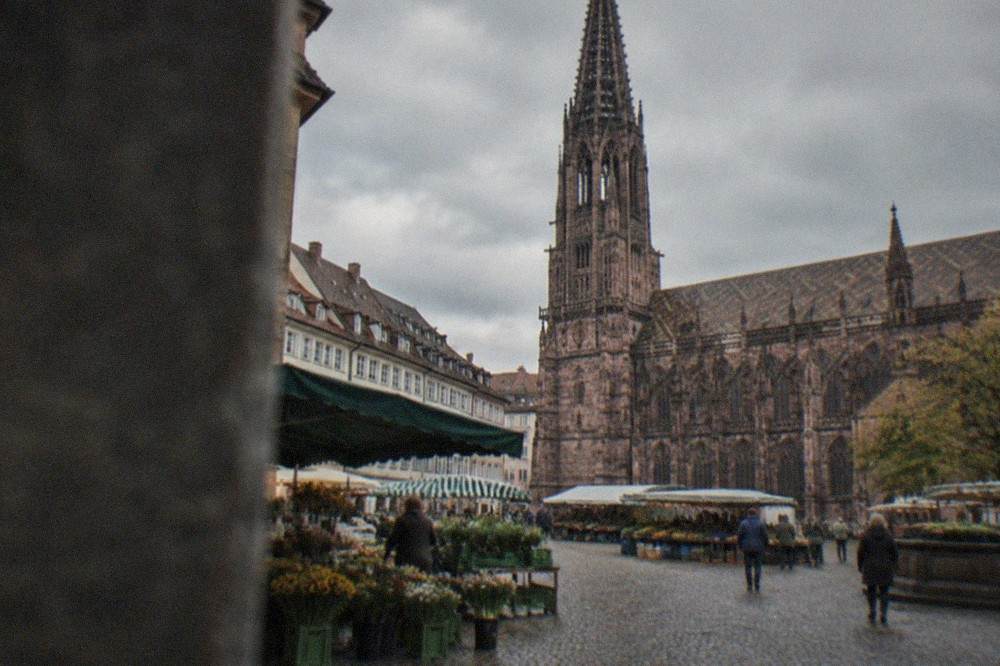
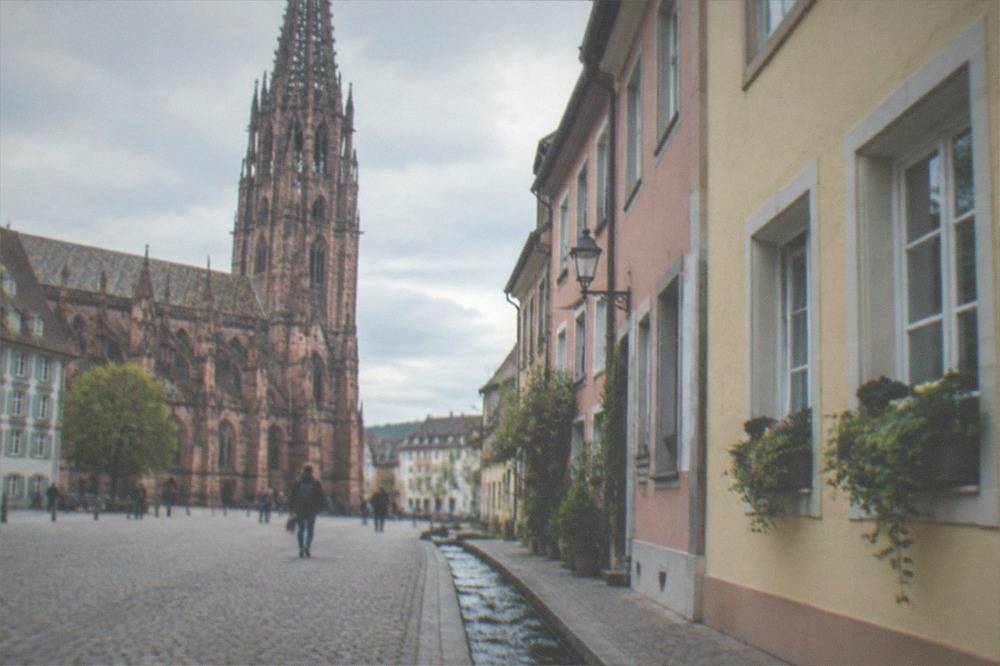
Around the cathedral, the Münstermarkt runs Monday to Friday from 07:30 to 13:30 with up to 130 stalls, and Saturdays from early morning into the early afternoon. It is the city's stomach: flowers, bread, regional produce and the stands that have fed the market square for generations. Go hungry rather than fed. The surrounding lanes carry the Bächle, the small runnels of water along the kerbside, and the two surviving gates, the Martinstor and the Schwabentor, frame the old town at either end.
| Sight | Admission | Note |
|---|---|---|
| Münster nave | Free | Open during cathedral visiting hours |
| Münster tower gallery | Adults €5, children and teens €3, family €13, under 7 free | 70 m gallery, closed in winter |
| Augustinermuseum | €12, reduced €8 | Day ticket valid across the city museums, free under 27 |
| Museum für Neue Kunst | €7, reduced €5 | Free under 27, open late on Thursdays to 19:00 |
| Archäologisches Museum Colombischlössle | €5, reduced €3 | Free under 27 |
| Museum Natur und Mensch | €5, reduced €3 | Permanent exhibition closed from 4 August 2026 to around end of February 2027 |
The Augustinermuseum is the museum headline of the moment. It fully reopened on 28 February 2026 after more than twenty years of phased renovation, adding around 1,600 square meters of new exhibition space in the former convent building and historic cellars, for a total of roughly 3,400 square meters. Anyone traveling on stale advice that calls it partly closed should ignore that advice. The €12 day ticket also covers the other city museums, and under-27s enter free, a policy that holds across the municipal houses.
Two Tours That Turn The Old Town Into A Story
The strongest first-evening or first-morning move in Freiburg is a dramatized walking tour. Guided City Tours with Actors runs about 1.5 hours, is rated 4.9 across 497 reviews and costs from $17. The Dramatized Tour of the Main Attractions, running since 1998, covers about 1 hour 45 minutes, is rated 4.7 across 78 reviews and also starts at $17. Both are bookable in English-friendly formats through the operator's live listing.
The actors tour is the one this site recommends most often for a Frankfurt arrival day, and the reason is structural rather than sentimental. A traveler stepping off an ICE has limited hours, tired legs and no context. A conventional walk gives you the context; a dramatized one gives you the context plus a reason to keep walking. Costumed figures from the city's past interrupt the guide at set pieces along the route, which sounds like a gimmick and plays as a pacing device: the stops land harder because someone is standing in them.
The Historix dramatized tour is the older sibling, running since 1998 with the same from-$17 price point. Its 4.7 rating across 78 reviews describes a smaller but loyal pool of guests. If the actors tour's time slots are full for your date, it is a genuine alternative rather than a consolation prize, covering the main attractions in a similar theatrical register. A third variant, "Witches, Torture, Stakes," leans darker, at 4.7 across 97 reviews from $17, and suits travelers who want the grim chapters rather than the charming ones.
For travelers who prefer a straight informational walk, the roster holds those too: the Gässle, Bächle and More City Tour at 4.7 across 3,187 reviews from $15 is the volume leader by review count, and Highlights of the Old Town at 4.6 across 236 reviews from $17 covers similar ground in about 1.5 hours. Nothing wrong with either. The dramatized options simply do something the straight walks cannot, which is why they anchor this guide's recommendations.
The Darker Chapters: Witches, Wars And The City'S Memory
Freiburg's history has genuinely grim sections, and two tours address them directly. The "Witches, Torture, Stakes" dramatized tour runs about 1.5 hours, rated 4.7 across 97 reviews, from $17. A Guided Walking Tour on National Socialism, World Wars and Dictatorship lasts about 1 hour, costs from $17, and carries only 2 reviews, too few a pool to support a star rating.
That review-count honesty matters. The National Socialism walk is a serious, legitimately offered product on a topic the city itself treats seriously, including a free documentation center. But with two reviews on the live listing, it cannot honestly be called highly rated, and this site will not dress it up as something the pool does not support. What can be said plainly is that the subject is real, the city documents it permanently, and the tour exists for visitors who want it framed by a guide rather than a plaque.
The witches tour is the more theatrical of the two and the better-reviewed. It belongs to the same Historix family as the main dramatized walk, so the production values are consistent, and the subject gives the costumed interludes sharper material: trials, stakes and the machinery of early modern punishment in a city that was a center of both learning and persecution. It runs about 1.5 hours from $17.
Between them, these two options say something about Freiburg that the postcard does not. This is a university town founded in 1457, with a charter signed by Albrecht VI of Austria on 21 September of that year, and university towns accumulate both enlightenment and its shadows. Travelers with a spare evening and an interest in the second category will not feel shortchanged.
The Schlossberg, The Cable Cars And Getting Above The Rooftops
Freiburg gives you two mechanical ways to rise above the rooftops. The Schlossbergbahn lift costs €3.70 one way or €6.50 up and down for adults, children €2.80 or €4.60. The Schauinslandbahn cable car, longer and further out, costs €15.00 return or €12.00 single and runs 09:00 to 17:00, with a maintenance closure from 16 November to 4 December 2026.
The Schlossberg is the close one, the wooded hill directly above the old town, and the lift is the lazy way up it. The hill itself is free to walk, and the tower at the top is reached on foot; the 33.27 m Schlossbergturm gives the widest panorama over the city toward the Black Forest escarpment. A round trip on the lift plus twenty minutes at the viewpoint is a comfortable late-afternoon slot after a museum morning. Modernization work on the lift was completed and accepted in March 2025, so the machinery is freshly overhauled rather than vintage.
| Lift or cable car | Adult price | Child price | Hours |
|---|---|---|---|
| Schlossbergbahn, one way | €3.70 | €2.80 | Daily service from the city side |
| Schlossbergbahn, return | €6.50 | €4.60 | Same |
| Schauinslandbahn, single | €12.00 | See the operator's listing | 09:00 to 17:00 |
| Schauinslandbahn, return | €15.00 | See the operator's listing | 09:00 to 18:00 in BW summer holidays |
The Schauinslandbahn is a different proposition: a 3,600 m cable car climbing the mountain of the same name, with the Eugen-Keidel-Turm at the summit reported to have reopened in April 2025 after an extended closure. It is included in the Welcomekarte, which is the arithmetic argument from earlier coming back around. Its maintenance calendar matters more than the Schlossbergbahn's, because the autumn overhaul closes both cable car and mountain restaurant from 16 November to 4 December 2026, and a spring 2027 closure of 22 February to 19 March has been published. Check the operating-days page if your trip sits near either window.
Eating Between Stops: The Markthalle, The Taverns And The Market
Food in Freiburg is regional rather than showy, and the honest anchor prices are museum and transit ones, not restaurant ones, because no verified typical restaurant figure exists. The Münstermarkt runs weekdays until 13:30 with up to 130 stalls, the Markthalle offers an all-weather indoor fallback, and the Badische tavern scene has been refreshed recently, with a new Trotte wine bar opening around August 2026 holding roughly 400 wines.
The market is the budget play. A roll, a piece of ham and a plum from the Münsterplatz stalls is a breakfast that costs a fraction of a hotel one, eaten against the Gothic tower. Our companion guide to the Münsterplatz market covers the stall layout and the Saturday rhythm; the same square hosts the city's own old town walking routes in miniature, since two gates and the Historisches Kaufhaus all stand within a few lanes of it.
The tavern news of the past year is real information for a visitor, not filler. Augustiner am Platz opened in October 2025 as the first Augustiner Wirtshaus in Baden-Württemberg, serving Bavarian and Badische specialties and Augustiner beers on Augustinerplatz. Ludvigs opened as the region's first Stehausschank, a standing wine bar, after a renovation of the former Café Légère site. Trotte arrived in Fischerau in summer 2026 with around 400 wines, twelve by the glass, and a focus on German and French rarities. Against that, Café Melange, an Italian-style institution on Eisenbahnstraße, closed at the end of August 2026 after 29 years, so strike it from any older list you are carrying.
For wine rather than dinner, the region's character is unmistakably Baden. The Kaiserstuhl and Markgräflerland vineyards sit within an easy outing, and the city's own Weinfest set a visitor record of around 110,000 guests over six days in early July 2026, with the 2027 edition announced for 1 to 6 July. A tasting product exists in the city itself: four wines at Town Hall Square with onion tart, from $31, though with too few reviews on the listing to support a rating claim.
If You Have A Second Day: Lakes, Summits And The Black Forest
A second day opens the Black Forest proper. Titisee is reachable by a direct regional train, though exact timings should be checked on the rail planner because the posted minutes are not verified against it. The Schauinslandbahn lifts you to a summit, and Feldberg's Bismarck monument renovation finished around August 2025. Europa-Park, reachable by train to Ringsheim then bus 7231, prices adult day tickets dynamically from €59.50 online to €76.00 as the fixed voucher price.
The train-plus-bus pattern is the shape of most Black Forest outings from Freiburg, and the station's role as a regional hub is why the Frankfurt arrival pairs so well with a lake day. The Höllentalbahn climbs into the high Black Forest with temporary maintenance closures of its own in 2026, so the planner check is not bureaucratic caution, it is the difference between a scenic ride and a surprise bus. Our one-day itinerary for the city and the getting around Freiburg guide carry the detail for each direction.
For a structured second-day option, the tour roster includes a wine hike and tasting, "Veni, Vidi, Vino," at 4.4 across 167 reviews from $79 for about 2.5 hours, and a Schlossberg hike with narrow paths, history and views from $28 for about 2.5 hours, though that one has too few reviews on the listing to print a rating for. A guided sustainable city walk from $17 suits travelers more interested in Freiburg's green reputation, the Vauban district and the solar research identity, than in elevation.
The seasonal timing question deserves the DWD numbers rather than folklore. Station data for Freiburg show monthly means from 2.5°C in January to 20.1°C in July, with 18.5 days at or above 30°C across a typical year and 64 frost days. Sunshine runs from 56.3 hours in December to 252.2 in July. In short: summer is genuinely warm and busy, winter is quiet with shorter market days and a closed tower gallery, and the shoulder months trade a few grey days for thin crowds.
Where To Sleep And What The Bill Adds
Freiburg's visitor levy is an Übernachtungsteuer of 5% of the net room price, not a Kurtaxe, and it has applied to private stays since 2014 and business stays since 1 July 2023, with under-18s exempt. No verified typical nightly rate exists for the city as a band, so compare live listings rather than trusting a quoted average. Hotel occupancy in 2025 ran at 55.2%, up 1.2 points on 2024.
That occupancy figure is the useful one, because it explains the pricing behavior. Freiburg recorded 1,010,708 arrivals and 2,130,785 overnight stays in 2025 across establishments with at least ten beds, about 2% below 2024, with the international segment actually up 2.7% on arrivals. The city is busy without being saturated, and weekends around the university calendar, the Christmas market from 19 November to 23 December 2026, and the July wine festival are the pinch points.
The brand churn of the past year is worth knowing when you compare old reviews. The Novotel am Konzerthaus opposite the station was acquired in September 2026 with a long-term lease to Scandic and a renovation-led rebrand to Scandic Freiburg planned for autumn 2027. The IntercityHotel near the station was taken over by Leonardo Hotels effective 1 December 2025 with a rebrand targeted through 2026. Vienna House became the Dormero Hotel Freiburg, and the Panoramahotel in Herdern has been closed since a June 2024 fire, with renovation plans announced in early 2026. Old review sites will lag all of this.
Practically, a stay near the station trades charm for logistics, and a stay inside the old town trades logistics for atmosphere at a premium. Either works for the itinerary in this guide; what matters is that the 5% overnight tax is on top of the quoted rate, and that no KONUS card comes with a Freiburg city stay, only the Welcomekarte you can buy separately.
How The Whole Trip Fits Together
A workable shape is: ICE down from Frankfurt in the morning, old town and Münster on arrival day, a dramatized tour in the early evening, museums and the Schlossberg on day two, and a Black Forest outing on day three with the Welcomekarte covering the transit and the cable car. Every price in that plan is a EUR till price for local services or a USD listing price for tours, and the two never blend.
The sequencing logic is simple. The station-side arrival costs you nothing extra because the walk into the old town is the orientation. The tour belongs on the first evening because it compresses the city's story into 90 minutes while your legs still work. Museums belong to the second morning because the Augustinermuseum's new spaces reward fresh attention. The mountain or lake belongs last because it is the day most exposed to weather, and the one where the Welcomekarte pays for itself if you ride the Schauinslandbahn.
The Freiburg Travel Guide carries the full set of neighborhood and day-trip pages behind this plan, and the FAQ below answers the questions Frankfurt travelers actually ask.
If the straight walk appeals more than the theatrical one after reading this far, that is a legitimate preference, and the volume of reviews behind the Gässle, Bächle and More tour suggests plenty of travelers share it. Whatever you pick, book the evening slot before you leave Frankfurt: the small-group dramatized tours fill their best times first, and an arrival-day seat is the one part of the plan you cannot improvise on the platform.
Common Questions About The Frankfurt To Freiburg Trip
How long does the train from Frankfurt to Freiburg take?
Recent reporting puts the direct ICE journey at roughly 1 hour 40 minutes to 2 hours. The figure is not independently verified against the rail operator's own planner, so check your specific connection there before booking, especially around the Rhine valley construction weekends in 2026.
Is the Deutschlandticket valid from Frankfurt to Freiburg?
Yes, on regional trains. At €63.00 per month it covers second-class regional services across Germany, plus Freiburg's trams and buses once you arrive. It is a subscription product, so check the cancellation terms before buying.
Do I need a car in Freiburg once I arrive?
No. The old town is compact and largely pedestrian, trams cover the city, and a Welcomekarte handles the region's buses and trains. Freiburg's walking, cycling and public transport share of trips reached 76% in 2023, and the city is built around that.
What is the visitor tax in Freiburg?
Freiburg levies an Übernachtungsteuer of 5% of the net room price, not a Kurtaxe. It has applied to private stays since 2014 and business stays since 1 July 2023, and guests under 18 are exempt.
How many days should I spend in Freiburg?
Two nights covers the old town, the Münster, a museum or two and the Schlossberg comfortably, and three lets you add a Black Forest outing such as the Schauinsland or Titisee. The dramatized walking tours run about 1.5 hours, so they slot into an arrival evening without costing a day.
Can I do a day trip from Frankfurt to Freiburg?
You can, but it is a long day and it shortchanges the city. With the ICE each way taking roughly 1 hour 40 minutes to 2 hours per recent reporting, plus construction risk on the corridor, an overnight stay lets you use the evening tours and the quieter early morning market hours that a day trip skips.