A Practical Guide To Mulhouse From Freiburg
Mulhouse sits just across the French border from Freiburg's corner of the Rhine valley, close enough that the airport serving the whole region carries its name. Here is how to plan the day, what the journey costs on the German side, and how to fold the trip into a Freiburg stay.
Short answer
Mulhouse is an easy French day trip from Freiburg: you travel to Basel by train, cross into France, and the whole region shares the euro and the Schengen area, so there are no border formalities. A Freiburg day ticket runs €7.20, and the airport between the cities, EuroAirport Basel-Mulhouse-Freiburg, added eight summer 2026 destinations.
A Practical Guide To Mulhouse From Freiburg
Mulhouse is the French city that Freiburg travelers pass closest to without always noticing. Its name is baked into the airport that serves the whole upper Rhine region, EuroAirport Basel-Mulhouse-Freiburg, and it sits on the French side of the border that Freiburg day-trippers cross constantly, toward Basel, toward Colmar, toward the Alsace wine route. A guide to the Freiburg and Alsace Basel triangle covers the broader geography; this page is the practical answer for one specific question: how do I actually do Mulhouse in a day, from Freiburg, without wasting the day on logistics?
The short version is that Mulhouse is a half-day-there, half-day-back trip built around a border crossing at Basel. The region makes it unusually forgiving. Germany and France are both in the Schengen area, so there is no passport check to build into your schedule. Both use the euro, so the money in your pocket at Freiburg's Münstermarkt works at a bakery in Mulhouse an hour later. What needs planning is the ticketing, because your German transit pass stops at the border, and the timing, because the cross-border legs have their own rhythms.
Why Mulhouse Works As A Day Trip From Freiburg
Mulhouse works as a day trip because it is the nearest sizeable French city on Freiburg's doorstep, stitched into the same cross-border region as Basel and the Alsace, with no border formalities and a single shared currency. You leave Freiburg in the morning, spend the middle of the day in France, and are back for dinner, with your German transit ticket covering the first leg and the whole trip fitting inside daylight hours.
That last point matters more than it sounds. Freiburg recorded 2,130,785 overnight stays across its accommodation establishments in 2025, and the city's own tourism reporting describes a visitor base that treats it as a base for the wider region, not just as a destination. Mulhouse is part of that region in a way that surprises people who have only ever flown into the airport bearing its name. The three-nation upper Rhine area, German Baden, Swiss Basel, French Alsace, functions as one travel zone, and the infrastructure reflects it.
The character of the reward is different from the more famous day trips. Colmar gives you the postcard Alsace of canals and half-timbered houses; Basel gives you Swiss museums at Swiss prices. Mulhouse is a working French industrial city with a museum scene built on that industrial past, less photographed, less crowded, and priced in euros rather than Swiss francs. For a traveler who has already done the picture-book towns, that difference is the point.
There is also a scheduling argument. Mulhouse's sights are largely indoors, which makes it a strong candidate for a day when the Black Forest weather turns. A Freiburg stay has enough outdoor anchors, the Schauinsland, the Schlossberg, the hiking around Titisee, that a flexible city day in reserve is genuinely useful. Mulhouse can be decided on the morning of, which the more complicated trips cannot.
Getting To Mulhouse From Freiburg Step By Step
The route is Freiburg to Basel by train, then Basel across the French border toward Mulhouse, with your RVF ticket covering the German leg and a separate French ticket from the border. A single Freiburg zone one ticket costs €3.00, a one-zone day ticket €7.20, and the border crossing itself involves no formalities beyond boarding a different train. Budget a relaxed morning, not a dawn start.
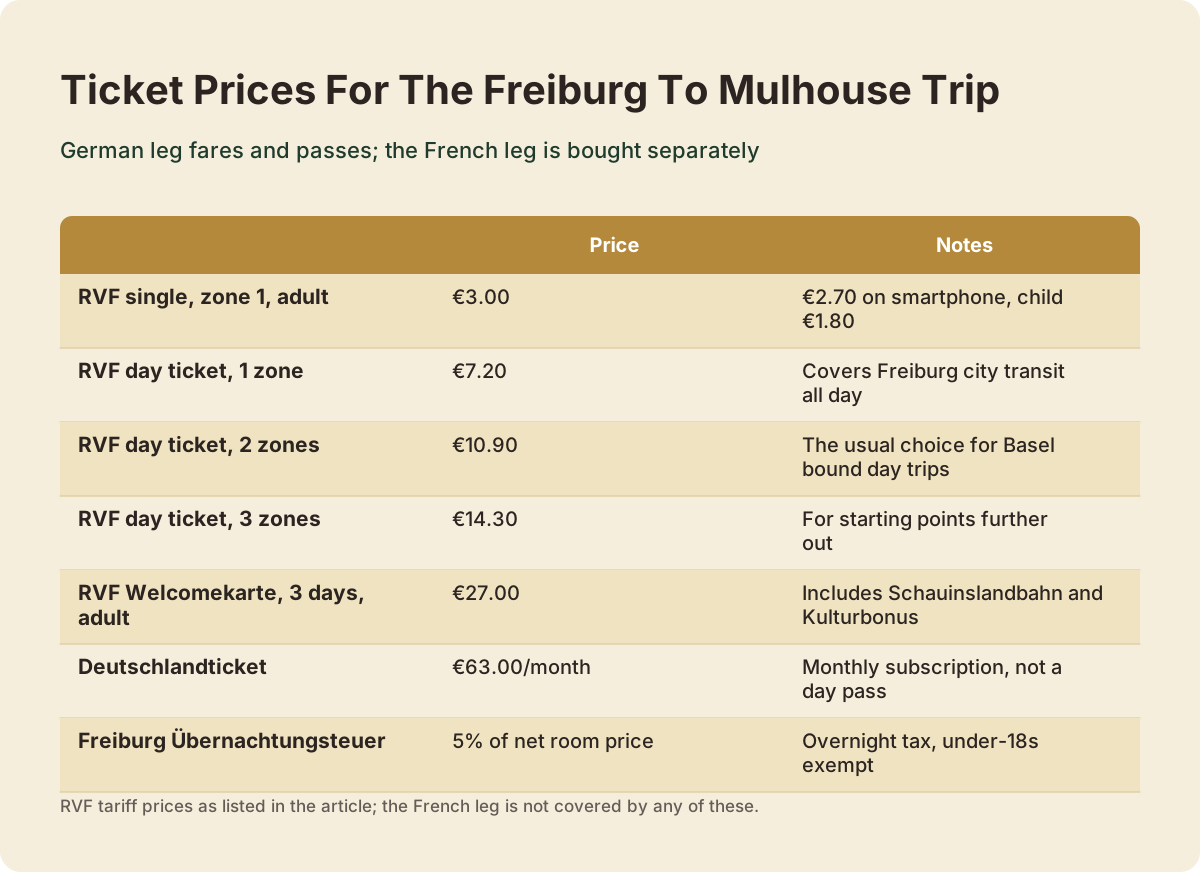
The German leg is the easy one. Freiburg's Hauptbahnhof sits on the Rheintalbahn, the main line running south toward Basel, and regional trains on that corridor run frequently through the day. Fares on the Freiburg side follow the RVF tariff: a single for one zone is €3.00 at a machine or €2.70 on a smartphone, a child pays €1.80, and day tickets run €7.20 for one zone, €10.90 for two, €14.30 for three. A day tripper heading to Basel will typically be looking at the two-zone day ticket. The details are on RVF's fare pages, which also cover the Welcomekarte.
The visitor card deserves a word because it is widely misunderstood. The RVF Welcomekarte, three days at €27.00 for an adult, covers buses and trains across the region and includes the Schauinslandbahn cable car plus a Kulturbonus for culture venues. It is the product for visitors staying in Freiburg. It is not the KONUS card: Freiburg is not a KONUS municipality, and no hotel stay in Freiburg hands you one. And neither card follows you into France, so from Basel onward you are on French ticketing for the Mulhouse leg.
One timing warning belongs in every Mulhouse plan. The Rheintalbahn is in the middle of years of construction for the Karlsruhe to Basel four-track expansion, and 2026 has seen repeated full weekend closures with replacement buses between Freiburg and Basel, including stretches in August, September and early October. Deutsche Bahn and local press publish the closure windows as they firm up; Badische Zeitung's report on the October closure is a typical example of what to check in the week before you travel. A closure turns a routine hop into a bus transfer, so it changes the shape of your day even when the trains still get you there.
Freiburg's Hauptbahnhof itself is under modernization from September 2026 until around December 2028, with platform renewals and new lifts staged so that the station keeps running. Allow a few extra minutes on the day, and if you are traveling with a wheelchair or heavy luggage, check the current platform access before you go, because the northern underpass works change the accessible routes during construction.
For travelers coming from further afield, the airport angle matters: Mulhouse is the closest French city of size to EuroAirport, and the airport's own summer 2026 schedule added eight new direct destinations including Stockholm, Warsaw, Podgorica and Lille, as the airport's summer 2026 schedule announcement sets out. If your Mulhouse day is the first or last of a trip built around a Basel airport arrival, the geography works strongly in your favor.
What A Day In Mulhouse Actually Looks Like
A sensible Mulhouse day leaves Freiburg mid-morning, arrives in France around lunch, spends the afternoon on the city's museums and old-town core, and returns through Basel in the early evening. The city's draw is its industrial and design heritage presented in large former factory buildings, and its center is compact enough that one afternoon on foot covers the historical streets, the museums needing the most time of anything you will do.
Start with realistic expectations. Mulhouse is not Strasbourg, and the pleasure of it is not a single postcard square. It is a city whose wealth came from textiles and engineering, and whose museum scene tells that story. If your frame of reference is the open-air farmyard feel of Freiburg's Mundenhof or the art collections of the Augustinermuseum, think instead of big halls, machines and printed fabric. That is a compliment: two of the city's museums have international reputations precisely because they are what they are, and they are the reason many Freiburg visitors make the crossing.
Lunch is easy to get right. Mulhouse is a French city at French lunch prices in euros, and the everyday bakery and bistro layer is exactly what a day tripper wants: fast, cheap, no reservation. France and Germany share the currency, so there is nothing to change and no exchange rate to compute in your head. Dinner, if you stay that late, is served at French hours, which start later than Freiburg's. Most day trippers eat their main meal at lunch in Mulhouse and are back in Germany for the evening.
The old-town core is walkable and modest. Give it an unhurried hour between or after museum visits rather than treating it as the destination itself, the way you might in Colmar. The Markthalle habit from home translates well: buy something at a market stall or bakery in the morning and eat it in a square, rather than hunting for a formal sit-down lunch that eats your museum time.
The return leg is where planning pays off. Trains back through Basel run into the evening, but the connection window at Basel can be tight depending on the hour, and the last thing you want after a long museum day is a sprint with a missed connection behind it. Work backward from the German timetable: pick your Basel departure first, then let it set your Mulhouse departure. On weekends, remember the Rheintalbahn closure risk applies in both directions.
What The Trip Costs And How To Buy Tickets
The German leg costs €3.00 as a zone one single or €7.20 as a one-zone day ticket, with a two-zone day ticket at €10.90 and the three-day RVF Welcomekarte at €27.00; the French leg from the border is bought separately, with no cross-border pass covering both. Meals and everything in Mulhouse are in euros.
The ticket split is the single most practical thing to understand about this trip. No single pass covers Freiburg to Mulhouse. Your RVF ticket, whatever form it takes, covers you to the German side of Basel; from there you buy a French ticket for the onward leg. Neither the Welcomekarte nor a Deutschlandticket, which is €63.00 per month, crosses into France for this journey. Budget in two ticket purchases and the trip becomes simple; plan around one pass and you will be buying the second one at a border station anyway. The rest of the planning pages sit on Freiburg Travel Guide.
| Item | Price | Notes |
|---|---|---|
| RVF single, zone 1, adult | €3.00 | €2.70 on smartphone, child €1.80 |
| RVF day ticket, 1 zone | €7.20 | Covers Freiburg city transit all day |
| RVF day ticket, 2 zones | €10.90 | The usual choice for Basel bound day trips |
| RVF day ticket, 3 zones | €14.30 | For starting points further out |
| RVF Welcomekarte, 3 days, adult | €27.00 | Includes Schauinslandbahn and Kulturbonus |
| Deutschlandticket | €63.00/month | Monthly subscription product, not a day pass |
| Freiburg Übernachtungsteuer | 5% of net room price | Overnight tax, under-18s exempt |
Note what the Welcomekarte does beyond transit: the Schauinslandbahn inclusion alone changes the arithmetic of a Freiburg week, since the cable car's adult return is €15.00 on its own. A visitor spending three or more days in the region and planning any travel beyond Mulhouse should do the sum with that inclusion in mind, because the card can pay for itself on non-Mulhouse days. On the Mulhouse day itself, a plain day ticket is usually the right choice.
On the French side, buy at the station or in the app of the French operator when you make the Basel onward connection, and keep both tickets until you are back on German soil, since fare inspection can happen on either national network. The whole region is one fare-checking zone of habits, not one tariff.
Picking Your Season For The Crossing
The best window for a Mulhouse day trip mirrors Freiburg's own: late spring through early autumn, when the Freiburg normals show means of 14.9°C in May and 15.4°C in September against 2.5°C in January, and the indoor-heavy Mulhouse plan doubles as bad weather insurance anyway. Rain peaks in May at 103.4 mm, so the museum city is best treated as the flexible day in your week.
That flexibility argument deserves a table, because Freiburg's climate data makes it concrete. Freiburg is one of Germany's warmest and sunniest cities, with an annual mean of 11.0°C and 1,815.1 hours of sunshine in the 1991 to 2020 normals, but it is neither the warmest nor the sunniest place in the country, and its summer rain is real.
| Month | Mean temp | Rain | Sunshine | Mulhouse day fit |
|---|---|---|---|---|
| March | 7.0°C | 54.3 mm | 146.8 h | Good: shoulder season, quiet trains |
| May | 14.9°C | 103.4 mm | 206.8 h | Mixed: warmest spring, wettest month |
| July | 20.1°C | 92.2 mm | 252.2 h | Strong: longest days, fullest schedules |
| September | 15.4°C | 77.4 mm | 176.2 h | Excellent: warm, drier, quieter |
| November | 6.1°C | 66.2 mm | 66.6 h | Fine for museums, short days |
| December | 3.4°C | 66.9 mm | 56.3 h | Possible, but see the market note below |
There is a seasonal collision worth planning around: the Christmas period. Freiburg's own Weihnachtsmarkt runs 19 November to 23 December 2026 across Rathausplatz and the other old-town squares, and it is a genuine anchor that pulls evening plans back homeward. Doing Mulhouse in December is perfectly possible, but you are trading against evenings you might rather spend at the market. The clean solution is a rule of thumb: Mulhouse on any day, but not on a day when you would otherwise be at the market, and never as a substitute for it.
Autumn also carries the specific operational warnings from the transport file. The Schauinslandbahn closes 16 November to 4 December 2026 for its annual overhaul, which does not affect the Mulhouse route but does scramble many travelers' regional assumptions about what is running. And the October 2026 Rheintalbahn closure window sits exactly in the prettiest shoulder-season weeks for this trip. Check the construction calendar before committing to a date in October or November.
Mulhouse, Basel And Colmar: Choosing Between The Three
If your trip allows only one cross-border day from Freiburg, choose Basel for Swiss museums and the Rhine, Colmar for the storybook Alsace, and Mulhouse when you have already done those or want a French city at euro prices with big industrial museums and thinner crowds. All three share the same first leg through Basel, so you can even defer the final choice to the platform.
That last point is the quiet superpower of Freiburg's position. Every one of the three classic cross-border day trips starts with the same Freiburg to Basel train ride. The decision that differentiates them happens at Basel, which means a genuinely flexible traveler can leave Freiburg with two plans and pick in the station based on weather, mood or how the knees feel. Compare the three on what actually differs:
| Day trip | Country | Character | Best for | Watch out for |
|---|---|---|---|---|
| Basel | Switzerland | Museums, Rhine, old town | Art and a big-city day | Swiss prices, francs not euros |
| Colmar | France | Canals, half-timbered old town | The postcard Alsace | Crowds at peak, very touristy core |
| Mulhouse | France | Industrial museums, working city | Rainy days, museum lovers, second visits | Plain center, less obvious charm |
Mulhouse is also the natural pairing with the airport. If your itinerary has you arriving or departing through EuroAirport, the French city sits on the airport's side of the border, and the Freiburger Reisedienst airport bus runs daily between Freiburg and the terminal in about an hour, which makes a fly-out morning after a Mulhouse evening, or a landing-day trip in the other direction, far more plausible than the map suggests. The airport has been in the middle of a large investment cycle, with runway renovation in spring 2026 and South Gates modernization beginning the same year, and its visitor terrace partially reopened in late 2025, so an airport-adjacent day has gotten more comfortable too.
For travelers who want the deeper Alsace experience rather than a single city, the wine route pages collect the region's towns: the Alsace wine route from Freiburg shows how a rental-car day strings Colmar, Eguisheim-type villages and vineyard stops together, and Mulhouse slots naturally onto the southern end of that route if you would rather drive than ride. By rail, the string is harder: the villages are scattered, and Mulhouse is best kept as its own dedicated train day.
Evening Plans Back In Freiburg
Returning from Mulhouse puts you back in Freiburg with the evening intact, and the city's evening economy runs from traditional taverns to themed walking shows: a guided pub crawl with drinks runs about four hours from $51 and rates 4.4 across 107 reviews, while the culinary tour of Freiburg, about two hours from $61, is too new to have enough reviews for a star rating. Book the evening before you leave in the morning, since popular slots fill.
The pub crawl is the straightforward choice after a long travel day. You come back through Basel, drop into your hotel, and let someone else do the route-finding across Freiburg's bars for the next four hours. Its 4.4 across 107 reviews is one of the larger review pools among Freiburg's evening products, so the rating has some statistical weight behind it. The culinary tour is the other flavor of evening: about two hours, from $61, built around the food of the old town, but it shows only 2 reviews, too few for a star claim, so treat it as a promising newcomer rather than a proven quantity.
Food-first travelers should also look at the city's restaurant and tavern scene, which had its own news this year: Augustiner am Platz, the first Augustiner Wirtshaus in Baden-Württemberg, opened in October 2025 on Augustinerplatz after a six-month conversion, pouring the Munich brewery's beers alongside Badische specialties, and the Trotte wine bar opened in Fischerau with around 400 wines, twelve by the glass. The café scene lost a fixture too, Café Melange closing in August 2026 after 29 years, which is a fair reminder that the local map shifts more than guidebooks admit.
The seasonal headline, though, is the one this site keeps returning to: from 19 November to 23 December 2026, the Christmas market takes over the old town with over 120 stands, free entry, and opening hours that run to 20:30 on weekdays. If your Mulhouse day falls inside that window, plan the return train so you land in Freiburg with the market still lit: coming back through Basel in the late afternoon gives you the Rathausplatz stalls at their most atmospheric, the smell of mulled wine and bratwurst doing exactly what it is supposed to do after a cold day of French museums. The market's closed on Totensonntag, 22 November, a Protestant observance that catches visitors out every year.
For a livelier December evening, the Christmas drag show walk with Betty BBQ, rated 4.6 across 55 reviews and from $43, is the seasonal counterpart to the city's year-round drag show walk, and it slots neatly into the same window between the market and dinner. Check availability before you leave for France in the morning so the evening is locked in.
Common Questions About Mulhouse
How do I get from Freiburg to Mulhouse?
Take a train from Freiburg toward Basel, using an RVF ticket for the German leg, then change onto a French train from Basel toward Mulhouse and buy that ticket separately from the French operator. There are no border checks, since Germany and France are both in the Schengen area, and both use the euro. Check for Rheintalbahn construction closures before you travel, since they add replacement buses on some weekends.
Do I need a passport to visit Mulhouse from Freiburg?
No border control is carried out on this route: Germany and France are both parties to the Schengen agreement, so you cross without formalities. You should still carry ID, as both countries can conduct police checks and airlines and some ticket checks require identification. A national ID card or passport is the standard document either way.
Does the Freiburg Welcomekarte cover travel to Mulhouse?
No. The RVF Welcomekarte, three days at €27.00 for adults, covers buses and trains within the German RVF network plus the Schauinslandbahn, but it does not extend into France. The Mulhouse leg from Basel onward is bought separately on French ticketing. Freiburg is also not a KONUS municipality, so no hotel stay there issues a KONUS card.
Is Mulhouse worth a day trip from Freiburg?
Yes, if you want a French city with major industrial museums at euro prices rather than a postcard old town. Mulhouse rewards travelers who have already seen Colmar or Basel, and its indoor focus makes it a strong pick on a rainy day. If it is your only Alsace day and you want the classic half-timbered look, choose Colmar instead.
When is the best time of year for a Mulhouse day trip?
Late spring to early autumn is the comfortable window: Freiburg's normals show means of 14.9°C in May, 20.1°C in July and 15.4°C in September, against 2.5°C in January. September is the sweet spot for warmth, drier weather and quieter trains. Avoid the early October 2026 Rheintalbahn closure window if you can, and on weekends generally check construction calendars before committing.
Can I combine Mulhouse with the EuroAirport?
Yes, and it is one of the more practical pairings in the region. Mulhouse is the closest sizeable French city to EuroAirport Basel-Mulhouse-Freiburg, whose summer 2026 schedule added eight new direct destinations. The Freiburger Reisedienst airport bus runs daily between Freiburg and the terminal in about an hour, so a fly-out day or a landing-day trip can be built around the same geography.
The pattern underneath all of these answers is the one worth keeping: Freiburg sits at the center of a three-country travel zone where the hard edges, currencies aside, have been sanded down to a train change in Basel. Mulhouse is the least touristy of the French options across that border, and the one that rewards a second visit or a rainy forecast. Do the ticket split right, dodge the construction weekends, and the day runs itself.