Breisach From Freiburg: A Rhine And Wine Day Trip
Breisach is the wine town where the Rhine, the French border and the Kaiserstuhl vineyards meet, and it is an easy local ride from Freiburg. Here is what to see, what it costs to get there and when the wine festivals happen.
Short answer
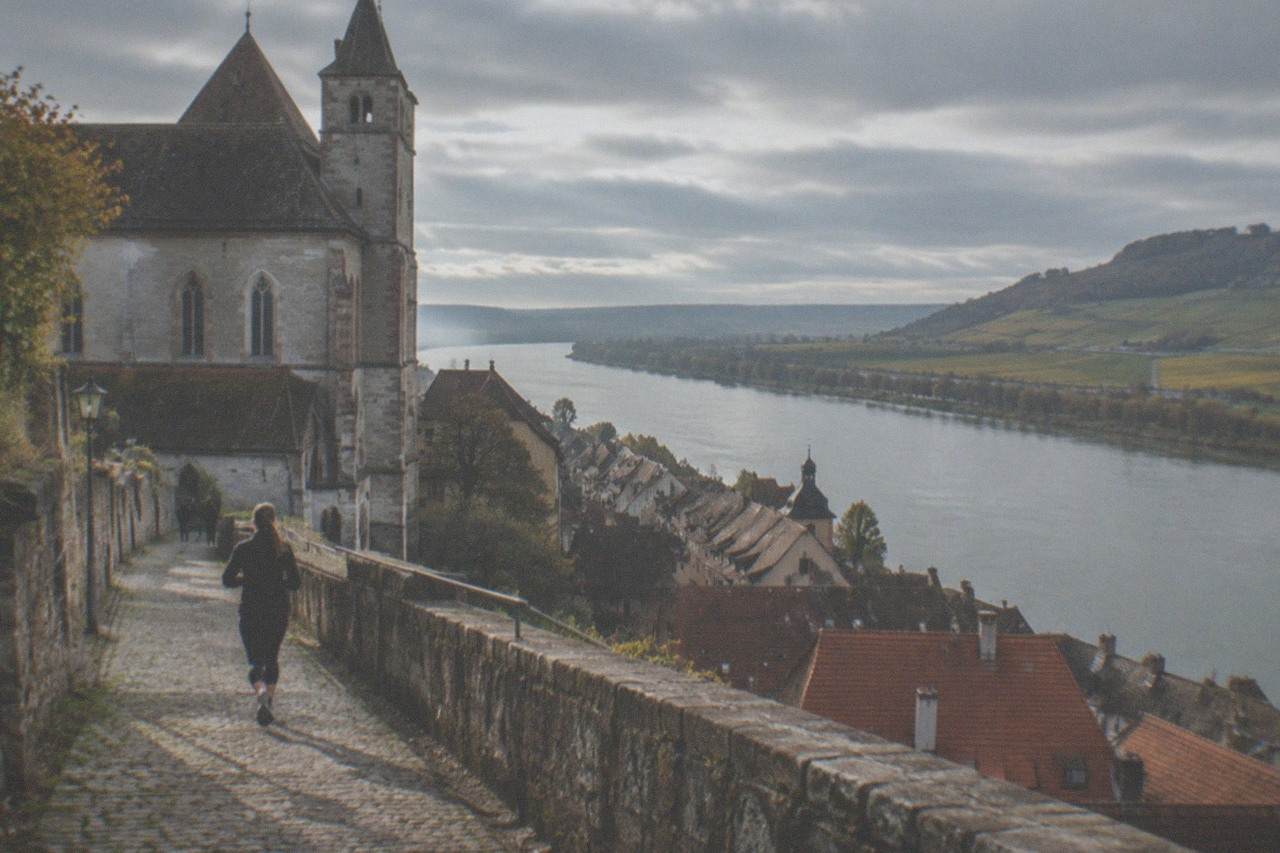
Breisach is a small hilltop wine town on the German bank of the Rhine, across the water from France and at the western edge of the Kaiserstuhl and Tuniberg vineyards. You reach it on local trains and buses under the RVF fare system. The draws are the Stephansmünster, the riverbank and wine: the Breisach wine festival runs 28–31 August 2026.
What Is Breisach And Why It Deserves A Day
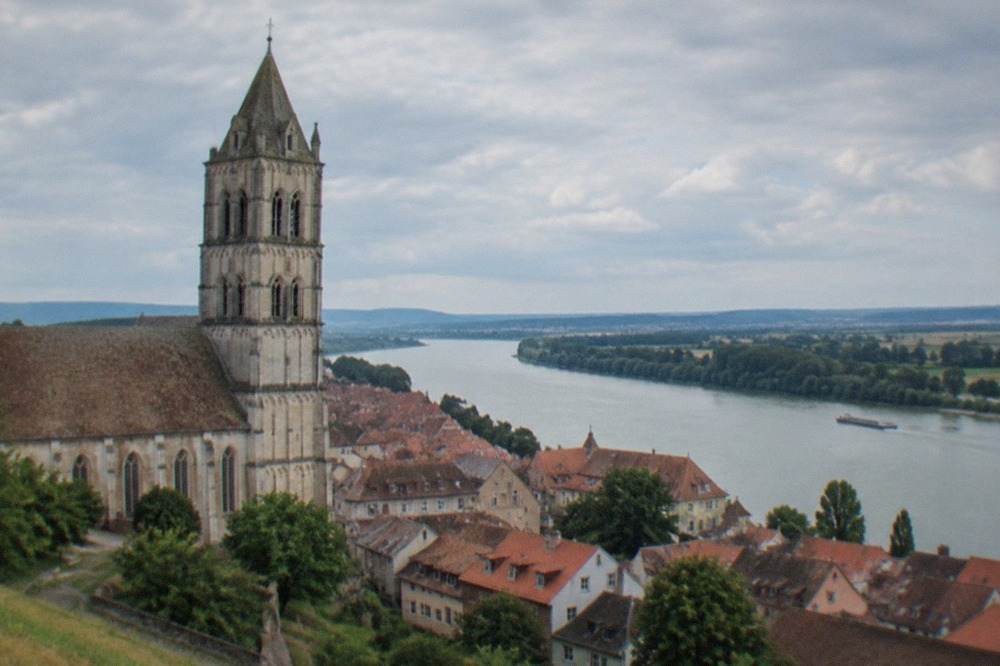
Breisach is a hilltop wine town on the German bank of the Rhine, directly across the river from France and wedged between the Kaiserstuhl and Tuniberg vineyard regions. It is small, compact and built around one dominant landmark, the Stephansmünster, which makes it a low-effort, high-reward day trip from Freiburg when you want wine country and a border river in one stop.
Most people arrive in Freiburg with a list that reads Münster, Bächle, Schlossberg, maybe a Black Forest loop. Those are the right first moves, but the immediate region holds quieter wins, and Breisach is one of them. The town sits where the upper Rhine plain flattens out into wide water and far bank, so the moment you climb toward the minster you get a view that the Freiburg old town simply cannot offer: France, on the other side of a broad river, with vineyards rolling away on your own side. For a trip built around this Freiburg Travel Guide material, Breisach is the day that changes the scenery.
The town's identity is wine before anything else. It shares its festival calendar with the Kaiserstuhl and Tuniberg grower communities, and the local wine festival, the Weinfest Breisach with the Kaiserstuhl and Tuniberg associations, fills the town at the end of August. If your dates line up, that weekend is the single best time to visit. If they do not, the hill, the minster and the riverbank are permanent, and they carry the trip on their own.
What Breisach is not: a second Freiburg. There is no tram network, no university quarter, no shopping street to speak of. It is a town you visit at walking pace for half a day or a full day, ideally with a glass of local Spätburgunder somewhere in the middle, and then carry back to the city. That modest scale is exactly why it works so well as a day trip rather than a base.
Getting To Breisach From Freiburg
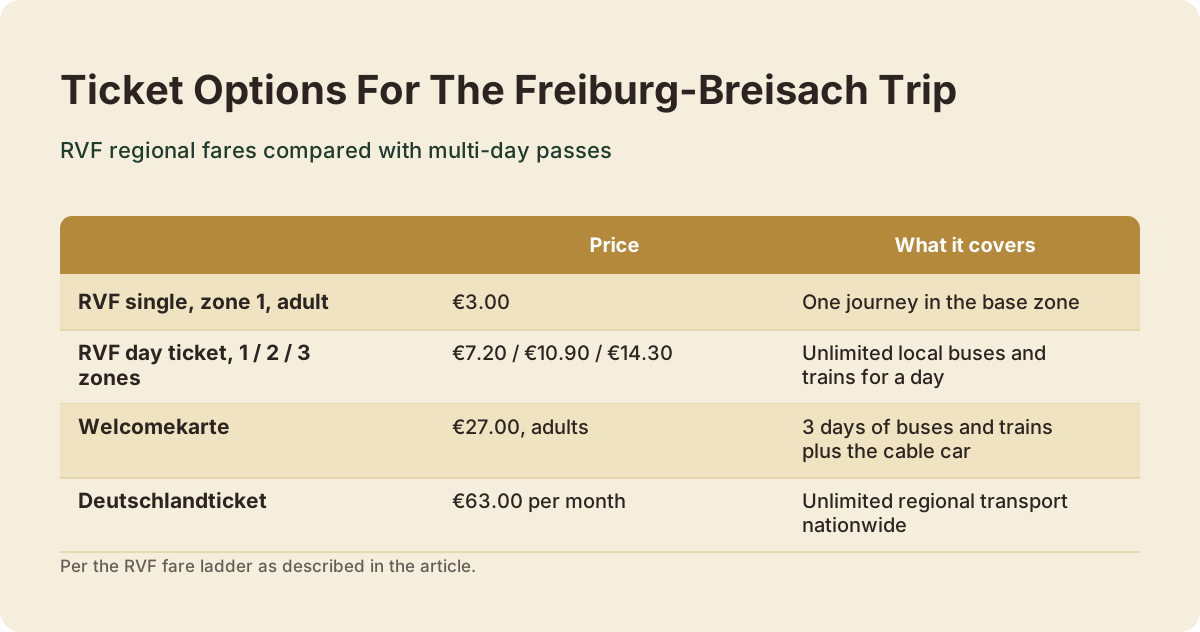
Breisach sits on the local rail network that radiates out of Freiburg, so the trip runs under the RVF regional fare system rather than long-distance pricing. A zone 1 single costs €3.00, day tickets run €7.20 to €14.30 depending on zones, and the 3-day Welcomekarte at €27.00 for adults covers buses and trains and even includes the Schauinslandbahn cable car plus a Kulturbonus for cultural venues.
The practical point is that you do not need a car. Local trains and buses link Freiburg with the surrounding communities on the standard RVF fare ladder, and the price of your ticket depends on how many fare zones you cross, not on which operator runs the vehicle. Check the zone count for your specific journey on the RVF tariff pages before you buy, because a day trip that crosses more zones costs more than the zone 1 baseline quoted above. Buying singles on a smartphone is slightly cheaper than at the machine, at €2.70 for a zone 1 adult single, with child singles at €1.80.
For visitors staying several days, the arithmetic usually favors the Welcomekarte. Three days of buses and trains, the cable car inclusion, and the cultural bonus make it the natural choice if Breisach is one of two or three regional outings you have planned. The Deutschlandticket at €63.00 per month only makes sense for a longer stay, but it is worth knowing it exists as the flat monthly option.
| Ticket | Price | What it covers |
|---|---|---|
| RVF single, zone 1, adult | €3.00 | One journey in the base zone; smartphone version €2.70, child €1.80 |
| RVF day ticket, 1 / 2 / 3 zones | €7.20 / €10.90 / €14.30 | Unlimited local buses and trains for a day within the zones chosen |
| Welcomekarte | €27.00, adults | 3 days of buses and trains, the Schauinslandbahn cable car, and a Kulturbonus |
| Deutschlandticket | €63.00 per month | Unlimited regional transport nationwide for the calendar month |
One planning note worth flagging: regional engineering works do interrupt individual lines for weekends and week-long stretches, so if your Breisach day is fixed, glance at current operator notices before you set out. Replacement buses are the standard fix and they do get you there, just less charmingly. The full RVF tariff overview is the source for any fare detail beyond the table above.
If your Breisach day is part of a wider first visit, you may also want someone else to handle the Freiburg side of the trip. Some travelers book a guided element for the city and keep Breisach as the free-form half, others prefer a guided option for everything. The selection below shows the kind of private and transfer products available around Freiburg, including the direct airport bus that many visitors use on arrival day before a trip like this.
The Stephansmünster And The Old Town On The Hill
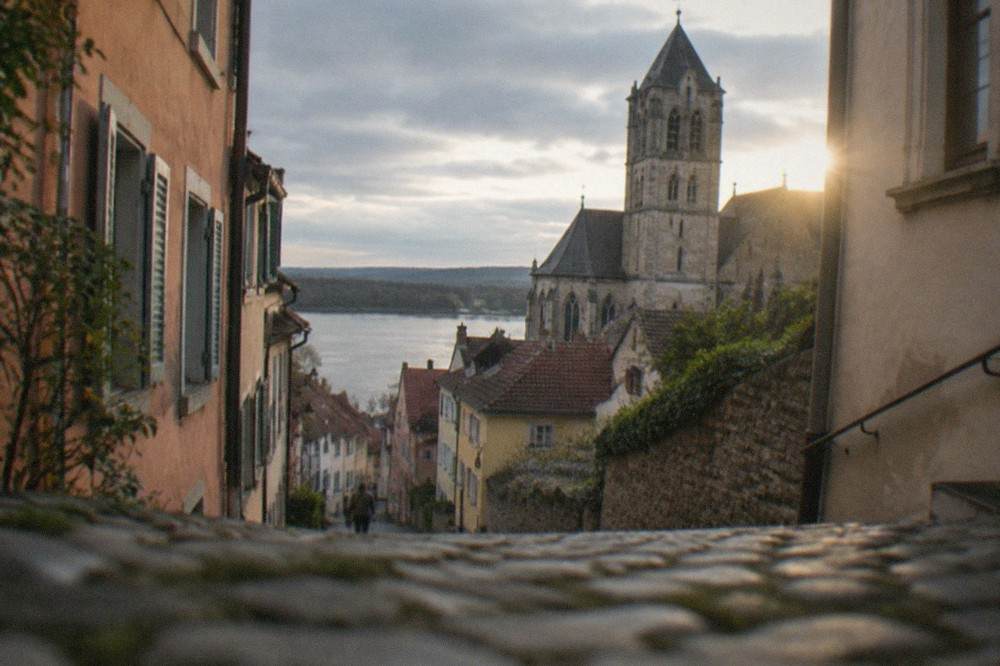
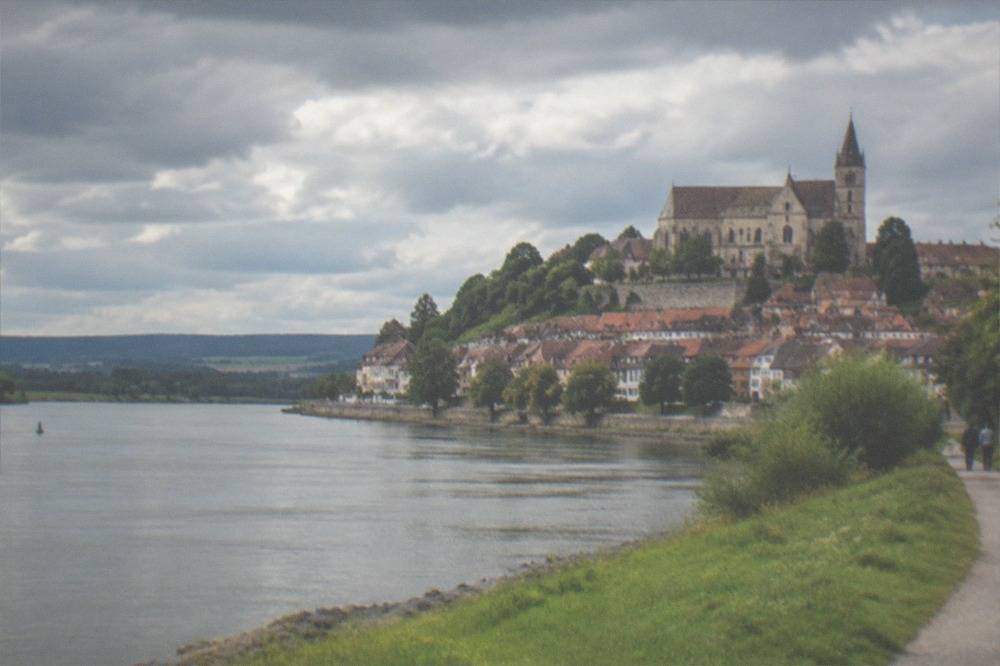
Breisach's old town climbs a single hill above the Rhine, and the Stephansmünster stands at its top as the town's one unmissable sight. The church dominates the skyline from every approach, the lanes around it are short and steep, and the whole ensemble is small enough to see properly in a couple of unhurried hours, leaving the rest of the day for the riverbank below.
The minster is the kind of building that gives the town its silhouette. You see it from the plain long before you see the town itself, and from the churchyard the land drops away on one side toward the river and toward France beyond it. That single viewpoint is the reason most people make the trip: it compresses the geography of the whole border region into one glance, vineyards on your side, wide water in the middle, another country on the far bank. Walk the churchyard circuit slowly, then pick a lane downhill and let the old town unfold.
Below the minster, the streets are a compact web rather than a grid. There are town houses, wine taverns, small squares and the sort of shop mix you expect in a town whose weekday population is modest: baker, pharmacy, wine merchant, café. Nothing here demands a schedule. The pleasure is in the walking itself, up one spine, down a parallel lane, pausing wherever a doorway or a painted facade earns a second look. Because the town is a hill, reasonable shoes beat anything fashionable.
| Sight | What it is | How long to allow |
|---|---|---|
| Stephansmünster | The hilltop minster and churchyard, the town's landmark and best viewpoint | 45 to 60 minutes, longer if you linger |
| Old town lanes | Steep streets of town houses, taverns and small squares below the church | 1 to 2 hours at strolling pace |
| Rhine promenade | The riverbank walk below the hill, open views toward France | 1 hour, easy and flat |
| Vineyard paths | Trails leaving the town into the surrounding Kaiserstuhl and Tuniberg slopes | Half a day if you walk out properly |
One pairing worth considering: many visitors do Breisach self-guided and then book a guided walk for Freiburg's historic center on a separate day, where the interpretive value is higher because the city's story is denser. The product called Walking and Strolling the Historic Center runs about 2 hours from $228 and currently has six reviews, too few for a reliable star rating; treat it as an intimate, small-group-or-private format rather than a crowd-verified classic. The historic center walk details page has the full breakdown.
A different approach suits different travelers. If your group is mixed ages or you simply do not want to manage logistics in a foreign language, a private format removes nearly all friction, and Breisach's compactness means a private guide there is short and cheap compared with the equivalent in a big city. Ask yourself honestly whether the hilltop lanes need narration, or whether the money is better spent on the food and wine. In Breisach, that is a real question, and the honest answer usually favors the glass.
Would A Guided Option Save Your Breisach And Freiburg Days?
For most travelers the answer is a qualified yes on the Freiburg side and a clear no in Breisach itself: the hill town is compact, signposted and perfectly enjoyable self-guided, while Freiburg's denser old town rewards a guide who can put the Münster, the gates and the medieval layout into context. Decide by format and language needs rather than by price alone, and keep any booking flexible in case a wine festival date changes your plans.
If deciding between a self-guided hill town and a booked walk feels like extra work, you can compare the current options in one place before committing.
Wine Country: Kaiserstuhl, Tuniberg And The Festival Calendar
Breisach is a wine town first, sitting at the western edge of the Kaiserstuhl and between it and the Tuniberg, and its calendar is built around grower festivals. The big local date is the Weinfest Breisach with the Kaiserstuhl and Tuniberg associations, running 28–31 August 2026, while Freiburg's own Münsterplatz wine festival drew around 110,000 guests over six days in early July 2026.
The Kaiserstuhl wine region is the name most visitors arrive knowing, and Breisach functions as one of its gateways. The volcanic hills behind the town carry vineyards up their slopes, and the walking paths that leave the old town thread straight into them. You do not need a car or a reservation to taste the region: taverns in town pour local wines by the glass, and the festival calendar does the rest. The Baden wine traditions that shape the whole area, Spätburgunder above all, are the frame for everything in the glass here.
The festival circuit is where Breisach earns its reputation as a wine town rather than a town with wine. Freiburg sets the tempo in early July, Staufen hosts the Markgräfler Weinfest at the end of that month, and Breisach itself takes the turn of August into September, when the grower associations from both hill regions fill the town. Per the regional festival calendar, the dates hold across the whole upper Rhine wine country. In autumn the tastings continue indoors with the KaiserHerbst series.
| Festival | Where | 2026 dates |
|---|---|---|
| Freiburger Weinfest | Münsterplatz, Freiburg | 2–7 July, around 110,000 guests, free entry |
| Markgräfler Weinfest | Staufen | 31 July to 3 August |
| Weinfest Breisach, Kaiserstuhl and Tuniberg | Breisach | 28–31 August |
| KaiserHerbst tasting series | Various Kaiserstuhl venues | Around 10 October to 8 November |
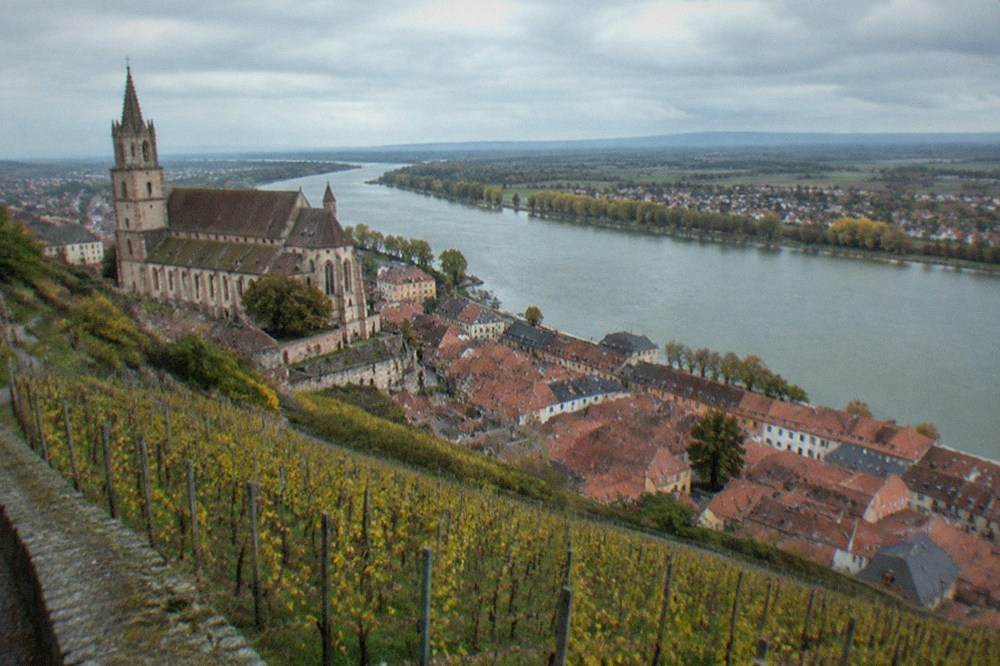
If you would rather walk the vines with a guide than read a map of them, the region offers that too. Veni, Vidi, Vino is a wine hike and tasting that runs about 2.5 hours from $79, rated 4.4 across 167 reviews, and it captures exactly the hill-and-glass rhythm that draws people to this corner of Baden. The wine hike and tasting details are worth a look if your Breisach day is flexible on format. If the dates line up with your trip, Check availability before the festival-season slots fill.
The Rhine, The Border And River Walks
The Rhine at Breisach is a border river in the plainest sense: wide, slow and lined with paths, with France visible on the far bank from the hill and the promenade below. The riverbank is flat, easy walking and completely free, and it gives the day its second half after the climb to the minster, a contrast between the steep little town above and the wide water beside it.
Stand at the churchyard wall and the geography explains itself. The river here is not a mountain torrent but a broad lowland artery, and the land on both sides is given over to agriculture, vines and small settlements. The French bank is close enough to pick out fields and rooftops, which does something odd and pleasant to your sense of scale: you are looking at another country the way you might look across a lake. That proximity is the quiet selling point of Breisach compared with hill towns further inland.
The walk along the bank is unstructured by design. Take the promenade, follow the water in either direction, and stop when the view suits you. In summer the path is a genuinely local space, walkers and cyclists rather than tour groups. If you are touring with children or anyone who tires on hills, this flat stretch balances the morning's climb and makes the town work as a full day rather than a two-hour stop.
Border towns also make good conversation pieces for the trip home. Breisach's position has shaped it for centuries, contested and shared, and the modern practicality is calmer: two countries, one river, bridges and crossings a short drive away. You will not need a passport for the German side, obviously, but if you plan to hop across to the French bank by bike or car later in your trip, carry your documents as normal. For a wider loop that takes in the French side properly, the Colmar and Alsace day trip connects naturally with this one, since both sit in the same borderland.
How Breisach Fits A Freiburg Itinerary
Breisach works best as a half-day or relaxed full-day outing slotted alongside city days in Freiburg, usually on day three or four of a first visit once the Münster, the old town and a viewpoint have been covered. Pair it with the Kaiserstuhl for a wine-focused double, or with a Black Forest day for contrast, and keep it away from the day you arrive or depart.
The simplest pattern looks like this. Days one and two in Freiburg: the Münster and market square, the Bächle lanes, Schlossberg, a museum or two, dinner in the old town. Day three, Breisach, morning hill and minster, riverbank in the afternoon, an early glass of local wine before heading back. Day four and beyond: the Black Forest or the Alsatian crossings, depending on which direction pulls harder. Breisach slots in at the point where travelers start itching for a second texture, and it delivers that without a long journey.
If you are building the trip around wine, make Breisach the anchor of a vineyard day rather than a standalone. The Kaiserstuhl trails leave from near the town, and the grower festivals in late summer mean a single well-timed visit can cover hill, church, river and a proper festival crowd in one go. If you are building around families, the flat riverbank and the easy local ride make this one of the lower-friction regional outings, with no mountain roads and no long transfers.
Language is a real consideration for some groups. German is the working language of the town, English works in tourist-facing businesses but less universally than in Freiburg, and if your party speaks Italian, there is even a dedicated private option: the Old Town Private Walking Tour in Italian runs about 1.5 hours from $51 with eleven reviews so far, too few for a star rating, and the Italian-language private tour details are on its page. For most English-speaking visitors the choice is simply between the private formats and going self-guided, and Breisach rewards the self-guided approach generously.
What To Eat And Drink In Breisach
Eating in Breisach means Baden wine tavern food: the ham, the onion tart, the sausage and trout traditions of the upper Rhine, washed down with local Spätburgunder and Weissherbst. Portions are generous, prices are tavern-level rather than fine-dining, and the best plan is one proper sit-down meal plus a market or bakery stop rather than grazing your way through the day.
Order the classics and you cannot go far wrong. Onion tart is the region's signature bake, and it appears everywhere in the wine country, festival stalls included. The cured ham of the Black Forest tradition shows up on every serious tavern board. Trout comes from the streams and ponds of the hills and is the region's most reliable plate. Pair any of it with a glass of what grows on the slopes you walked in the morning, and the meal explains the landscape better than any plaque.
The taverns in the old town are where the festival energy lives outside festival weekends. Some are grower-run, pouring their own estate wines in plain rooms, others are fuller restaurants with terraces that catch the afternoon light. In late August the Weinfest converts much of this into open-air eating anyway, with stands run by the Kaiserstuhl and Tuniberg associations, so if your dates overlap the festival, plan to eat at the stands and skip the sit-down booking entirely.
Two practical notes. First, the hill is steep enough that a big lunch before the climb is a mistake; eat after the minster, not before it. Second, Sunday and Monday openings in small German towns can be thin, so if your Breisach day falls early in the week, buy picnic material in Freiburg before you travel and let the riverbank be your dining room. A bottle from the local merchant plus the promenade is a perfectly respectable Baden lunch.
When To Go: Weather, Seasons And The Festival Dates
The best time for Breisach is late April through October, with the vineyard walk at its greenest in spring, the long hot days of July and August suiting the riverbank and festivals, and harvest season giving the wine its annual narrative. July averages 20.1°C with 252.2 sunshine hours in the nearby Freiburg readings, while October still manages 10.9°C and the KaiserHerbst tastings run into November.
The climate here is the upper Rhine plain at its friendliest, one of Germany's warmest and sunniest corners without any overstated superlatives about records. The readings below come from the official 1991–2020 normals for the Freiburg station, the nearest long-term record, and they hold well for the whole plain including Breisach. Rain falls somewhere in every month, but the summer half-year carries the sun, and May through August is when the riverbank and vineyard paths earn their keep.
| Month | Mean temperature | Sunshine hours | Rainfall |
|---|---|---|---|
| April | 10.8°C | 182.2 h | 63.8 mm |
| July | 20.1°C | 252.2 h | 92.2 mm |
| September | 15.4°C | 176.2 h | 77.4 mm |
| October | 10.9°C | 116.2 h | 78.5 mm |
Match the month to your priority. Festival-first travelers should aim at the 28–31 August 2026 Weinfest Breisach or the early July Freiburg Weinfest, which pulled around 110,000 guests in 2026 and returns 1–6 July 2027. Harvest travelers want October, when the KaiserHerbst series runs roughly 10 October to 8 November and the vines turn. Fair-weather walkers want May through August, accepting that July and August also bring the biggest crowds to the whole region. Winter visitors can still enjoy the hill and the minster, but the tavern scene contracts and the festival calendar goes quiet, so treat a cold-season Breisach day as a short one.
Whenever you go, the structure of the day holds: up the hill first while your legs are fresh, the minster and churchyard before the sun is high, down through the lanes to a late tavern lunch, the flat riverbank walk to finish, and the local train back to Freiburg before dinner. It is a small town with one big view and one big glass, and it fills a day exactly as well as it should.
If that structure appeals but you would like the city days of your trip handled by someone who knows the ground, these are the current guided and transfer options worth comparing before you finalize the plan.
Common Questions About Breisach
Is Breisach in Germany or France?
Breisach is in Germany, on the east, German bank of the Rhine. France lies directly across the river, close enough to see clearly from the minster churchyard, but the town itself, its festivals and its vineyards are all Baden in southwest Germany.
How do I get from Freiburg to Breisach without a car?
Local trains and buses link the two under the RVF fare system. A zone 1 single costs €3.00, day tickets run €7.20 to €14.30 by zone, and a 3-day Welcomekarte at €27.00 covers regional buses and trains plus the Schauinslandbahn. Check your zone count on the RVF tariff pages before buying.
When is the Breisach wine festival?
The Weinfest Breisach, run with the Kaiserstuhl and Tuniberg grower associations, runs 28–31 August 2026. Freiburg's larger Münsterplatz wine festival precedes it in early July, drawing around 110,000 guests in 2026, and the KaiserHerbst tastings follow in October and early November.
How long should I spend in Breisach?
Half a day covers the hill, the Stephansmünster and a tavern lunch; a full day adds the riverbank walk and vineyard paths at a relaxed pace. Most visitors pair a half-day in Breisach with time elsewhere, but festival weekends justify staying for the whole day and evening.
Is Breisach worth it compared with Colmar or the Alsace towns?
They serve different moods. Breisach is a quiet, compact Baden wine town with a hilltop minster and river views, while Colmar is a larger, more polished Alsatian showpiece. If you want depth of wine country without border formalities or long transfers, Breisach wins on effort; if you want half-timbered spectacle, cross the river.
What should I eat in Breisach?
Stick to Baden tavern classics: onion tart, the region's cured ham, local trout and sausage plates, all paired with a Spätburgunder or Weissherbst from the surrounding hills. During the August wine festival, eat at the grower stands instead of booking a restaurant.