What City In Germany Is Closest To The Black Forest?
Freiburg im Breisgau is the German city closest to the Black Forest and the region's main gateway. This guide compares it with Baden-Baden, Offenburg and the other candidates, with verified fares and figures.
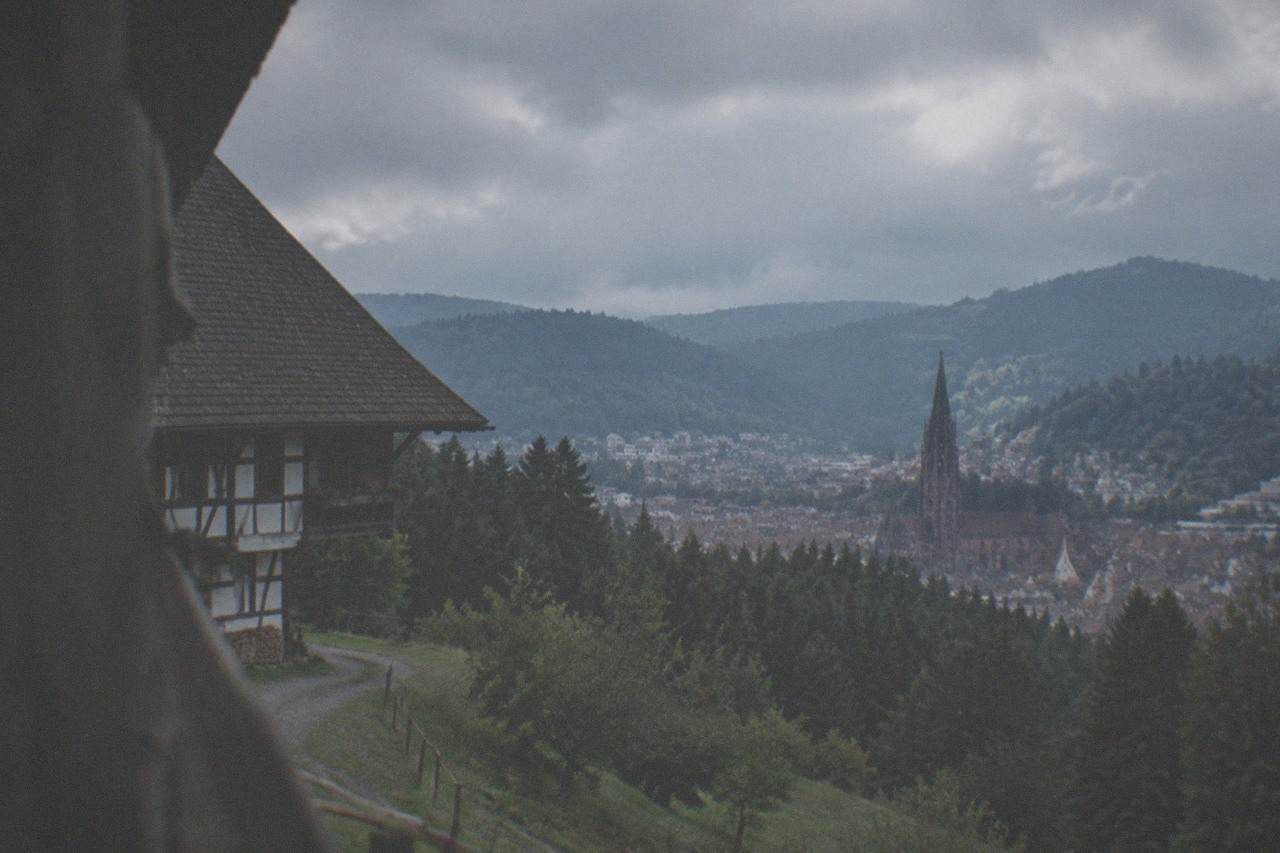
What City In Germany Is Closest To The Black Forest?
Freiburg im Breisgau is the answer most travelers are looking for. With 237,299 residents, it is the largest German city that sits directly against the western edge of the high Black Forest, and it is the transport hub from which the region's railways, cable cars and hiking trailheads are actually reached. Baden-Baden and Offenburg touch the northern fringe, but Freiburg is the city the Black Forest grew around.
The question sounds simple, and geographically it is. The Black Forest is a block of low mountains running roughly north to south along the Upper Rhine, from around Karlsruhe in the north down to the Swiss border near Basel. Cities sit on every side of it. What separates Freiburg from the rest is not just distance, it is function: the Höllentalbahn railway climbs from Freiburg into the southern highlands, the Schauinslandbahn cable car carries visitors up a 3,600 m cable to the Schauinsland summit, and the regional train network threads the whole Breisgau. The city's own tourism office markets it as the gateway for exactly that reason.
There is also a practical distinction worth making. Baden-Baden, at the northwestern corner, is closer to the northern Black Forest's spa towns and the Black Forest High Road. Basel and Mulhouse sit outside Germany altogether. If your destination is the southern Black Forest, Feldberg, Titisee, the Ravenna Gorge, the cuckoo clock villages around Furtwangen, then the nearest large German city, and the only one with direct rail lines into those valleys, is Freiburg.
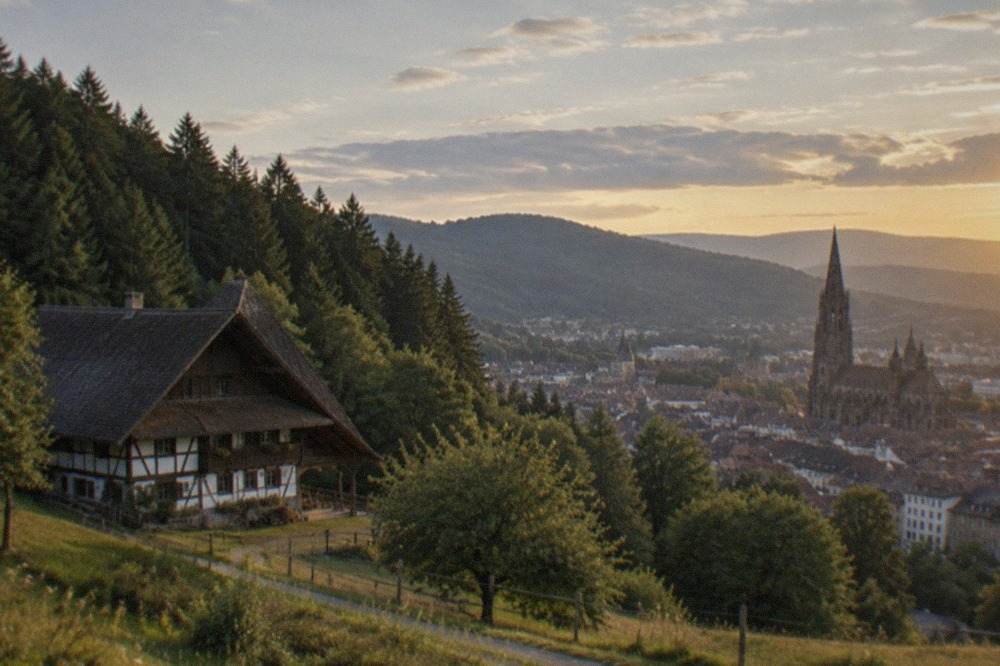
The city itself is worth an honest look before you commit to it as a base. The Freiburg Minster's west tower stands 116 m over the old town, with a climbable gallery at 70 m, and the Münstermarkt below it runs up to 130 stalls on weekdays from 07:30. A base with a working market, a free cathedral nave and a train station with direct Black Forest lines is a different proposition from a town that is merely close to the map's green area. For more on the city's own sights, see the Freiburg Travel Guide homepage, which carries the full destination coverage.
Why Freiburg Works As The Black Forest Base
Freiburg is the only major German city whose ordinary local transport already reaches into the Black Forest. The RVF Welcomekarte, at €27.00 for three days, covers regional buses and trains and includes the Schauinslandbahn cable car, something no other gateway city's visitor ticket does. The city is also the region's rail junction, with lines radiating toward Titisee, Basel and the Rhine valley.
That transport fact is the decisive one for most trip plans. A visitor staying in Freiburg buys one ticket and rides trams, buses, regional trains and the cable car on it. The Welcomekarte also includes a "Kulturbonus" for cultural venues, per the RVF's fare page. Staying in a small Black Forest town instead usually means a hotel without a rail line, and a rental car or a sequence of bus connections to get anywhere.
The card worth comparing it with is the KONUS guest card, and here a correction matters: Freiburg city is not a KONUS municipality. KONUS is issued by member towns inside and around the Black Forest, places like Kirchzarten, Horben, Titisee-Neustadt, Bad Krozingen, Staufen and St. Peter, and it gives free second-class transport across nine networks, including Freiburg's trams, from check-in to departure day. A card issued in one of those towns works on Freiburg's trams. A stay in Freiburg itself does not produce one. The official KONUS page lists the participating communities.
Freiburg's own character also earns it the base role. It is a university city, chartered in 1457, with 24,507 students in the winter semester, which means restaurants, a real evening economy and English-language services that villages of four hundred people cannot support. The Bächle, the little gutters running along the old town streets, the two surviving gates, Martinstor and Schwabentor, and the Augustinerplatz terrace steps are all within a fifteen minute walk of each other. Our Schlossberg hill and tower guide covers the viewpoint that looks back over the city toward the hills.
Before choosing accommodation, it helps to see the old town you would be staying in, and a guided walk is the fastest way to do that. The roster has one private option built exactly for this decision.
The Walking and Strolling the Historic Center tour runs about two hours from $228, in a private format, and the listing currently carries 6 reviews, too few a pool to support a star-rating claim. What a private walk buys here is the ability to ask a local guide the questions this article cannot answer for you: which neighborhood suits your pace, where the market streets empty out at night, and how the tram lines connect to the station you will depart from. For a cheaper first look, the self-guided audio tour in the same roster runs from $9.
How The Other Gateway Cities Compare
Baden-Baden is the strong answer for the northern Black Forest, Offenburg serves the western mid-section, and neither matches Freiburg's reach into the southern highlands. Stuttgart is far outside the region. Basel, Mulhouse and Strasbourg are Black Forest gateways too, but they are not German cities. Freiburg wins on size, rail links and the range of Black Forest territory reachable from it.
A fair comparison has to be honest about what each city actually offers. Baden-Baden is a spa town at the northwestern edge, well placed for the Black Forest High Road, the Mummelsee and the northern trail network, and its own thermal baths justify a stay on their own. Offenburg sits on the Rhine valley rail line and is the practical approach for the Kinzig valley towns, Gengenbach among them. Freiburg, at the southern end, has the high country: Feldberg, the highest summit in the whole range, the Titisee and Schluchsee lakes, and the deeper valleys of the Höllental region.
The table below keeps to what is verifiable rather than marketing copy. Distances between cities and specific Black Forest sights vary with the sight chosen, so the comparison is by role and rail access, not a single disputed kilometer figure.
| City | Position | Black Forest territory it serves best | Rail access into the region |
|---|---|---|---|
| Freiburg im Breisgau | Southern western edge | Southern highlands: Feldberg, Titisee, Höllental, Schauinsland | Direct lines to Titisee and the Rhine valley; cable car within the city ticket |
| Baden-Baden | Northwestern corner | Northern hills, High Road, Mummelsee, spa region | Local lines and buses; often a connection via Offenburg |
| Offenburg | Western mid-fringe | Kinzig valley, Gengenbach, central towns | Rhine valley main line, branch lines into the valleys |
| Karlsruhe | Northern tip outside | Northern fringes, Pforzheim direction | Main lines, but the city is not inside the region |
One more consideration cuts in Freiburg's favor and is easy to miss: the visitor levy. Freiburg charges an Übernachtungsteuer, an overnight tax of 5% of the net room price, not a Kurtaxe, and it applies to private stays and, since July 2023, to business stays, with under-18s exempt. That is a city-style levy. Staying in a KONUS member town instead trades that for a guest card, and the trade is genuinely worth weighing if your itinerary is entirely inside the Black Forest. Our KONUS guest card explainer works through the comparison in detail, and the Welcomekarte guide does the same for the Freiburg-side option.
Getting From Freiburg Into The Black Forest Without A Car
The Schauinslandbahn cable car reaches the Schauinsland summit from inside the city's fare zone, the Höllentalbahn railway climbs toward Titisee, and regional buses reach trailheads like the Todtnau waterfall. An adult cable car return costs €15.00, or is included with the €27.00 three-day Welcomekarte. No other German city puts this range inside a single visitor ticket.
Start with the cable car, because it is the clearest proof of the city's position. The Schauinslandbahn is 3,600 m long, runs daily from 09:00 to 17:00, and its mountain station sits on the Schauinsland, where the Eugen-Keidel-Turm observation tower reopened in April 2025 per recent reporting. A single adult ride is €12.00, a return €15.00. The cable car closes for annual maintenance, with a reported autumn overhaul closure from 16 November to 4 December 2026, so check the operator's operating times page before planning around it.
The Höllentalbahn is the historic railway that leaves the Rhine plain and climbs into the southern highlands toward Titisee. It is a direct regional service from Freiburg, though an exact journey time should be confirmed on the operator's own timetable rather than taken from an aggregator. From Titisee onward, connections fan out to Feldberg, Hinterzarten and Schluchsee. Our Titisee guide and Feldberg guide cover what to do once you are there, and the Höllental route itself is treated in the regional overview.
For arrivals, many visitors reach Freiburg through EuroAirport Basel-Mulhouse-Freiburg. The Freiburger Reisedienst Airportbus runs daily and takes about an hour; the fare is best checked on the live listing rather than estimated, since aggregator figures vary. That transfer, plus the two city walks below, are the two decisions most travelers make in their first day here.
The Airportbus, operated by Freiburger Reisedienst, runs about 55 minutes, and its fare is shown on the operator's listing rather than quoted here. If you are flying into Basel and planning a Freiburg base, booking the direct bus in advance removes the one awkward leg of the journey, since the alternatives involve a tram or bus into Basel SBB and a train from there.
What A Freiburg Base Costs And What To Book
A three-day Freiburg transport base costs €27.00 with the Welcomekarte, the Minster tower climb is €5 for adults, and city museum entry runs €5 to €12 with free admission under 27. Guided experiences in the city start from $3 for a self-guided format and reach $239 for a private guide.
The honest framing is that Freiburg is not the cheapest base in the region, a village guesthouse in a KONUS town usually undercuts it, but it concentrates costs usefully. The table below gathers the verified figures a three-day plan actually draws on. Note the currency split: transit, museums and the cable car are charged in euro at the till, while the tours and experiences bookable through this site are priced in US dollars on their listings.
| Item | Verified cost | Notes |
|---|---|---|
| RVF Welcomekarte, 3 days, adult | €27.00 | Includes Schauinslandbahn and a Kulturbonus |
| RVF single ticket, zone 1, adult | €3.00 | €2.70 on smartphone |
| Schauinslandbahn return, adult | €15.00 | Single €12.00; daily 09:00-17:00 |
| Minster tower climb, adult | €5.00 | Gallery at 70 m; top gallery closed in winter |
| Augustinermuseum, adult | €12.00 | Reduced €8; day ticket covers city museums; free under 27 |
| Other city museums | €5.00-€7.00 | Free under 27 across city museums |
On the experience side, the roster's pricing runs wide. The self-guided scavenger hunt format starts at $3, the dramatized historical walks with actors, rated 4.9 across 497 reviews, start at $17, and the private guided formats run from $90 for a 60-minute express walk to $239 for a full private guided tour with too few reviews, 12, to support a rating claim. The lesson in that spread: the cheap group and self-guided formats are plentiful and well reviewed, while the private formats are a small-review-pool premium product. Book the private ones for the questions you want to ask, not for the stars.
Guided walks are also where the gateway city pays off over a village stay. An Italian-language private option, for example, exists specifically because Freiburg draws enough international visitors to support one.
The Old Town Private Walking Tour in Italian runs about an hour and a half from $51, with 11 reviews on its listing, again too few for a star claim. It is a useful marker of how multilingual the city's guiding scene is. The main English-language alternatives, from the Gässle and Bächle city tour at 4.7 across 3,187 reviews, from $15, to the dramatized actor-led walks, are covered in the wider destination pages.
Picking Between Freiburg And The Alternatives
Choose Freiburg if the southern Black Forest, public transport or a city-plus-mountains mix is the goal. Choose Baden-Baden for spas and the northern hills, a KONUS member town for a car-free, card-covered village stay, and Offenburg only if the Kinzig valley is your focus. There is no wrong answer, but there is a best one for each itinerary.
The decision rarely comes down to geography alone, because every candidate is close enough to something. It comes down to what you want your evenings to look like and how much you want to drive. Freiburg gives you a city at night, a market in the morning, and a tram to the station for a train into the hills. A KONUS town gives you silence, a guest card and a two-minute walk to a trail, plus a bus schedule to respect. Baden-Baden splits the difference, at a price.
Weather is a real factor here and favors planning honestly rather than optimistically. The DWD 1991-2020 normals for the Freiburg station show an annual mean of 11.0 °C and 1,815.1 hours of sunshine, which makes it one of Germany's warmest and sunniest cities, though not the single warmest or sunniest, a claim local marketing sometimes reaches for. The hills above it are cooler and wetter in every season. May through August carries the rain peak, with May averaging 103.4 mm, and the city records about 18.5 days at or above 30 °C per year, almost all in June through August. Our Freiburg weather guide and best time to visit guide carry the full seasonal breakdown.
For the final choice, the three bookable options below cover the three most common first-day moves: seeing the old town on foot, in a private multilingual format, or arriving straight from Basel airport.
Common Questions About The Black Forest Gateway
What city in Germany is closest to the Black Forest?
Freiburg im Breisgau is the largest German city directly at the Black Forest's edge and the main gateway to its southern highlands, with 237,299 residents and direct rail and cable car links into the region. Baden-Baden serves the northern fringe and Offenburg the middle valleys, but neither matches Freiburg's reach.
Is Freiburg inside the Black Forest?
Freiburg sits at the western edge of the range, not inside it. The city center is in the Rhine plain, and the Black Forest hills begin immediately to the east, close enough that the Schauinslandbahn cable car, inside the city's fare zone, reaches the Schauinsland summit.
Is Baden-Baden or Freiburg a better Black Forest base?
Baden-Baden suits the northern Black Forest, the High Road and a spa-focused stay. Freiburg suits the southern highlands, Feldberg, Titisee and the Höllental, and any plan that leans on public transport rather than a car.
Do hotels in Freiburg give you the KONUS card?
No. Freiburg city is not a KONUS municipality. The visitor transport product for stays in Freiburg is the RVF Welcomekarte, at €27.00 for three days. A KONUS card issued by a member town such as Titisee-Neustadt or Staufen is valid on Freiburg's trams and buses, but a Freiburg hotel stay does not produce one.
Can you visit the Black Forest from Freiburg without a car?
Yes, and it is one of the city's main advantages. The Welcomekarte covers regional buses and trains, includes the Schauinslandbahn cable car, and the Höllentalbahn railway runs a direct regional service toward Titisee. Feldberg, Hinterzarten and Schluchsee are all reachable on the rail network.
What is the main city in the Black Forest region?
Freiburg is the largest city at the range's edge and the region's transport hub. Inside the Black Forest proper, the population thins out into small towns like Titisee-Neustadt, Furtwangen and Donaueschingen, none of which approaches Freiburg's size or rail connections.