Is Freiburg Close To Munich?
A direct answer to whether Freiburg is close to Munich, plus where Freiburg actually sits, which cities and regions really are nearby, and how travel between the two works.
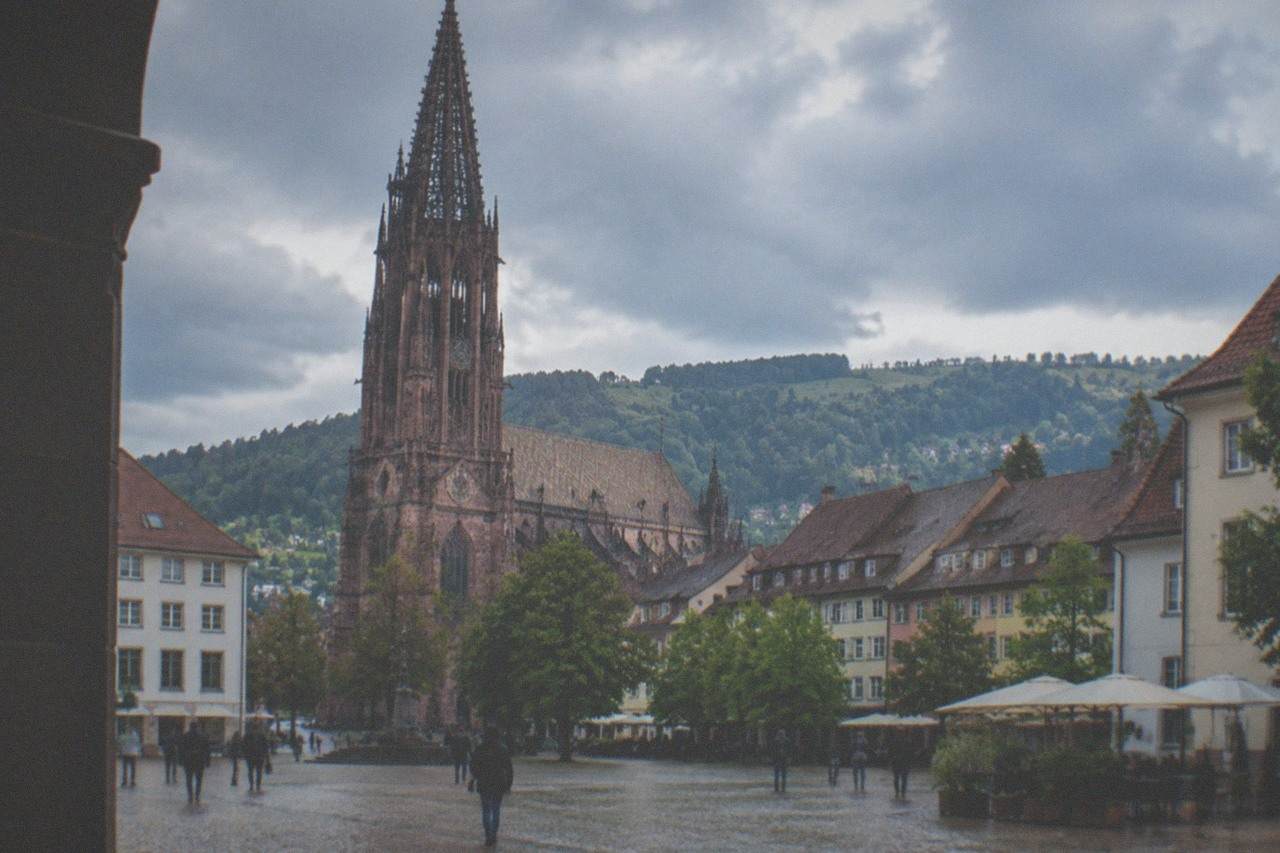
Is Freiburg Close To Munich?
No, Freiburg is not close to Munich. Freiburg sits in the far southwest of Germany, in the Upper Rhine plain near the French and Swiss borders, while Munich lies in Bavaria, in the country's southeastern corner. The two are separated by several hours of rail or road travel each way, which rules out any realistic day trip between them.
Both cities carry a "southern Germany" label in most people's heads, and that label is what creates the confusion. Southern Germany is a big place. Freiburg belongs to Baden-Württemberg, the state that hugs the Swiss and Alsatian borders, and its nearest big-city neighbors are Basel in Switzerland and the French Alsatian towns of Colmar and Mulhouse. Munich belongs to Bavaria and looks toward the Alps and Austria. Between the two cities lies most of the width of the Black Forest, the Swabian Jura, and a large stretch of Baden-Württemberg and Bavaria countryside.
The practical consequence is simple. If Munich is your base, Freiburg is a destination you travel to deliberately, not something you swing by for an afternoon. The same applies in reverse. Travelers who try to bolt Freiburg onto a Munich trip as a side excursion usually end up spending the better part of two days on trains for a few hours in the old town, and the old town deserves more than that.
The name adds its own wrinkle, too. Freiburg im Breisgau, the city this site covers, is the Baden-Württemberg one. There is also a Freiburg in Saxony (Freiberg, sometimes confused in older English travel writing), and the Swiss Fribourg sits just across the border in the same general region. So when a search result or a forum post says "Freiburg is close to Munich," it is sometimes answering a different question about a different place entirely.
None of this makes the pairing pointless. Munich to Freiburg is a well-trodden route, and the Munich to Freiburg travel guide breaks it down in detail. It just is not a short one.
If you are planning to be in Freiburg itself, the city rewards the time you give it, and a short guided introduction is a good first move.
Where Freiburg Sits On The Map
Freiburg im Breisgau sits in the Breisgau region of southwestern Baden-Württemberg, at the edge of the Black Forest and on the Upper Rhine plain, about 46 km from the Swiss border area around Basel. The city has 237,299 residents, a university founded in 1457, and roughly 24,507 students, which shapes everything from its bar scene to its bike traffic.
The city's position is its defining feature. The Black Forest rises directly to the east; the vineyard hills of the Tuniberg and Kaiserstuhl begin just to the west; and beyond them the Rhine marks the French border. Basel, in Switzerland, is the nearest large city. This is why the standard Freiburg itinerary pairs the city with Alsace, Basel, and Black Forest valleys rather than with Bavaria. The where Freiburg actually is guide unpacks the geography in full.
The border position also explains the climate. Freiburg is one of Germany's warmest and sunniest cities, with an annual mean temperature of 11.0°C and 1,815.1 hours of sunshine in the 1991-2020 DWD normals for its station. Those are strong numbers for Germany, but not national records: the station ranks 34th of 1,093 for mean temperature and 20th of 1,091 for sunshine, so the city deserves its "warm and sunny" reputation without the "warmest in the country" claim that circulates online.
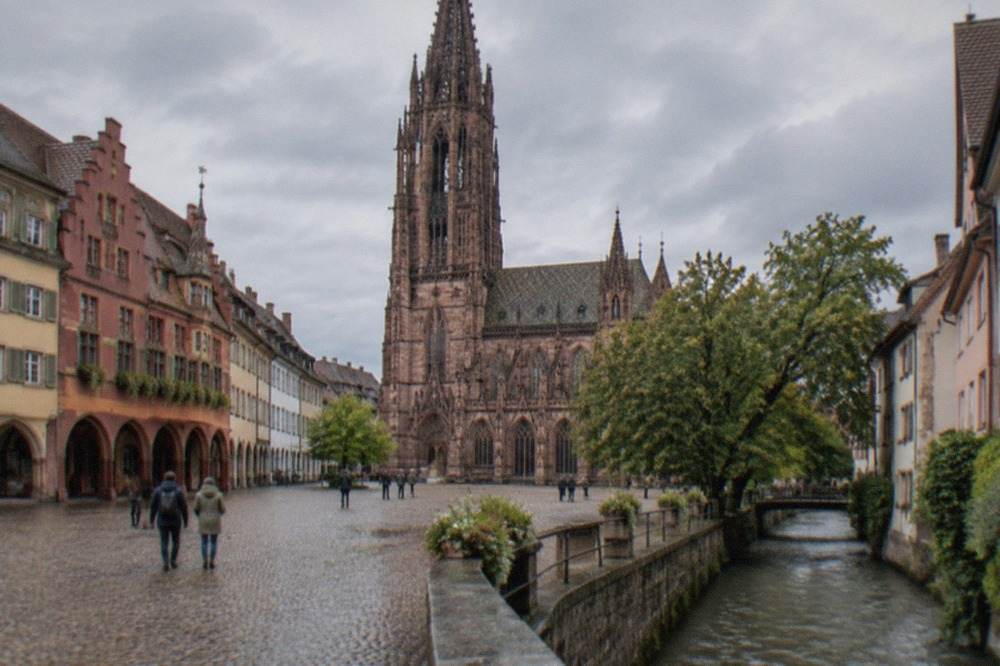
The city's own numbers confirm how much of its tourism is regional rather than national. In 2025 Freiburg recorded 1,010,708 arrivals and 2,130,785 overnight stays across accommodation providers with at least ten beds, a small decline on 2024, while international arrivals actually rose 2.7 percent. The city draws heavily on visitors from Switzerland, France, and the neighboring German regions, and much less on long-haul routes that pass through Munich.
The university, chartered on 21 September 1457 by Albrecht VI of Austria, is one of Germany's oldest, and with 24,507 students in the winter semester of 2025/26 it keeps the city of 237,299 people feeling far younger than its medieval core looks, per the official city population figures.
For a first visit, the compact old town is the main event, and the lanes themselves are the attraction. The Gässle, Bächle and More City Tour is built exactly around those narrow alleys and the little open water channels that line the streets: it runs about 1.5 hours, is rated 4.7 across 3,187 reviews, and starts from $15. That review pool is unusually large for a city walk, and it reflects how many people use the tour as their orientation hour on day one.
A cheaper still option for independent walkers is the self-guided audio tour in English, from $9, which covers the same core sights at your own pace.
What Cities And Regions Are Actually Near Freiburg
The places genuinely near Freiburg are Basel in Switzerland, the Alsatian towns of Colmar and Mulhouse in France, the Kaiserstuhl wine country, and the Black Forest valleys including Titisee and Feldberg. Most sit within an hour or two of travel, connected by direct regional trains, and several are close enough that a KONUS guest card issued in a neighboring town even works on Freiburg's trams.
This is the practical answer to the Munich question. If you are already in Freiburg, the day trips that make sense point west and south, not east. Basel is the nearest big city and the anchor of the region's airport, EuroAirport Basel-Mulhouse-Freiburg, which sits on the French side of the border and is reached from Freiburg by a daily direct airport bus taking about an hour. Colmar and the Alsace Wine Route sit just across the Rhine. Titisee, Feldberg, and the higher Black Forest sit up the Höllentalbahn line, a direct regional train route into the mountains.
| Destination | Country / region | Why people go | Getting there from Freiburg |
|---|---|---|---|
| Basel | Switzerland | Old town, Rhine, museums, EuroAirport | Direct regional trains; airport bus about an hour |
| Colmar | France (Alsace) | Half-timbered old town, wine villages | Regional train with a short connection |
| Kaiserstuhl | Germany (Baden) | Volcanic vineyard hills, wine taverns | Regional train or short drive west |
| Titisee and Feldberg | Germany (Black Forest) | Lake, hiking, highest peak in the range | Direct regional train up the Höllentalbahn |
| Staufen and St. Peter | Germany (Baden) | Small wine and monastery towns | Regional trains from the city |
Two local transport details are worth knowing before you plan any of these. Freiburg city itself is not a KONUS municipality, so a hotel stay in the city does not hand you a free Black Forest guest card; nearby member towns such as Kirchzarten, Titisee-Neustadt and Staufen do issue them, and a card issued there is valid on Freiburg's trams and buses. For visitors staying in Freiburg, the real product is the RVF Welcomekarte, 3 days at €27.00 for adults, covering buses and trains in the region and including a ride on the Schauinslandbahn cable car, per the official fare page.
The card matters because the Black Forest is the thing people actually come for, and it is on Freiburg's doorstep in a way Bavaria's lakes and mountains are not. The Black Forest overview guide covers the whole range, and the cable car up the Schauinsland, a 3,600 m lift running daily from 09:00 to 17:00, costs €15.00 return for adults and is included in the Welcomekarte.
How Travel Between Freiburg And Munich Works
Travel between Freiburg and Munich means long-distance rail, a long drive, or a flight with a connection, and none of it fits into a day trip. Rail routes run via the Rhine corridor or via Stuttgart, the drive crosses most of Baden-Württemberg and Bavaria, and the sensible plan is to treat each city as its own base with an overnight if you want both.
The train is the standard choice. Long-distance ICE services link the two cities, generally routed either along the Rhine valley toward the north and then east, or via Stuttgart in the middle of Baden-Württemberg. Neither routing is quick, and exact journey times vary enough by connection that it is worth checking the live timetables rather than planning around a single quoted number. The Freiburg Hauptbahnhof itself is well set up for the trip: it is a through station on the Rhine valley main line, with the old town a few minutes' walk out the front door. More of these guides are collected on Freiburg Travel Guide.
Two current engineering works matter if your travel dates fall in 2026 or 2027. The main station began a barrier-free modernization in September 2026 that will run until around the end of 2028: five new lifts in the northern underpass, renewed platforms 3 to 5, new platform roofs and lighting, at a total cost of about €36.7 million, per the rail operator's project announcement. And the Rheintalbahn, the very Rhine valley line most Munich routings use at their northern end, is subject to recurring weekend closures for the four-track Karlsruhe to Basel expansion, with replacement buses on affected sections. Neither blocks the route; both can stretch a tight connection.
Driving is the alternative, and it is a real drive rather than a hop. The route crosses the width of Baden-Württemberg, skirts Stuttgart, and continues into Bavaria, with the Black Forest and the Swabian Jura in between. It is a journey most people break rather than attempt in one push alongside a day of sightseeing.
Flying barely helps. Freiburg has no airport of its own; the regional one is EuroAirport near Basel, and connecting from there toward Munich usually means a transfer somewhere. For travelers arriving in Germany through Munich and wanting Freiburg, the train is almost always the better answer, and the route deserves a seat reservation in peak summer and around the Christmas market, which runs 19 November to 23 December 2026 across Rathausplatz and the surrounding old town squares.
| Option | What it involves | Best for |
|---|---|---|
| Long-distance rail via Stuttgart | ICE services with a change at or routing via Stuttgart | Travelers without a car; the standard choice |
| Long-distance rail via the Rhine corridor | Services routed north along the Rhine then east | Alternative when Stuttgart connections are disrupted |
| Driving | A cross-country route over several hours with rest stops | Itineraries that also visit Stuttgart, the Swabian Jura or Black Forest towns en route |
| Flying | EuroAirport or a Frankfurt connection, with transfers | Rarely worth it; door-to-door usually no faster than rail |
Better Pairings Than Munich For A Freiburg Trip
The itineraries that work from Freiburg pair it with Basel, Colmar and the Alsace Wine Route, the Kaiserstuhl vineyards, and the Black Forest valleys, all within easy reach by regional train. Munich pairs naturally with Bavaria: Neuschwanstein, the Bavarian lakes, Nuremberg and Salzburg. Mixing the two in one short trip mostly produces travel days.
The regional triangle is the whole point of basing yourself in Freiburg. From the city you can have breakfast beside the Münster, be in a Colmar wine village by late morning, and end the day in a Basel riverside bar. Strasbourg, the capital of Alsace, is a straightforward regional journey away. The Freiburg, Alsace and Basel triangle itinerary on this site lays out exactly that loop, and it is the trip most visitors who ask the Munich question actually want once they see the map.
Bavaria, by contrast, is its own dense cluster. Munich's day trips are Bavarian: the castles, the lakes, the Alps foothills. Combining Freiburg and Munich in a single trip is entirely doable if you have a week or more, and plenty of rail travelers do exactly that, usually with an overnight stop in Stuttgart or the Rhine valley breaking the journey. What does not work is the compressed version, the Munich hotel with a Freiburg excursion tagged on. The distances are simply too large, and you spend your day watching the Black Forest go by through a train window.
A middle path exists that many travelers overlook. If you must fly into or out of Munich and want a taste of the southwest, spend your Munich nights in Munich, then move: take the train to Freiburg with one overnight minimum, ideally two or three, and use the city as the base it is. The Highlights of the Old Town walk, about 1.5 hours from $17 and rated 4.6 across 236 reviews, is a good way to get the layout fast on arrival day.
Making The Most Of A Short Stopover In Freiburg
A short stopover in Freiburg should center on the Münster and its market square, the Bächle-lined old town lanes, a climb up the 116 m tower to the 70 m gallery, and either the Augustinermuseum, fully reopened on 28 February 2026, or the Schlossberg viewpoint. Admission costs are modest: the tower climb is €5 for adults, the Augustinermuseum €12.
The old town is compact enough that a few well-chosen hours cover a lot. The Münster, the Gothic minster at the center, has a free nave and a paid tower climb: adults €5, children and teens €3, family €13, under 7s free, with the last ascent about 15 minutes before closing and the top gallery closed in winter. Note the honest version of the tower figure: the west tower is 116 m tall, but visitors climb to a gallery at 70 m, not to the top. The Münstermarkt outside runs Monday to Friday from 07:30 to 13:30 and Saturdays to 14:00, with up to 130 stalls.
Museum-wise, the Augustinermuseum is the headline. It fully reopened on 28 February 2026 after more than two decades of phased renovation, adding around 1,600 m² of new exhibition space in the former convent building, and admission is €12, reduced €8, with the day ticket valid across the other city museums and free entry for under-27s. The Museum für Neue Kunst at €7, the Colombischlössle archaeological museum at €5, and the Museum Natur und Mensch at €5 round out the set, with one caveat: the Natur und Mensch permanent exhibition is closed for renovation from 4 August 2026 to around the end of February 2027, though the museum stays open for special exhibitions.
| Stopover item | Cost | Notes |
|---|---|---|
| Münster tower climb | €5 adults, €3 children | Gallery at 70 m; top gallery closed in winter |
| Münster nave | Free | Open during visiting hours |
| Augustinermuseum | €12 / reduced €8 | Reopened 28 February 2026; under-27s free |
| Schlossberg and Schlossbergturm | Free | Reached on foot; funicular one way €3.70 |
| Gässle, Bächle and More City Tour | From $15 | About 1.5 hours; 4.7 across 3,187 reviews |
| Tour of the City with Cathedral Visit | From $20 | About 1.5 hours; 4.6 across 284 reviews |
| Self-guided audio tour in English | From $9 | Independent pacing |
For orientation, the Tour of the City with Cathedral Visit, about 1.5 hours from $20 and rated 4.6 across 284 reviews, threads the old town together with the minster itself, and a dramatized alternative, the Guided City Tours with Actors, runs from $17 and is rated 4.9 across 497 reviews if you want history with theater rather than a lecture.
Common Questions About Freiburg And Munich
Is Freiburg close to Munich?
No. Freiburg is in the far southwest of Baden-Württemberg near the Swiss and French borders, while Munich is in Bavaria in the southeast. Several hours of rail or road travel separate them, so treat them as two separate bases rather than one excursion from the other.
Can you do a day trip from Munich to Freiburg?
Realistically, no. The journey in each direction takes up much of a day once connections are included, leaving only a couple of hours in the city. If you want both, plan at least one overnight in Freiburg, ideally two or three, and use them for the old town, the Münster and a Black Forest or Alsace side trip.
What cities are actually close to Freiburg?
Basel in Switzerland is the nearest large city, with the Alsatian towns of Colmar and Mulhouse just across the Rhine in France. Titisee and Feldberg in the Black Forest sit up a direct regional train line, and the Kaiserstuhl vineyards begin a short ride west of the city.
How do you get from Munich to Freiburg without a car?
Long-distance rail is the standard answer, generally routed via Stuttgart or along the Rhine corridor. Check live timetables for your date, since journey times vary by connection and the Rheintalbahn line is subject to recurring engineering closures with replacement buses.
Which airport should I use for Freiburg?
EuroAirport Basel-Mulhouse-Freiburg is the regional airport, reached from Freiburg by a daily direct airport bus taking about an hour. Zurich, Frankfurt and Munich airports are all workable alternatives by train, but EuroAirport keeps the transfer shortest.
Is Freiburg worth adding to a Munich trip?
Yes, if you give it its own nights. The old town, the minster, the Bächle channels and the surrounding wine and Black Forest country repay at least a full day and an overnight, and the city works far better as a base for Basel and Alsace than as a Munich tag-on.