Is Freiburg A Walkable City?
A direct, honestly sourced answer to whether Freiburg is a walkable city, with verified fare figures, old town distances, and where pedestrian Freiburg ends.
Is Freiburg A Walkable City?
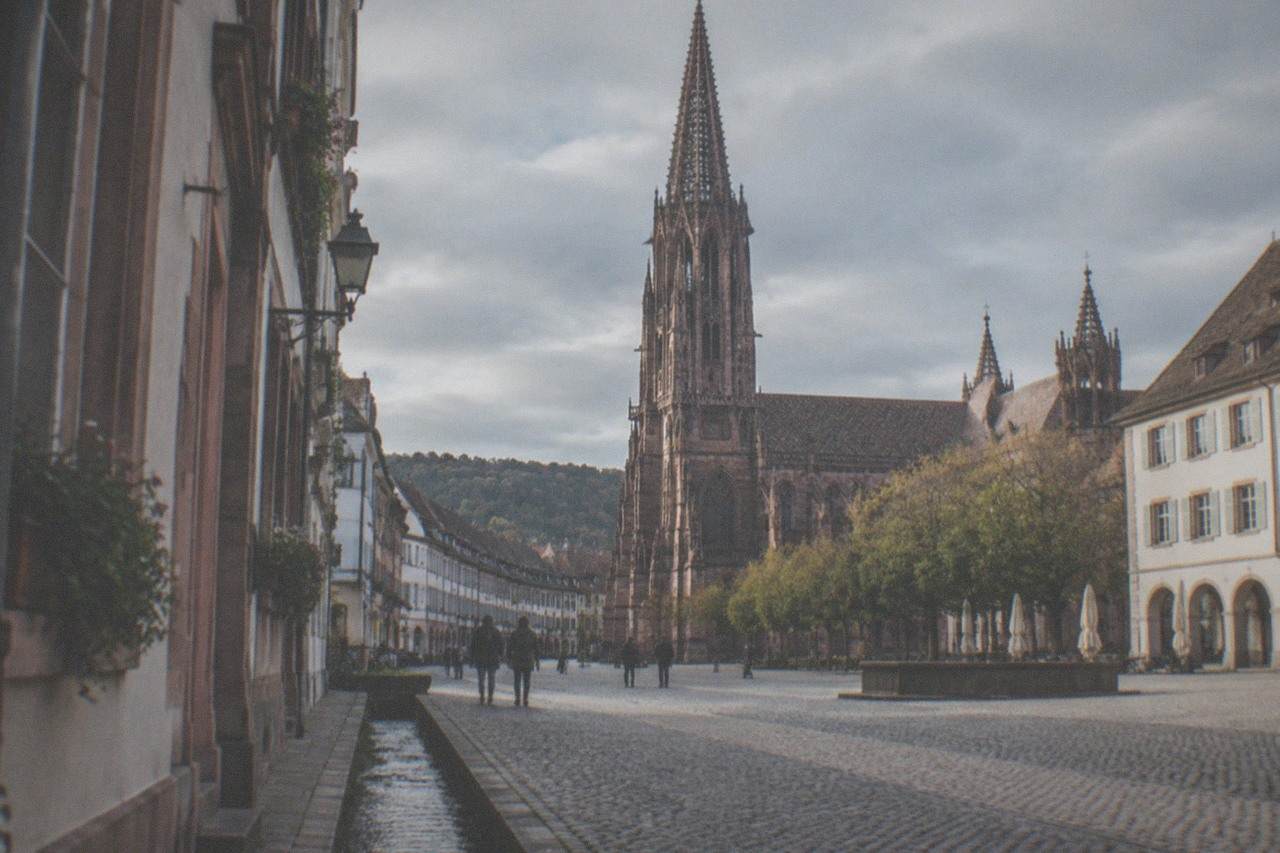
Yes, and unusually so for a German city of its size: Freiburg's old core is compact, largely pedestrianized, and laced with the famous Bächle gutters, and official city monitoring puts walking, cycling and public transport together at 76% of all trips in 2023. Nearly everything a visitor actually wants to see sits within roughly a 15 minute walk of the Münster.
That 76% figure deserves a moment, because it is the clearest proof of the answer. The city's own monitoring report shows the combined share of walking, cycling and public transport rising from 67% of all trips in 2017 to 76% in 2023, which means fewer than a quarter of trips in Freiburg are now made by car. You can read the numbers yourself in the city's modal split monitoring report. Very few German cities of 237,299 residents can say anything close to that, and the physical reason is visible within five minutes of stepping out of the main station.
The old town is the walkable heart. The historic core sits inside a ring of gates, and the streets between the Martinstor and the Schwabentor, around the Münsterplatz, and along the Kaiserstraße shopping spine are either fully pedestrianized or effectively car-light. The Bächle, those little water channels running beside the pavements, are not decoration for tourists: they are medieval drainage, and they force you to pay attention to your feet in the most pleasant way possible. Visitors who want the full picture of those channels can read the site's guide to the Bächle gutters, which explains the local superstition about accidentally stepping in one.
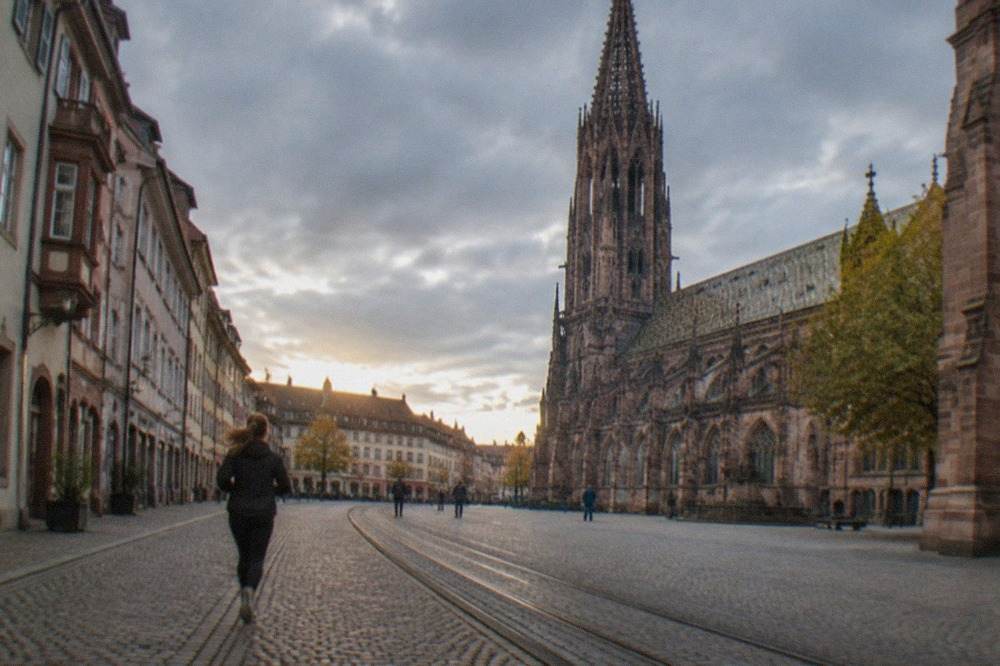
What makes the answer more than a simple yes is that walkability in Freiburg is layered rather than uniform. The old core is genuinely car-reduced. The inner ring quarters around it, the Stühlinger and Wiehre, are pleasant and walkable in a normal central-European way. The outer districts and the Black Forest trailheads are not walkable in the vacation sense at all, and pretending they are would be dishonest. This article walks through each layer in turn, with the verified fare and distance figures that decide whether you need a tram ticket at all.
For travelers who prefer a guided introduction before exploring alone, these walking options cover the pedestrian core in different formats and languages:
How Compact Is The Old Core On Foot?
The old town fits inside a rectangle roughly a kilometer from corner to corner, and its two surviving gates, the Martinstor and the Schwabentor, are about a ten minute walk apart through the pedestrian spine. The Münster sits in the middle, the Augustinerplatz about five minutes southwest of it, and the Rathausplatz market two minutes east. Flat shoes are enough; the only real climb is the Schlossberg.
The practical geometry works like this. Start at the Martinstor at the top of the Kaiserstraße and walk south through the pedestrian zone to the Münsterplatz, and you have covered the main shopping and market spine in about eight to ten minutes at a normal pace. Turn west toward the Augustinerplatz with its terrace of steps and the Augustinermuseum, which fully reopened on 28 February 2026 after the final phase of more than twenty years of renovation, and you add another five. Cross the Rathausplatz and the Historisches Kaufhaus on the Münster's other side and you have seen the whole historic core on foot in well under an hour, not because you rushed but because the core is small.
The Münster's own numbers give a sense of how everything clusters. The west tower is 116 m tall, though visitors climb only to a gallery at 70 m, with the climb running Monday to Saturday 11:00-16:00 and Sundays and holidays 13:00-17:00, adults €5, children and teens €3, family €13, under-7s free, and the top gallery closed in winter. The tower visit is the single biggest physical effort the old core asks of you, apart from the Schlossberg, and even that has a funicular if you would rather not climb.
The Münstermarkt on the square below runs Monday to Saturday, 07:30-13:30 on weekdays and until 14:00 on Saturdays, with up to 130 stalls, and the market's own official listing confirms the hours. A morning that combines the market, the nave, which is free to enter, and a slow loop through the surrounding alleys is the standard first day in Freiburg, and it involves no vehicle of any kind.
The Schlossberg is the one honest footnote to the flatness. The hill above the city is free to access on foot, the 33.27 m Schlossbergturm on top is a climb of stairs rather than an elevator ride, and the Schlossbergbahn funicular charges adults €3.70 one way or €6.50 up and down if you would rather save your knees. The site's guide to the Schlossberg covers the paths, the viewing tower, and the funicular in detail.
Do You Even Need Public Transport As A Visitor?
Mostly no: for two or three days spent inside the old core, the ring quarters and the river meadows, you can walk everywhere and spend nothing on transit. If you stay further out, cross town, or head to the Schauinsland cable car, a single RVF ticket at €3.00, a day ticket from €7.20, or the 3-day Welcomekarte at €27.00 covers it, and prices are verified from the RVF tariff sheet.
The fare logic is worth knowing before you decide, because walkable does not mean you should never ride. The RVF network covers the trams and regional buses, and its published 2026 tariff lists a zone 1 single at €3.00 for adults, €2.70 on smartphone, with children at €1.80. Day tickets run €7.20 for one zone, €10.90 for two, €14.30 for three. The Deutschlandticket costs €63.00 per month, which is only relevant to residents and long-stay visitors, not a weekend traveler. More of these guides are collected on Freiburg Travel Guide.
| Ticket | Price (EUR) | What it covers |
|---|---|---|
| RVF single, zone 1, adult | 3.00 | One tram or bus trip, €2.70 on smartphone |
| RVF day ticket, 1 zone | 7.20 | Unlimited rides in the city zone for one day |
| RVF day ticket, 2 zones | 10.90 | Adds the immediate outer zones |
| RVF Welcomekarte | 27.00 | 3 days, buses and trains, includes the Schauinslandbahn cable car, plus a Kulturbonus |
| Deutschlandticket | 63.00 per month | Nationwide local transit, monthly subscription |
| Münster tower climb | 5.00 adults | Tower gallery at 70 m, closed in winter |
The Welcomekarte line in that table is the one genuinely useful transit purchase for a walking-focused visitor who also wants one big view, because the 3-day card includes the Schauinslandbahn, the long cable car up Freiburg's own mountain, which otherwise charges adults €15.00 return. For a trip built entirely around the old town, none of these tickets are necessary. For a trip that adds the Schauinsland, the card pays for itself, and the RVF Welcomekarte page lists the current inclusions.
One correction worth making here, because it trips up a lot of first-time visitors: a hotel stay in Freiburg does not include the KONUS guest card. Freiburg city is not a KONUS municipality; the card is issued only by member towns in the Black Forest, such as Kirchzarten, Titisee-Neustadt or Staufen, and the Welcomekarte above is Freiburg's own visitor product. The site's guide to the Freiburg Welcomekarte explains the difference in full, and it matters if you are splitting your trip between the city and the Black Forest.
Planning to anchor the walk with a private guide? This option is worth a look:
What The Bächle, The Gates And The Green Streets Mean For Pedestrians
The old core is engineered around people on foot, not around cars: the Bächle gutter network lines the pavements, the two surviving gates mark the medieval entry points, and whole stretches of the center are closed to through traffic. The result is a city center where the default way of moving is walking, and where the tram network exists to connect the center outward rather than through it.
The pedestrian experience itself is distinctive enough to be famous. The Bächle run along many old town streets, fed by the Dreisam river, and historically served as the city's water supply and drainage. Local lore says that if you step in one you will marry a Freiburger, which is the kind of superstition that keeps visitors watching their feet and noticing the streets rather than their phones. The gates, the Martinstor and the Schwabentor, once one of five, are now traffic-calmed landmarks, and the guide to the old town maps how the streets connect between them.
The green quarters extend the same logic outward. The Wiehre, across the river to the south, and Stühlinger, just west of the station, are classic inner residential quarters, walkable in about 15 minutes from the center and full of cafés and ordinary neighborhood life. The Vauban district, further south, is the famous car-reduced development, built around the former French barracks and designed so that homes, schools and shops sit within walking distance of a tram stop. It is the clearest physical expression of why the modal split figure rose as it did, and it makes a rewarding walk for anyone interested in how a city can be planned around pedestrians. The site's guide to Vauban covers how to get there and what to look at.
Where Walkable Freiburg Ends
The pedestrian core ends at the ring roads, and the answers get more honest from there: the outer districts like Herdern and Günterstal are pleasant but require a tram, the Black Forest trailheads start at suburban stations, and the Schauinsland summit, Europa-Park and the Alsace day trips are not walking destinations at all. A visitor who plans only the old town on foot will be fine; a visitor who plans everything on foot will not.
The honest boundary is roughly the Stühlinger and Wiehre edges. Beyond that, the terrain rises toward the Schlossberg and the Lorettoberg, or spreads into outer districts where distances are measured in tram stops. None of it is hostile to walking, but it stops being a vacation-scale walkable core. The walking-adjacent attractions tell the story: the Seepark and the Mundenhof animal park in the west, the botanical garden near the university, the Hauptfriedhof cemetery with its old oak woodland. All are reachable, none are strollable from the Münster in the way the Rathausplatz is.
For the Schauinsland, the city's own mountain southeast of town, the cable car covers the 3,600 m length from the valley station, and the welcome alternative is the hike up, which serious walkers do and casual visitors should not. The guide to the Schauinsland lays out both. Note the maintenance calendar if a cable-car visit matters to your plans: the autumn overhaul closes the cable car and mountain restaurant from 16 November to 4 December 2026, and a further spring closure is listed for 22 February to 19 March 2027.
Day trips define the outer edge of the answer completely. Europa-Park at Rust is a 30-40 minute drive or a train-plus-bus combination, the Titisee and Feldberg resorts sit up in the High Black Forest, and Colmar and Strasbourg across the French border are rail days. The site's overview of getting around Freiburg covers the trams, the bike-share and the regional trains that bridge these gaps, and it is the right next read once the walking plan meets its limits.
How To Get Your Bearings On A First Visit
Walk one loop first: station to Kaiserstraße down the pedestrian spine, Martinstor to Münsterplatz, west to the Augustinerplatz and the museum, then the Rathausplatz and the gates, roughly 90 minutes including a market stop, all on level ground. From that loop, every decision about the Schlossberg, the quarters and the tram network makes sense, because the loop is the skeleton of the city.
A first-visit plan in practice works like this. Arrive, drop bags, and do the core loop above before anything else, because it calibrates the scale: after the loop, the surprise is not how much there is but how close it all is. The second half-day goes to the Schlossberg, up by path or funicular for the panorama over the rooftops and the Black Forest horizon. The third goes outward, by tram or on foot along the river, to one of the quarters or the Seepark. This is the pattern the site's one day in Freiburg itinerary expands in full, and it holds up because none of it requires a car.
Guided walks divide into two useful kinds for a first visit. The dramatized and themed walks of the old town, costumed actors, witches and torture lore, the drag show walks with Betty BBQ, are group entertainment that happens to be a tour. The private walks, by contrast, are for travelers who want a route tailored to what they already know they like, or who need a language other than English. The private options in Italian are the clearest example on this site's roster: the Old Town Private Walking Tour in Italian runs about an hour and a half, from $52 per person, with a review pool of only six reviews, so it is a language-specific niche product rather than a crowd-tested one.
The self-guided alternative suits the walkable-city question perfectly, since a self-guided format assumes you are on foot anyway. The scavenger hunt self-guided tour, about three hours, rated 4.9 across 15 reviews, from $45, and the self-guided audio tour in English, from $9, both turn the old core into a route you follow at your own pace. The cheapest of these, at from $3 for a self-guided highlights walk, is barely more than the price of a tram day ticket, which is the honest benchmark for what a walkable city does to the value of guided products.
Seasonal timing changes the walk, not the answer. The Christmas market runs 19 November to 23 December 2026 across the Rathausplatz, Kartoffelmarkt, Unterlindenplatz and Franziskanerstraße, free to enter, and it compresses the whole walking city into an evening loop of lights and Glühwein stalls. The July Weinfest on the Münsterplatz, the spring and autumn fairs, and the Fasnet carnival in February all do the same thing: they take the compact, car-light core and fill it. Rain matters more than season; the DWD climate normals show the wettest month is May at 103.4 mm and the driest January at 48.6 mm, with an annual mean of 11.0 °C that makes Freiburg one of Germany's warmest and sunniest cities, though not the single warmest.
For travelers weighing the formats, these are the walks that fit a pedestrian city best:
Common Questions About Walkability In Freiburg
Is Freiburg a walkable city?
Yes. The old core is compact, largely pedestrianized and flat, the city's own monitoring puts walking, cycling and public transport at 76% of all trips in 2023, and nearly everything a visitor wants to see sits within about a 15 minute walk of the Münster. Only the outer districts and the Black Forest excursions need transit.
Is the old town car-free?
Largely, not fully. The Kaiserstraße spine, the Münsterplatz surroundings and most of the lanes between the Martinstor and the Schwabentor are pedestrianized or closed to through traffic, and trams run along a few key axes. Delivery traffic uses early-morning windows, which is why the center still feels car-light at midday.
Do I need a transit ticket if I stay near the old town?
Usually not for the core itself. If you stay further out or want the Schauinsland cable car, a single costs €3.00, a one-zone day ticket €7.20, and the 3-day Welcomekarte €27.00, which includes the cable car. All figures are from the RVF tariff sheet.
Is Freiburg hilly for walking?
The old core is flat. The only real climbs are the Schlossberg, which has the Schlossbergbahn funicular at €3.70 one way for adults, and the Lorettoberg, a gentle residential hill. The Schauinsland summit is a proper hike, not a city walk.
Can you walk everywhere in Freiburg without a car?
Within the city, yes, with trams covering the longer hops. The Black Forest trailheads, Europa-Park and the Alsace towns are day trips by train, bus or cable car, so a car-free trip works well but not as a pure walking trip beyond the city limits.
What are the Bächle, and do they affect walking?
The Bächle are small open gutters running beside many old town pavements, originally the medieval water system. They keep walkers' eyes on the street, and local lore says stepping in one means you will marry a Freiburger. They are shallow and easy to avoid once you notice them.