How Many Waterfalls Are In The Black Forest?
The honest answer to how many waterfalls the Black Forest has, plus the famous falls worth visiting, how to reach them from Freiburg by transit, and when the water runs hardest.
How Many Waterfalls Are In The Black Forest?
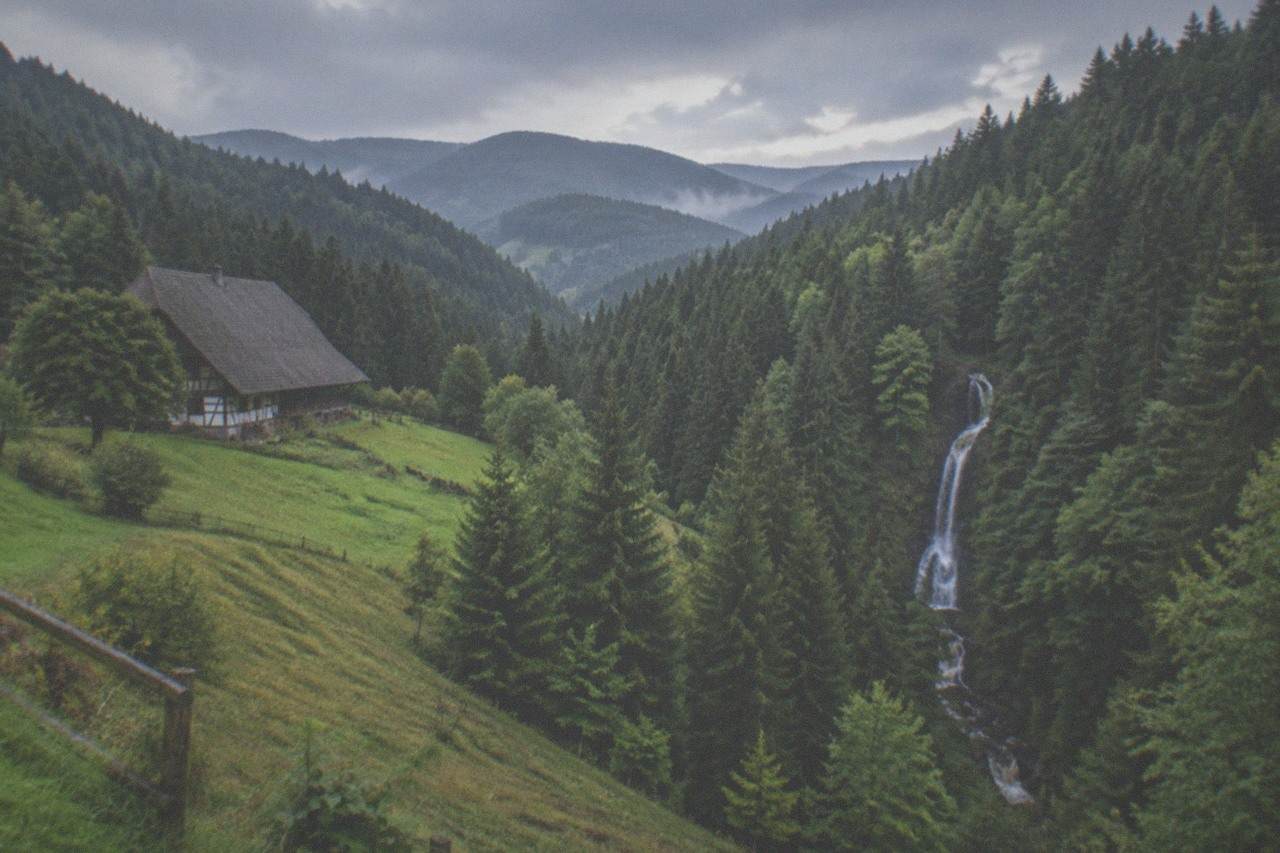
No official register counts the waterfalls of the Black Forest, so the honest answer is that nobody publishes a number. The region's famous, signposted falls, the ones with trails, parking and their own names on maps, number roughly a dozen, led by the Triberg falls near the town of Triberg and the Todtnau waterfall in the southern Wiese valley. Below that headline tier sit dozens of smaller cascades, many unnamed except on hiking maps.
That answer frustrates people who want a single figure, and it should. Tourism bodies count overnight guests and museum admissions, not cascades. A stream that drops five meters over mossy stone in a ravine is a waterfall to the hiker who finds it and a nonevent to the surveyor. So every precise number you may have read, whether it claims 30 or 300, is somebody's estimate rather than a counted fact, and this site will not print a confident number where no official one exists.
What can be said with confidence is the shape of the answer. The Black Forest is a uplifted plateau of Bunter sandstone and granite, deeply carved by streams running west toward the Rhine and east toward the Danube. That geology, plus rainfall that Freiburg's own weather station, the reference point for the southern edge of the region, measures at 886.5 mm per year in the 1991-2020 normals, produces falls along almost every major valley. The famous ones cluster in the south, within a day trip of Freiburg, which is why this guide treats the question as a planning question rather than a trivia question.
The practical version of the question is not "how many" but "which ones are worth your limited days." The short version of that answer: the Triberg falls are the headline act, the Todtnau waterfall is the locals' favorite, and the Ravenna gorge packs several small cascades into one walkable canyon on the edge of Freiburg's own backyard. Everything else is a bonus for hikers with time.
The Famous Falls Worth The Trip
Five waterfall destinations cover almost everything a first-time visitor wants from Black Forest water: the Triberg falls for scale and fame, the Todtnau waterfall for a dramatic single drop, the Ravenna gorge for several falls in one narrow canyon, the Wutach gorge for wild water in a nature reserve, and the Feldsee area for a quiet lake and falls pair. Each sits on the southern side of the region, reachable from Freiburg without a hotel change.
The Triberg falls are the region's signature cascade, a series of seven steps rather than one vertical curtain, dropping through a wooded gorge just above the town. They are the most visited falls in the Black Forest, with an entrance fee, paved paths and viewing platforms built for heavy foot traffic, and they sit at the heart of the cuckoo clock country around Triberg, which pairs the falls with the town's clock shops.
The Todtnau waterfall, in the Wiese valley south of Todtnau, is a different animal: one long, plunging drop over a rock face, reached on a short steep trail, with far fewer people than Triberg on most days. Locals in the southern Black Forest consistently point visitors here when asked for the "real" waterfall experience. The falls freeze into a climbing wall in cold winters, which tells you something about both the drop and the winter climate.
The Ravenna gorge is the closest of the big names to Freiburg, a steep canyon on the old road toward Hinterzarten where a stream has cut a sequence of small falls between rock walls, crossed by footbridges. It is the one waterfall walk you can do comfortably as a half-day outing from the city, and the Ravenna gorge guide covers it in detail, including the winter illuminations along the gorge road.
| Waterfall | Base town or access point | Character | Best for |
|---|---|---|---|
| Triberg falls | Triberg | Seven-step cascade, entrance fee, built paths | The classic postcard visit |
| Todtnau waterfall | Todtnau | One dramatic drop, short steep trail | Fewer crowds, raw feel |
| Ravenna gorge series | Ravenna gorge near Hinterzarten | Several small falls in one canyon | Half-day trip from Freiburg |
| Wutach gorge | Wutachschlucht area | Wild river rapids and falls, nature reserve | Hikers with a full day |
| Feldsee area | Near Feldberg | Quiet lake and small falls | Combining with Feldberg hikes |
Beyond these five, the count starts to blur, which is exactly the point of the honest answer above. Streams drop all over the plateau's western escarpment, and hikers on almost any long-distance trail, including the well-known Westweg route, cross unnamed cascades as a matter of course. If your itinerary already includes Titisee, Schluchsee or the high road between them, water will find you without any extra planning.
How To Reach The Falls From Freiburg
All the southern falls are reachable from Freiburg by train plus bus, with no car required. The region's transit association sells a day ticket covering one zone for €7.20, two zones for €10.90 and three zones for €14.30, and the three-day RVF Welcomekarte at €27.00 for adults adds the Schauinslandbahn cable car and a culture bonus to unlimited bus and train travel.
The transit backbone is the Rheintalbahn line down the Rhine valley toward Basel, plus the Höllentalbahn climbing east into the high Black Forest toward Titisee. Triberg sits on the Schwarzwaldbahn, the famous climb from Offenburg, so the journey is scenic by design rather than by luck. One caveat belongs in every Black Forest transit plan: the Rheintalbahn has recurring engineering closures in 2026, with replacement buses between Freiburg and Basel on some weekends in early October, so check the live timetable the day before any falls trip that runs down the Rhine side.
Ticket choice depends on your base. Staying in Freiburg itself, you buy RVF tickets, and the Welcomekarte page lists the three-day adult version at €27.00 with the Schauinslandbahn included. Staying in a Black Forest resort town instead changes the arithmetic completely, because many of those towns, though not Freiburg, issue the KONUS guest card, which the official 2026 KONUS flyer confirms covers buses and second-class trains across nine transport associations, including Freiburg's own network. A KONUS card issued in Titisee-Neustadt or a similar member town is valid on the tram back into Freiburg for a city afternoon.
Two practical notes finish the transit picture. First, a single RVF zone 1 ticket costs €3.00, or €2.70 on a smartphone, so a pure city day costs far less than a falls day; budget by destination, not by habit. Second, the Deutschlandticket at €63.00 per month only makes sense for a stay of two weeks or more, since the monthly price passes the cost of several day tickets quickly, and visitors on shorter trips should ignore it. Car travelers pay a different tax: the B31 tunnels through Freiburg run periodic night closures for maintenance, and a full renovation of that corridor is not planned to start before 2028, so none of this disrupts a waterfall day trip materially.
When The Falls Run Hardest
The falls run hardest in late spring, because the Black Forest's rain peaks in May at 103.4 mm in the 1991-2020 normals, and warm June temperatures of 18.3°C mean keep snowmelt and rainwater moving together. Late autumn is the secondary window, after October's 78.5 mm of rain recharges the streams, while August's 83.3 mm spread over the busiest hiking season keeps the famous falls respectable but rarely spectacular.
Timing a waterfall trip around flow sounds fussy until you have stood at a dry-summer cascade reduced to a wet stripe. The climate data from Germany's weather service, measured at the Freiburg station that anchors the southern Black Forest's reference numbers, gives a clear pattern: May, June and July are the wettest months, with 103.4, 89.8 and 92.2 mm respectively, and May alone carries roughly a third more rain than April. Falls fed by those catchments are at their most photogenic in late May and early June.
Winter is the sleeper season, oddly. Days at or above 30°C number 18.5 per year on average, and they all fall between May and September, so summer visits pair water with warmth and crowds. In deep winter the frost-day count climbs to 15.7 in January and 13.8 in December, and the Todtnau waterfall can freeze into a pillar that local climbers ascend on ropes. That spectacle does not suit everyone, but it explains why the answer to "when should I go" depends on whether you want rushing water or frozen architecture.
| Month | Mean temperature | Rainfall | What it means for the falls |
|---|---|---|---|
| March | 7.0°C | 54.3 mm | Low flow, quiet trails |
| May | 14.9°C | 103.4 mm | Peak flow, peak green |
| July | 20.1°C | 92.2 mm | Strong flow, biggest crowds |
| September | 15.4°C | 77.4 mm | Comfortable, mid flow |
| October | 10.9°C | 78.5 mm | Autumn color, rebuilt flow |
| December | 3.4°C | 66.9 mm | Possible frozen falls |
One planning note cuts across all seasons: the region's biggest single draw, the Triberg falls, keeps town-scale opening hours and an entrance system, while smaller falls like those in the Ravenna gorge are simply on the trail, free and open whenever you arrive. Falls that charge admission also close on some winter days, so a deep-winter itinerary built entirely around the famous names can thin out. The Ravenna gorge's winter illuminations, by contrast, run precisely in the cold months, turning the canyon into a lit evening walk rather than a summer scramble.
Which Waterfall Fits Your Trip?
Choose the Triberg falls if this is your one Black Forest waterfall day and you want the famous version, the Todtnau waterfall if you would trade fame for solitude and a single dramatic drop, and the Ravenna gorge if your time is short and your base is Freiburg. Hikers with a full free day should look at the Wutach gorge, where the water runs wild through a reserve rather than dropping politely into a viewing basin.
The choice is mostly a choice about time and transport, not about water. Triberg involves the longest journey from Freiburg, a ride down the Rhine valley and up the Schwarzwaldbahn, and rewards it with the complete waterfall infrastructure: paths, platforms, a town built around the visit. The Todtnau waterfall sits closer in pure distance but often needs a bus connection from the Wiese valley line, which makes it a morning-of decision rather than a spur-of-the-moment one. The Ravenna gorge needs the least commitment, roughly a regional train ride plus a walk, and delivers the most falls per minute of travel.
Travelers who finish a waterfall day and still have an evening in the city have options that cost almost nothing in time. The "Hey Hallöchen, Freiburg!" Travestie city tour with Betty BBQ, rated 4.9 across 140 reviews and priced from $41, runs about an hour and 20 minutes through the old town in full show format, a deliberately unsober ending to a day of trails. Check availability alongside the Triberg falls guide if the falls day starts or ends in Freiburg.
For a calmer bridge between water and city, a short orientation walk has real value on a falls trip, because the old town you return to each evening deserves more than a restaurant and a bed. One option priced from $92, "Explore Freiburg in 60 Minutes with a Local," rated 4.7 across 23 reviews, compresses that orientation into an hour, which suits a traveler whose real daylight hours are all spoken for by water.
The rest of this Freiburg Travel Guide site covers each of these bases in depth, from the Titisee and Schluchsee lakes that pair naturally with the southern falls to the Black Forest high road that strings several of them together in one drive. A two-night Freiburg stay comfortably covers Triberg plus the Ravenna gorge; a week lets you add the Wutach, the Feldberg massif and the Feldsee without ever repacking. However many waterfalls the Black Forest has, you will run out of days before you run out of falls, and that is the only count that matters.
Common Questions About Black Forest Waterfalls
How many waterfalls are in the Black Forest?
There is no official count. The famous, signposted falls number roughly a dozen, led by the Triberg falls and the Todtnau waterfall, while dozens of smaller cascades appear only on hiking maps. Any precise figure you read is an estimate, not a counted number.
Which is the biggest waterfall in the Black Forest?
The Triberg falls are the region's most famous cascade, dropping in seven steps through a gorge above the town. This site does not print a height ranking, because the verified facts on file do not include one, and waterfall height is measured differently by different sources.
Do you have to pay to see the Black Forest waterfalls?
The Triberg falls charge an entrance fee and keep structured visiting hours. Smaller falls, including the cascades along the Ravenna gorge, sit on public trails and cost nothing. Budget one paid admission if Triberg is on your list.
Can you visit the waterfalls from Freiburg without a car?
Yes. Regional trains plus bus connections reach Triberg, Todtnau and the Ravenna gorge area from Freiburg. RVF day tickets cost €7.20 to €14.30 depending on zone count, and the three-day Welcomekarte at €27.00 adds the Schauinslandbahn cable car.
When should I visit for the strongest water flow?
Late May and early June, when rainfall peaks and snowmelt still feeds the streams. October is the secondary window after autumn rain. In hard winters the Todtnau waterfall can freeze solid, which is a different spectacle entirely.