Freiburg Photography Spots: Where To Point Your Camera
Freiburg photographs well for boring, structural reasons: a red sandstone minster at the center of a low-rise old town, water channels running down the alleys, two surviving medieval gates, and a hill with an elevator attached. This guide puts the spots in the order the light actually works.
Short answer
The core Freiburg photography spots are Münsterplatz and the minster tower, the Bächle alleys around Gerberau and Fischerau, Martinstor and Schwabentor, the Schlossberg overlooks, and the museums for interiors. The tower climb costs €5, the Schlossbergbahn lift is €3.70 one way, and the Christmas market runs 19 November to 23 December 2026.
Where Are The Best Photography Spots In Freiburg?
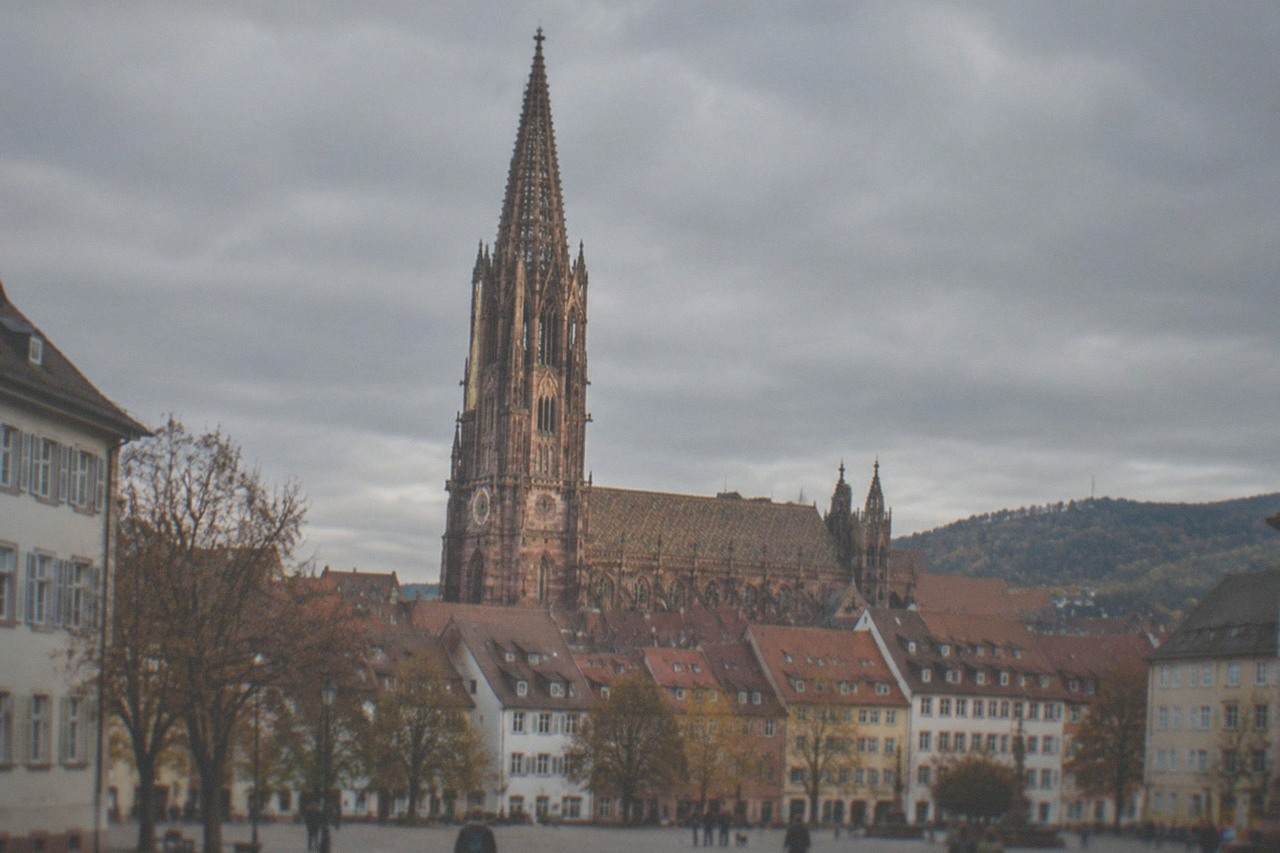
The best Freiburg photography spots cluster in a walkable core: Münsterplatz with the minster tower, the Bächle-lined alleys south and west of it, the two medieval gates on Kaiserstraße, and the Schlossberg hill above the river bends. Add the Augustinermuseum for interiors and the Christmas market for winter light. Most spots sit within 15 minutes on foot of one another, so one well-timed loop covers them.
Freiburg rewards photographers who plan around light rather than distance. The old town is compact, the streets run narrow, and the minster is tall enough that midday sun puts half of Münsterplatz in hard shadow. Shooters who arrive between 07:30 and 09:00 get the market setting up, empty frames and warm low light off the sandstone. Those who come at noon get tour groups and flat contrast.
The city also photographs differently depending on where you stand. Street level is all Bächle, geraniums and cobbles. The 70 m gallery on the minster tower gives you the red roofscape from inside the Altstadt. The Schlossberg, a short walk or a €3.70 lift ride from the bottom, gives you the whole bowl of the city with the Black Forest wall behind it. A good portfolio uses all three heights.
This table is the working shortlist. Light windows are directional guidance for planning, not promises.
| Spot | Best light window | Why it works |
|---|---|---|
| Münsterplatz and tower | Early morning, late afternoon | Red sandstone glows at low sun angles; market stalls add foreground |
| Bächle alleys, Gerberau and Fischerau | Mid morning to early evening | Reflected light in the water channels; geraniums in season |
| Martinstor and Schwabentor | Afternoon | Gates frame Kaiserstraße tram lines in both directions |
| Schlossberg and Schlossbergturm | Golden hour into dusk | Elevated city panorama, river bends, Black Forest horizon |
| Augustinermuseum | Any weather, all day | Interiors, cloisters and sculpture in a fully reopened building |
| Christmas market locations | Blue hour, 17:00 onward | Lantern and stall lighting from late November |
Münsterplatz And The Minster Tower In Morning Light
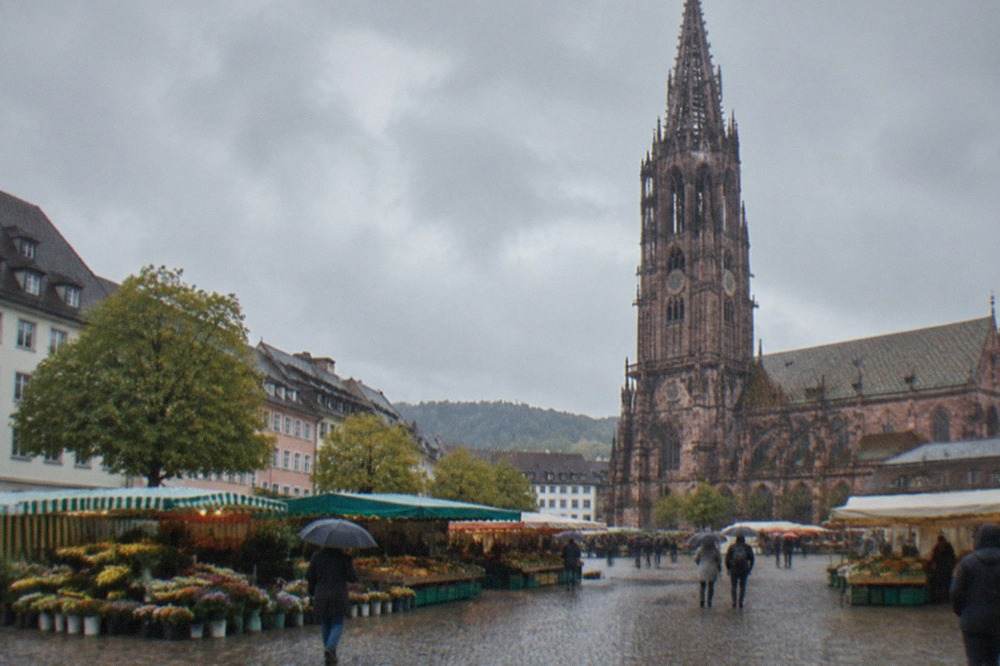
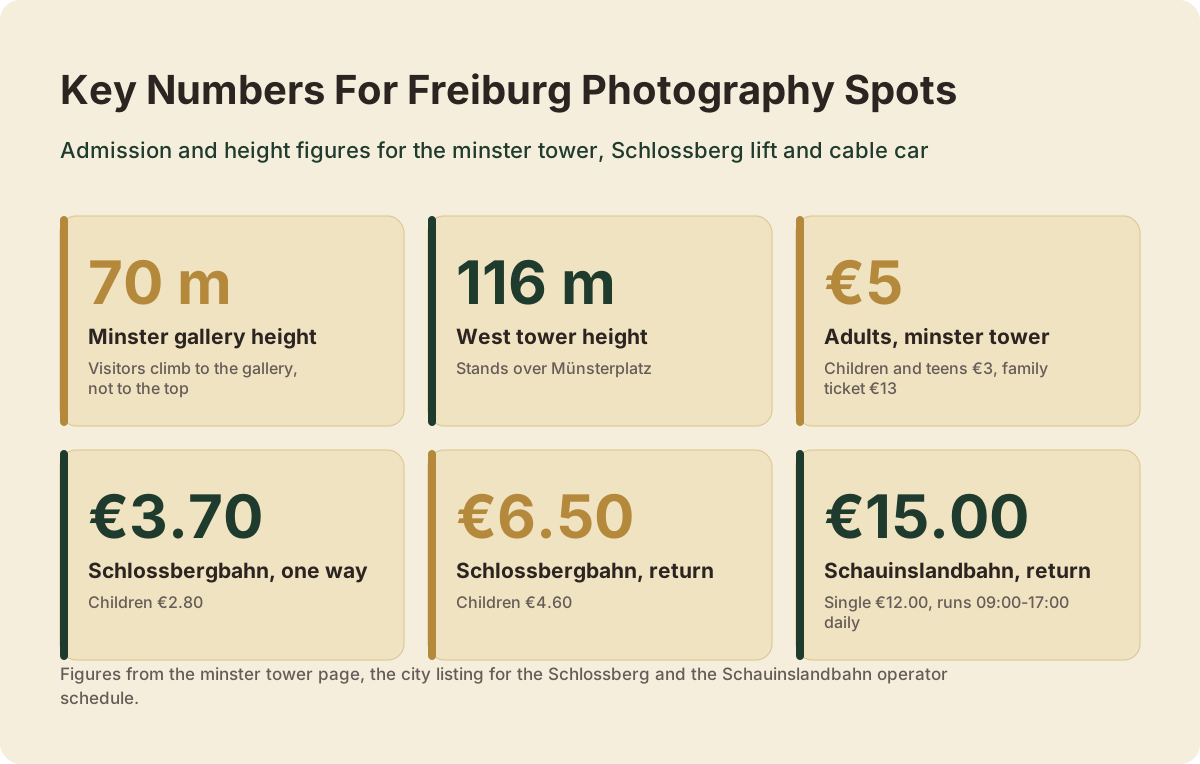
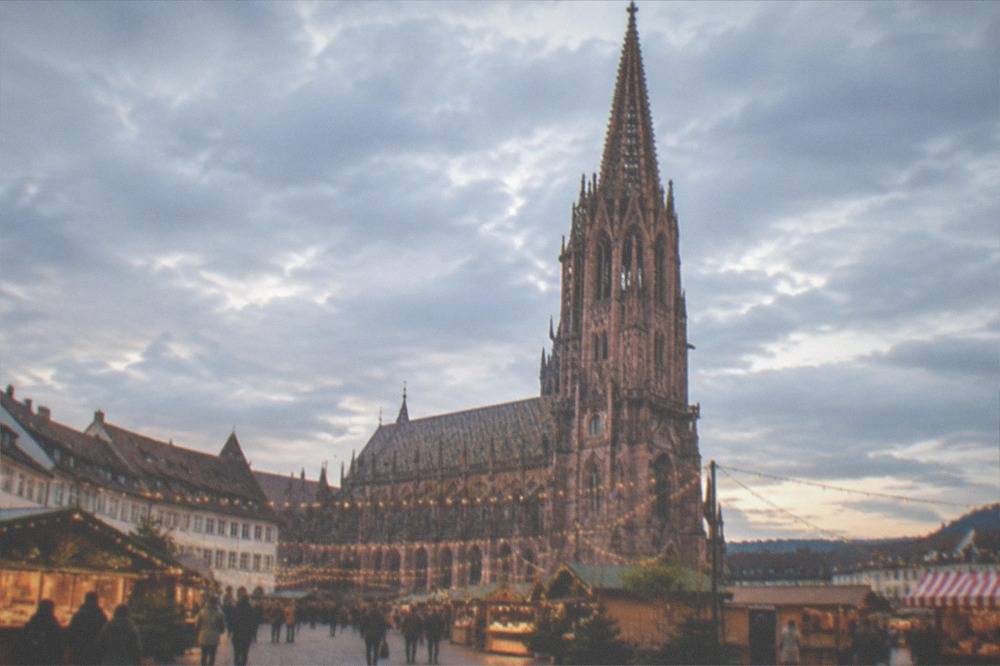
Münsterplatz is the most photographed frame in Freiburg and it earns it: the west tower stands 116 m over a market square of up to 130 stalls, and visitors climb to a gallery at 70 m, not to the top, for the rooftop view. The tower opens Mon to Sat 11:00-16:00 and Sundays and holidays 13:00-17:00. Adults pay €5, children and teens €3, a family ticket €13, and under-7s climb free.
The square is a working market first and a monument second, and that is what makes it photograph. On weekdays the Münstermarkt runs 07:30-13:30 and on Saturdays to 14:00, according to the city's official market page, with up to 130 stalls spread across the square. Early arrival buys you crates, tarpaulins and hand trucks mid-scene; mid-morning buys you produce, flowers and crowds. Both are honest pictures of the same place.
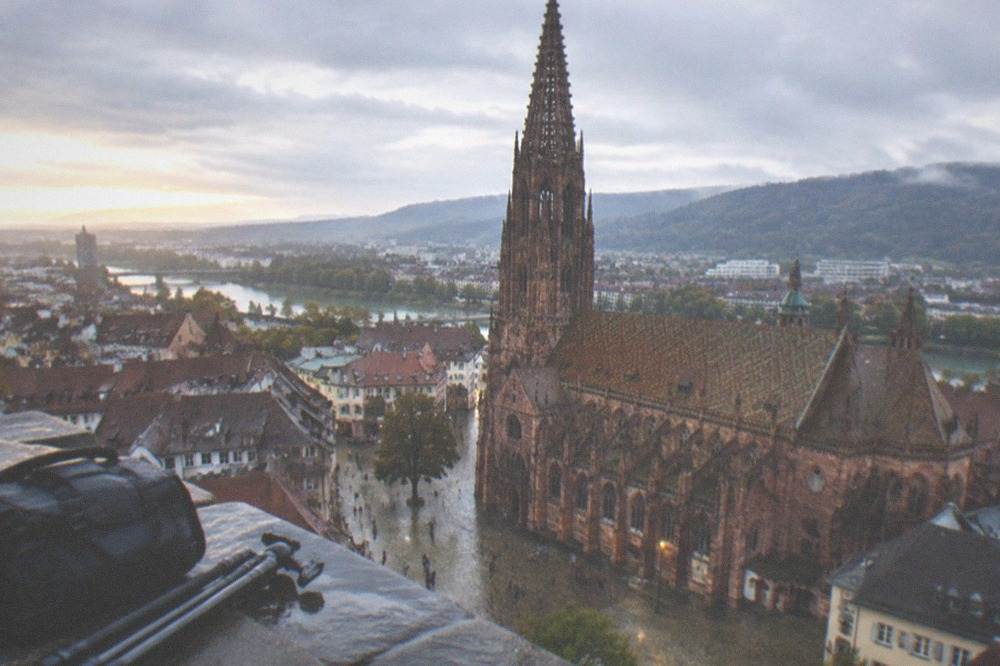
The tower climb is the one paid vantage inside the old town, and its rules are simple. The minster's own tower page lists the hours above, with the last ascent roughly 15 minutes before closing and tickets sold in the Türmerstube at the base. The 70 m gallery looks out over the roofscape, and since the tower itself is 116 m tall, you are shooting from roughly two-thirds height. The parapet interrupts the view in places, so plan on portrait and telephoto frames rather than sweeping wide shots.
For more on the building itself, the dedicated Freiburg Minster guide covers the architecture and the restoration work that has sections of scaffolding on the choir and nave through the current campaign, with a tower octagon restoration expected from about 2027. Scaffolded stone is not a reason to stay away; it is a reason to frame tighter.
If you want someone else to handle the routing, a guided walk keeps the pace honest for a half-day shoot.
The Historisches Kaufhaus on the square's south side is the late-Gothic money shot: red facade, arcades, coats of arms. It photographs best from the north side of the square in the afternoon, when the sun crosses it directly. Check the Münsterplatz market guide for the stall layout by day of the week, which matters when you want foregrounds rather than barriers.
The Bächle, The Gates And Old Town Alleys
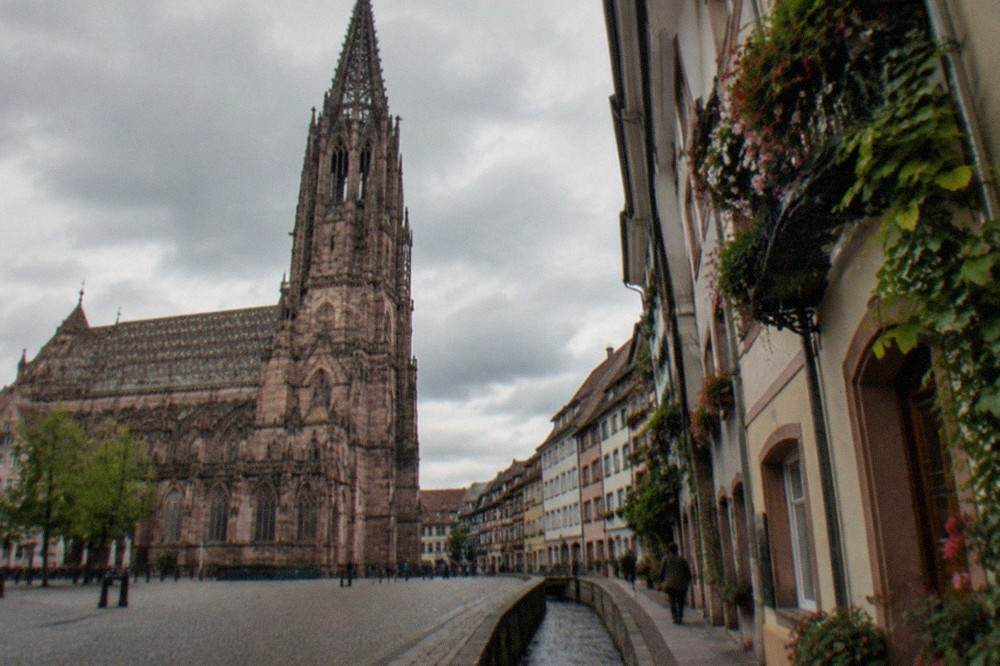
The Bächle, the small open water channels running along many old town streets, are Freiburg's signature detail shot, and they work best where the alleys are narrow enough to keep them in shade: Gerberau, Fischerau and the lanes between the Augustinerplatz and the river. Martinstor and Schwabentor, the two surviving medieval gates on Kaiserstraße, add the vertical frames, and both are free to walk through at any hour.
Reflected light off the Bächle gives the alleys a softness that direct sun never manages. In high summer the geraniums that hang from window boxes do most of the color work, and on the narrower lanes the contrast between sunlit upper facades and shaded cobbles is the whole picture. The dedicated Bächle guide maps which streets carry live channels, worth knowing because not every gutter in the old town is a Bächle.
The gates reward patience with trams. Kaiserstraße is the tram spine, and Martinstor and Schwabentor each frame a stretch of it. A wide lens at the gate with a tram crossing gives you movement against centuries-old stone; a long exposure after dusk turns the tram into a light streak under the arch. Neither gate charges admission and neither closes, so they double as the fallback subject when the weather kills your plans elsewhere.
Fischerau and Gerberau, the two lanes running down toward the Dietenbach, are the closest Freiburg gets to a postcard alley. The restaurant terraces mean the lanes are rarely empty, which is fine: the tables, umbrellas and kitchen noise are the picture. Shoot along the channel rather than across it, let the water carry the eye, and keep the horizon off-center.
A guided structure helps on the first pass through these lanes, because the good frames are not on the obvious route. The Old Town Medieval Gates walk runs about 2 hours, from $232, with a modest 6 reviews so far, too few a pool for any star claim; Check availability if a gates-focused route suits your shooting pace.
Schlossberg, The River Bends And Overhead Views
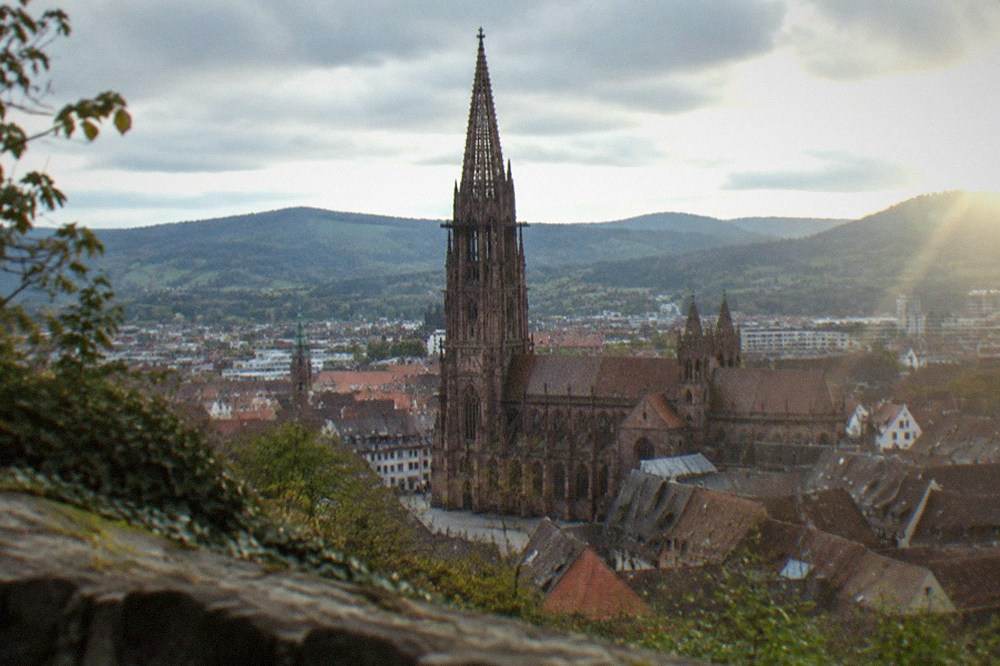
The Schlossberg is the free, walkable hill immediately east of the old town, and it holds the two overhead views that define Freiburg from above: the city bowl with the minster and the bends of the Dreisam, and the Schlossbergturm, a 33.27 m tower reached on foot at no charge. The Schlossbergbahn inclined lift saves the climb for €3.70 one way or €6.50 return, children €2.80 and €4.60.
The tower is the better photographic platform because it clears the tree line, which the lower viewpoints do not. It is a lattice structure with open stairways, so you shoot through geometry rather than glass, and the 360-degree circuit covers the old town, the river, the vineyards on the facing slope and, on clear days, the Vosges to the west. The Schlossberg itself is free to enter, per the city's listing for the site.
The lift matters mostly for equipment or timing. If you are carrying a tripod up for dusk, the €6.50 return fare is cheaper than the extra 20 minutes of uphill. If you are shooting blue hour and descending after dark, note the lift's operating hours before you commit, and carry a headlamp for the paths regardless.
There is one more altitude worth the trip. The Schauinslandbahn, the 3,600 m cable car to the Schauinsland summit southeast of the city, runs 09:00-17:00 daily, with a return ticket at €15.00 and a single at €12.00. It closes for its autumn overhaul from 16 November to 4 December 2026, per the operator's published schedule. From the top you get the whole Breisgau plain, Freiburg as a distant cluster, and the ridge lines of the Southern Black Forest, a completely different picture from anything in the city. The details are in the Schauinsland guide.
A private walk that ends on the hill gives you the street material and the panorama in one loop, with someone local deciding when to move on.
Museum Interiors, Details And Low-Light Work
The Augustinermuseum is the interior centerpiece and it is fully open: after more than 20 years of phased renovation it reopened completely on 28 February 2026, with about 3,400 square meters of exhibition space in the former convent building, the church and the historic cellars. Admission is €12, reduced €8, free for under-27s, and the day ticket covers the other city museums.
For a photographer the building is a two-fer: Gothic church architecture as subject, and a roofed option that keeps a rainy afternoon productive. The cloister and stair wells handle natural light well; the galleries are deliberately dim in places, so a fast prime lens matters more than a tripod, which most museums will not allow anyway. The museum's Tuesday to Sunday hours are 10:00-17:00, with Fridays to 19:00.
The other city museums split the remaining interior work. Check house rules on photography at the desk before setting up; policies differ by building and by exhibition.
| Museum | Admission | Notes for shooters |
|---|---|---|
| Augustinermuseum | €12 / €8 reduced | Free under 27; day ticket valid at all city museums; fully reopened 28 February 2026 |
| Museum für Neue Kunst | €7 / €5 | Free under 27; Thursdays to 19:00 |
| Archäologisches Museum Colombischlössle | €5 / €3 | Neo-Gothic villa exterior shoots well from the garden |
| Museum Natur und Mensch | €5 / €3 | Permanent exhibition closed 4 August 2026 to about end of February 2027; special shows remain open |
| Dokumentationszentrum Nationalsozialismus | Free | History content; check photography rules on arrival |
The Colombischlössle deserves a note beyond its admission line: the villa itself, set back behind a small park a few minutes south of the center, is one of the quietest architectural frames in the city and almost never has anyone in it. The Natur und Mensch closure above is the current planning reality, folded in once here rather than repeated below.
Seasonal Events And When The City Photographs Best
The calendar does as much for Freiburg photography as the weather does. The Christmas market runs 19 November to 23 December 2026 across Rathausplatz and other old town locations with free entry, the Herbstmess fairground runs 16 to 26 October 2026, the Zelt-Musik-Festival fills late July, and the Weinfest takes Münsterplatz in early July with the 2027 edition set for 1 to 6 July.
The Christmas market is the big one. Blue hour, from about 16:30 onward, is when the stall lanterns and tree lights carry the frame against the darkening sandstone. The market's official site lists the locations and the 2026 dates; entry is free and the stands spread across several squares, so a single long walk covers them. Weekday evenings are calmer than weekends. The dedicated Freiburg Christmas Market guide breaks down the locations and the food worth stopping for.
| Event | Dates | What it gives a camera |
|---|---|---|
| Christmas market | 19 November to 23 December 2026 | Lanterns, timber stalls, blue hour over Rathausplatz |
| Herbstmess | 16 to 26 October 2026 | Fairground rides, fireworks finale, night color |
| Weinfest | 1 to 6 July 2027 | Münsterplatz under strings of lights, regional wine stands |
| Fasnet | 4 to 8 February 2027 | Costumed carnival, the 8 February procession at 14:00 |
| Zelt-Musik-Festival | Mid July to early August annually | Circus-tent stages at Mundenhof, festival crowds |
Summer street life is the other seasonal subject. Verified city figures put walking, cycling and public transport at 76% of all trips in 2023, up from 67% in 2017, which translates concretely into streets that are full of bikes and light on cars. For a photographer that means motion in every frame on Bertoldsbrunnen or the Kaiserstraße tram canyon, and it means a bike is often the fastest way to chase light between spots.
If you are in town for the market season specifically, a themed walk keeps you in the lit zones after dark, when wandering alone with a camera is less appealing.
Gear, Timing And A Practical Shot List
Plan around two numbers: 1,815.1 hours of annual sunshine, which puts Freiburg 20th of 1,091 German weather stations, and 886.5 mm of annual rain, which mostly falls May through August. Carry a fast lens for museum and market interiors, a wide for the alleys, and something long for the tower gallery, and check the sun table below before booking an early alarm.
The climate record, from the official 1991-2020 normals for the Freiburg station, is the photographer's real planning tool. Summer gives long light and 232.7 to 252.2 sun hours a month from June to July, but also the heaviest rain. Winter gives 64.7 sun hours in January against 15.7 frost days, which is the trade: cold, hard, clear frames or grey weeks.
| Month | Mean sun hours | Mean temperature | Frost days |
|---|---|---|---|
| January | 64.7 | 2.5 C | 15.7 |
| March | 146.8 | 7.0 C | 8.9 |
| June | 232.7 | 18.3 C | 0 |
| July | 252.2 | 20.1 C | 0 |
| September | 176.2 | 15.4 C | 0 |
| December | 56.3 | 3.4 C | 13.8 |
A workable day-one shot list, in shooting order: the market setup on Münsterplatz from 07:30, the Historisches Kaufhaus facade as the sun crosses it, one Bächle alley in Fischerau, both gates on Kaiserstraße with a tram, the tower gallery in the afternoon, and the Schlossberg for the last hour into blue hour. That is a full day and it fits inside the old town plus one hill.
For direction rather than itinerary, a private guide is the efficient option. The private Italian-language walk runs about 1 hour 10 minutes to 1 hour 30 minutes from $52, with 6 reviews, too few for a star claim, so read the listing rather than trusting a rating; there is also an instaworthy-spots walk from $115 with no reviews yet, honest as a new listing. If Italian is not your language, treat that option as a format to compare, not a recommendation.
Budget note, since this is a photography page and photo walks are a real category here: self-guided options start at $3 for a scavenger-hunt format rated 4.4 across 43 reviews, and the dramatized actor-led city tours run from $17 with a 4.9 rating across 497 reviews. Prices on this site are shown in USD; the till prices in the tables above, transit and admissions, are in euro, and the two should never be added together.
One planning footnote on Freiburg Travel Guide itself: every figure in this article comes from official sources, the city's tourism statistics, the museum pages, the operator tariff sheets and the national weather service's published normals, so the hours and fares above can be relied on when you build your own route.
The final variable is transport works, which affect access rather than subjects: the main station is mid-modernization until about December 2028, and the Rheintalbahn line to Basel has periodic weekend closures with replacement buses through 2026. Neither blocks a shoot inside the old town; both matter for dawn starts from out of town.
Whether you are shooting solo or with a guide, these are the three formats that map most directly onto a photography-focused visit.
Common Questions About Freiburg Photography
Where Are The Best Photography Spots In Freiburg?
Münsterplatz and the minster tower, the Bächle alleys in Fischerau and Gerberau, the Martinstor and Schwabentor gates on Kaiserstraße, the Schlossberg and its 33.27 m tower, and the Augustinermuseum interiors. All but the last are free to access; the tower climb is €5 and the Schlossbergbahn lift is €3.70 one way.
Can You Photograph From The Freiburg Minster Tower?
Yes. Visitors climb to a gallery at 70 m on the 116 m west tower. It is open Mon to Sat 11:00-16:00 and on Sundays and holidays 13:00-17:00, adults €5, children and teens €3, family €13, under-7s free. The top gallery closes in winter and the last ascent is about 15 minutes before closing.
When Does The Christmas Market Photograph Best?
Blue hour from about 16:30 onward, when the stall lighting carries the frame. The market runs 19 November to 23 December 2026 across Rathausplatz and other old town locations, with free entry. Weekday evenings are noticeably calmer than weekend nights.
Is The Schlossberg Free For Photographers?
The hill, the paths and the Schlossbergturm are free. The Schlossbergbahn inclined lift costs €3.70 one way or €6.50 for a return, with child fares of €2.80 and €4.60. The tower is reached on foot and clears the tree line, which the lower viewpoints do not.
Which Museums Allow Interior Photography In Freiburg?
Policies vary by house and by exhibition, so ask at the desk. The Augustinermuseum, €12 reduced €8 and free for under-27s, is the main interior subject after its full reopening on 28 February 2026, and its day ticket covers the other city museums. The Museum Natur und Mensch permanent exhibition is closed from 4 August 2026 until about the end of February 2027.